Customers now ask chat tools questions they used to type into Google, and the answers name businesses. LLM SEO is the work of being one of them. This guide is for US small business owners and marketers who already have a website and want a plain plan. You'll get a definition, a table that compares LLM SEO with ordinary SEO, a seven-step checklist and a short list of advice to skip. You don't need new software to start. Every figure names its source, and dollar examples are marked as assumed.
What Is LLM SEO?
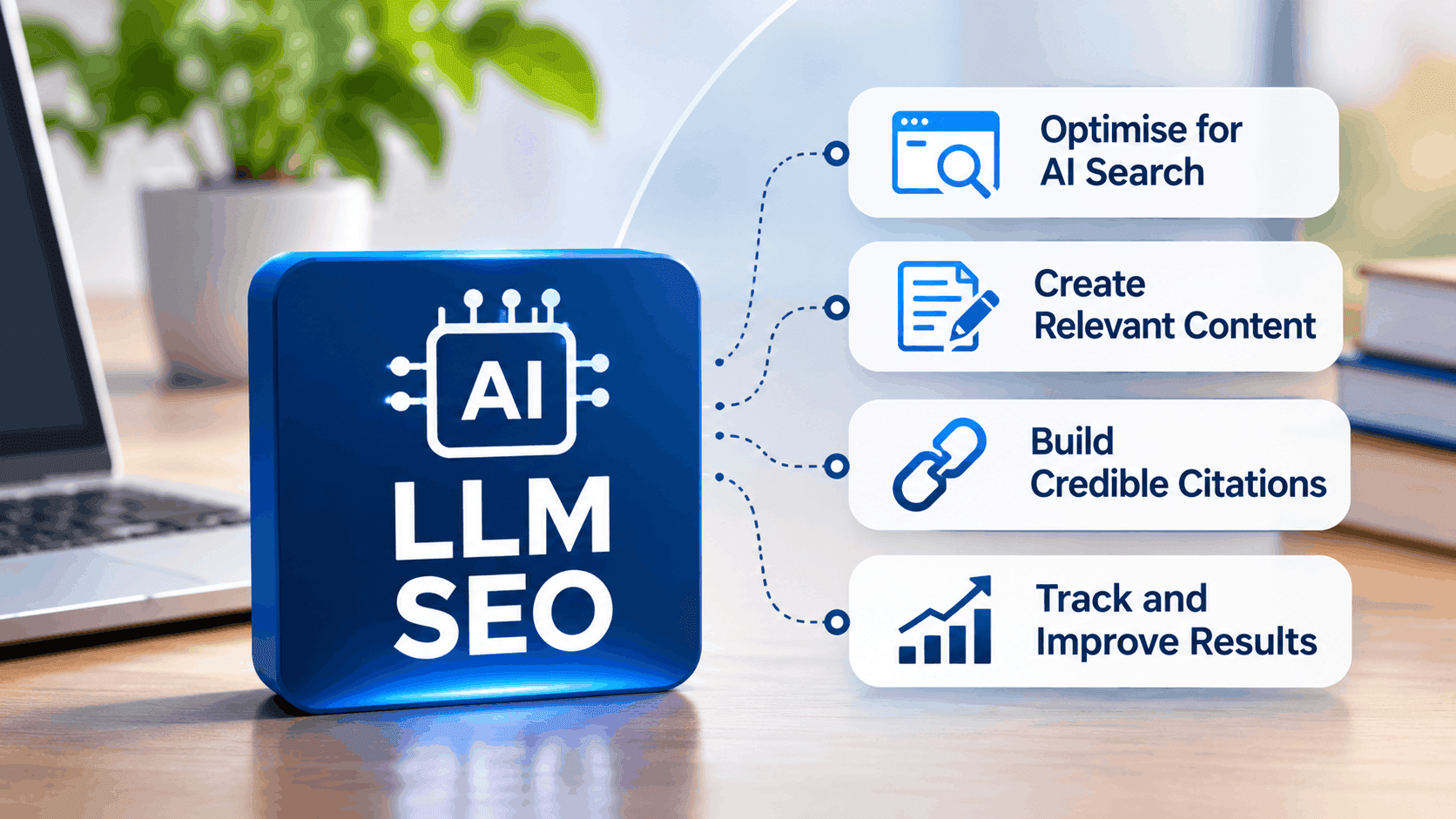
LLM SEO is the work of making your content easy for large language models and the AI search tools built on them to find, understand and cite. You may also see it called GEO or AEO. Google's guide says those terms describe work focused on visibility in AI search experiences, and that from its perspective this is still SEO. The goal is to be named, or linked, when an AI answer appears. Pages get retrieved, summarized and linked, so clear facts and crawlable content matter.
An LLM is the model behind the chat box. The tools around it decide what gets retrieved, and each vendor sets its own rules.
Why Does It Matter for US Businesses?
It matters because people are using these tools for real questions, and a business that isn't in the answer can't win the click or the call.
Pew Research Center found that 34% of US adults said in 2025 that they've used ChatGPT, including a 58% majority of adults under 30.
Google's AI features pull from its Search index, so the work also helps in Google. Google says generative AI features use publicly accessible, crawlable content.
Example: a Minneapolis tax preparer gets asked "who does small-business taxes near me?" in a chat tool. The answer names two firms. Neither is the preparer with a thin website and no reviews.
How Do LLMs Find and Use Pages?
LLMs use pages in two ways: they retrieve them at answer time, and they learn from them during training.
Retrieval is the one you can influence quickly. Google describes retrieval-augmented generation, which relies on its Search ranking systems to pull relevant pages from the index, and query fan-out, which sends related searches to find more sources. OpenAI's crawler documentation says OAI-SearchBot surfaces websites in ChatGPT's search features.
Training is separate. OpenAI says GPTBot crawls content that may be used to train its models, and that each crawler setting is independent of the others. A site can appear in search while opting out of training. Check both settings in your robots.txt.
How Does It Differ From Traditional SEO?
LLM SEO differs from traditional SEO mainly in what the reader sees and which crawlers matter, since the foundation is shared.
| Question | Traditional SEO | LLM SEO |
|---|---|---|
| What appears | Ranked links | A written answer with sources |
| Who crawls | Google's crawlers | Google's and OpenAI's, among others |
| Where you control it | Robots rules, meta tags | Separate robots.txt tags per bot |
| What still wins | Useful pages | Useful pages |
Google says SEO best practices continue to apply to its generative AI features. The new work sits on top of the old work, not in place of it.
How Do You Optimize a Site Step by Step?
The work takes seven steps, and the first costs nothing.
- 1.Open your robots.txt and decide, bot by bot, what you allow.
- 2.Confirm your key pages are indexed in Google and can show a snippet.
- 3.Add first-hand detail a rival page lacks, such as prices and photos.
- 4.Put key facts in plain text: services, hours, service area.
- 5.Keep Business Profile and other listings current.
- 6.Ask AI tools the questions your customers ask, and note which sources they cite.
- 7.Review monthly.
OpenAI says robots.txt changes can take about 24 hours to take effect. Write down the date you change each rule.
What Should You Ignore or Treat With Care?
Ignore tricks that Google says don't matter, and treat any promise of guaranteed AI mentions with suspicion.
- llms.txt. Google says Search itself doesn't use such files. It's fine to create one for other systems that read them.
- Chopping pages into tiny chunks. Google says there's no requirement to.
- Buying mentions. Google says seeking inauthentic ones isn't as helpful as it might seem.
- One new page per possible question. A high quantity of pages doesn't make a site better.
Google also warns that no third-party tool has access to its internal ranking or AI systems, so treat outside scores as estimates. Time spent on tricks is time not spent on your pages.
How Do You Measure Results, and What Does It Cost?
Measure results with Search Console's Generative AI performance report for Google, and keep your own log for other tools.
Google says traffic from its AI features is included in the overall search traffic in Search Console. For other tools, run your own test questions each month and record which sources they cite. Google's SEO guide says to wait a few weeks before judging a change.
Example (assumed figures, not a price list): a Minneapolis tax preparer spends $900 refreshing its six main service pages with prices, photos and plain-text facts. Then it logs the same ten test questions every month and compares the answers. Keep the questions identical so the months compare fairly.
What Mistakes Should You Avoid?
Avoid blocking the search crawler by accident, publishing AI drafts nobody checked and chasing hacks.
- Blocking OAI-SearchBot. OpenAI says opted-out sites won't be shown in ChatGPT search answers, though they can still appear as navigational links.
- Unchecked AI text. Google says generative models don't retrieve facts, they predict a likely sequence of words.
- Hoping a tool fixes thin pages.
- Changing everything at once.
- Forgetting to re-check robots.txt after a site redesign.
- Ignoring the Business Profile.
Pro Tip: before you edit a page, check which sources an AI tool cites for your topic. Then ask what those pages offer that yours doesn't.
What Is Changing in 2026?
AI agents that act for people are the next step, so keep key facts readable and your booking or contact path simple.
Google's guide describes AI agents as autonomous systems that can perform tasks on behalf of people, such as booking a reservation. Browser agents can read your site the way a person would.
Pew's 2025 survey shows how fast habits moved: ChatGPT use among US adults was about double the share in 2023. Expect the tools, and the crawlers behind them, to keep changing. Check each vendor's crawler page every quarter, and write down what it says today so you can spot changes later.
What Should You Do Next?
LLM SEO mostly means doing SEO well and checking that crawlers can reach your best pages. Start with your robots.txt, then your top three service pages. Add detail only you have. Then repeat the test questions in a month. If a rival keeps getting named, compare what their page says that yours doesn't. Log the date of each change. Margo Digitech's AI SEO team can review your setup with you. Our guides to SEO vs AEO and Google AI Overviews go deeper.
Frequently Asked Questions
In SEO, LLM refers to large language models, the AI systems behind chat and AI search tools. LLM SEO means making your content easy for those systems to find, understand and cite. Google's guide treats optimizing for generative AI search as still SEO, so the basics carry over.
LLM SEO also goes by GEO, for generative engine optimization, and AEO, for answer engine optimization. Google's guide says both terms describe work focused on improving visibility in AI search experiences. From Google's view, optimizing for generative AI search is optimizing for the search experience, so it's still SEO.
They aren't the same kind of thing. SEO is the practice of helping search engines understand your content and helping people find your site, and an LLM is an AI model. The usual comparison is SEO versus LLM SEO, and Google says SEO best practices still apply to its generative AI features.
LLMs can help with research and structure, but Google warns that generative models don't retrieve facts. They predict a likely sequence of words. Google calls it critical to manually fact-check and review all AI-generated content before publishing, including titles and meta descriptions. Use them as assistants, not authors.
SEO is evolving. Google says SEO best practices continue to apply to its generative AI features, and Pew found 34% of US adults have used ChatGPT, so there are more places to be found. Treat AI visibility as an extension of the same work: useful pages, clear facts and crawlable content.