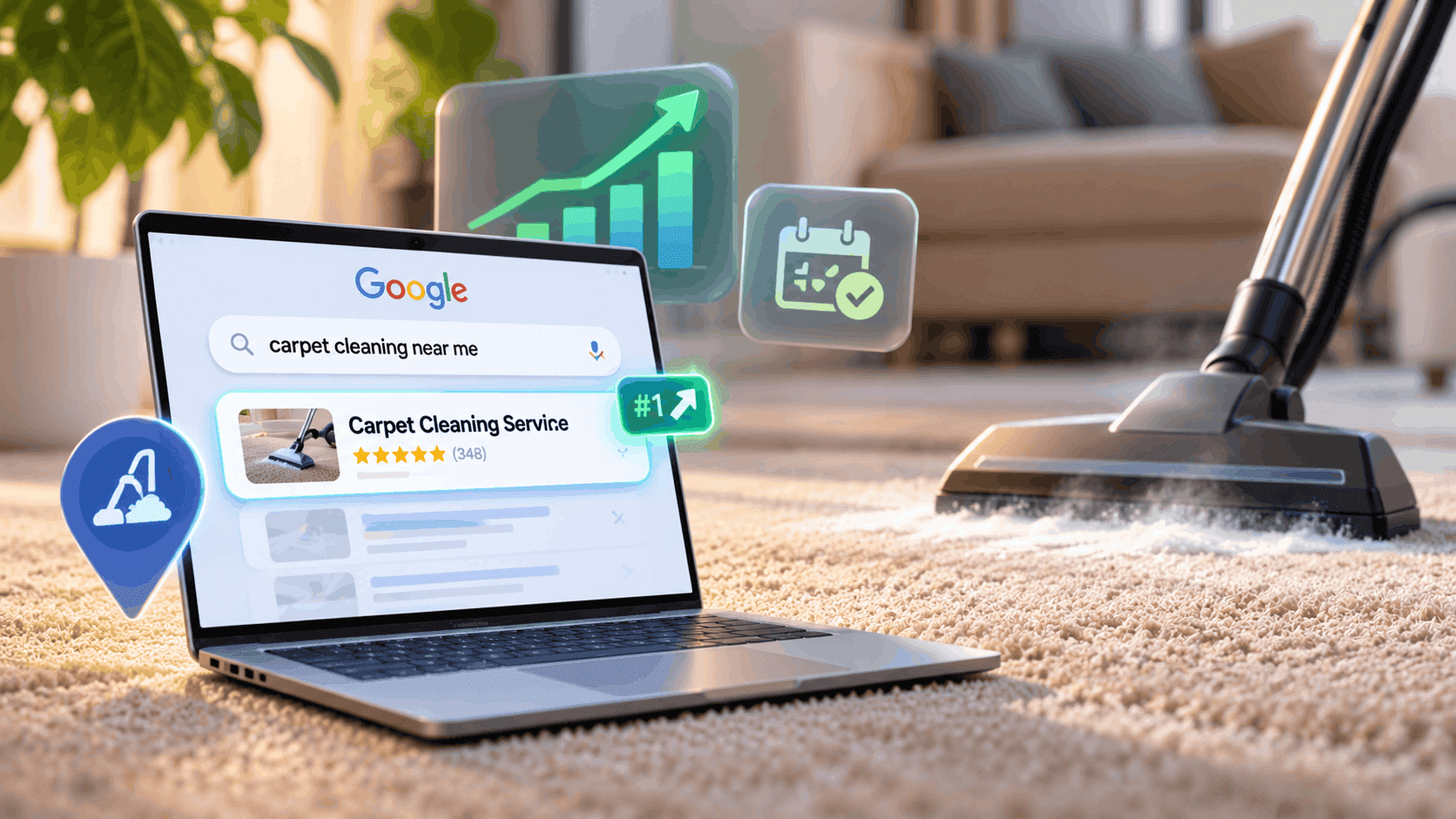
Someone spills red wine on a Friday night and searches for help on their phone. The business that shows up with a clear service page and a nearby listing gets the call. Carpet cleaning SEO is how you become that business. This guide is for US carpet and upholstery cleaners who want a plain plan they can run themselves or check against a quote. You'll get a definition, how Google picks local results, a seven-step plan and a way to price a job. Every figure names its source, and dollar examples are marked as assumed.
What Is Carpet Cleaning SEO?
Carpet cleaning SEO is the work of making your business easy to find on Google when people in your service area search for carpet, upholstery or stain removal help. It combines a complete Google Business Profile, a page for each service, real reviews and answers to the questions customers ask. Your Business Profile is the listing shown in Google Maps and Search, so it does early work. Google's SEO guide defines SEO as helping search engines understand your content and helping people decide whether to visit your site.
Customers search for a cleaner near them, so the work is local. Searchers outside your service area aren't your customers.
Why Does It Matter for a Carpet Cleaning Business?
It matters because organic results cost nothing to appear in, and a call that starts there has no ad bill attached.
Google says it never accepts money to include or rank sites in its results. Labor is a real cost in this trade. The Bureau of Labor Statistics puts the median hourly wage for janitors and building cleaners at $17.71 as of May 2025, so each wasted trip adds up. Qualified calls matter more than raw traffic. Quote only the jobs you want.
Example: a Tulsa cleaner has one "Cleaning" page. A homeowner searching for pet stain removal finds a rival whose page covers exactly that, with photos of finished jobs.
How Does Google Pick Local Carpet Cleaners?
Google picks local results mainly on relevance, distance and popularity, and its Business Profile help says there's no way to request or pay for a better local ranking.
Relevance is how well your profile matches what the person searched. Distance is how far you are from them. Prominence is how well-known you are, which Google ties to the number of websites linking to you and the number of reviews you have.
Google says it keeps ranking details confidential. Be careful with anyone selling a secret formula. Google says replying to reviews shows you value the feedback, and more reviews and positive ratings can help your local ranking.
Which Parts of the Work Matter?
Four parts do most of the lifting, and each one answers a different question a customer has.
| Part | What to do | Customer question it answers |
|---|---|---|
| Business Profile | Verify, set service area | Are you real and nearby? |
| Service pages | One page per service | Do you handle my problem? |
| Reviews | Ask, then reply | Can I trust you? |
| Photos | Real before-and-after shots | What will I get? |
Google says businesses with complete and accurate info are more likely to show up in local results. Fix the row where you're weakest first.
How Do You Get Started Step by Step?
A carpet cleaner can set up local SEO in seven steps, and the profile comes first.
- 1.Claim and verify your Business Profile.
- 2.Use your real business name, with no keywords added.
- 3.Pick the fewest categories that describe your core work.
- 4.Set a service area, not a made-up address.
- 5.Build a page for each service, such as pet stains or upholstery.
- 6.Add your own job photos and name the town.
- 7.Ask every customer for a review, and reply to each one.
Check results after a few weeks. Our guide to setting up a Google Business Profile covers step 1.
How Do Service Areas and Seasons Change Your Plan?
Service-area businesses need one profile with a designated service area, and your demand pattern decides when to publish.
Google says a service-area business serves customers at their locations and should have one profile for the central office or location with a designated service area. A rented mailing address that you don't operate from is a virtual office, and Google says it isn't eligible.
Demand moves through the year. Google's own example is diets in January and turkey in November. Set Search Console's date filter to 16 months to see your yearly pattern, then publish before your busy weeks. Don't promise areas you won't drive to.
How Do You Price a Job and Check It's Profitable?
No neutral national price list exists, so build your price from your costs and a margin you've chosen.
Add labor, solution and equipment wear, vehicle costs and fees, then add your margin. The BLS median wage above is a reference for labor cost, not a rate to charge.
Example (assumed figures, not a price list): a job priced at $240 uses 3 hours of labor at $20, which is $60. Add $25 of solution and wear and $20 of fuel. That leaves $135. If SEO brings five such jobs a month, that's $675 against the fee.
Ask any SEO for examples of previous work, as Google advises.
What Mistakes Should You Avoid?
Avoid stuffing your business name, using a virtual office and paying for reviews.
- Adding "Best Carpet Cleaning Tulsa" to your profile name. Google says unnecessary information in a name isn't permitted and could get the profile suspended.
- A virtual office as your address.
- Several profiles for one business. Google says there should be one.
- Paid or incentivized reviews. The FTC's reviews rule took effect on 21 October 2024.
- Missing calls. Google says that if you regularly fail to answer calls or respond to messages, your Local Services Ads ranking may be affected.
Common Mistake: one "Services" page for carpet, upholstery and stains. Each deserves its own.
What Is Changing in 2026?
Google's paid local listings are moving into Google Ads, and AI answers are starting to use business information.
Google's Ads Help says the Local Services Ads migration began in August 2026 for select home and storefront service advertisers in the United States, naming plumbing, HVAC, house cleaning and lawn care among them. Carpet cleaning isn't in that list, so check your category. Late 2026 brings service-area businesses without storefronts. You still pay only for valid leads.
Google says SEO best practices continue to apply to its AI features. A November 2026 core update began on 10 November. Write down the date of each change you make.
What Should You Do Next?
Carpet cleaning SEO starts with a verified, accurate profile and one good page for each service. Fix those this week, then ask your next five customers for a review. Check Search Console in a few weeks and note what moved. Margo Digitech's local SEO team can review the setup with you. Our guide to Google Local Services Ads explains the paid route. Reply to every review while you're at it. Write down each change and its date, so you know what helped.
Frequently Asked Questions
Start with the free routes: a verified Google Business Profile, a page for each service and real reviews. If your category is eligible, Local Services Ads charge when a customer contacts you, not for clicks. Google says those ads are available only for certain service categories, so check yours first.
It can be, but no neutral figure exists to quote. Work it out yourself: take the job price, subtract labor, solution, vehicle costs and fees, then compare what's left with your marketing spend. The BLS median wage for janitors and building cleaners, $17.71 in May 2025, is a reference for labor cost.
No neutral national price list exists, so build your price from your costs and a margin you've chosen. Count labor, solution, equipment wear, vehicle costs and fees. Then compare your price with nearby businesses you directly compete with. Customers comparing quotes should ask what's included in each one.
No neutral price exists, so compare quotes on what each includes: the area covered, stain treatment and any minimum fee. The FTC says advertising must be truthful and non-deceptive, so a quoted price should match what you're charged. Ask for the total in writing before work starts.
No neutral price exists, so use arithmetic with the quote you're given. Multiply the per-square-foot rate by 2,000, then add any minimum fee or stain treatment. Example (assumed rate, not a price list): at $0.30 a square foot, 2,000 square feet comes to $600.