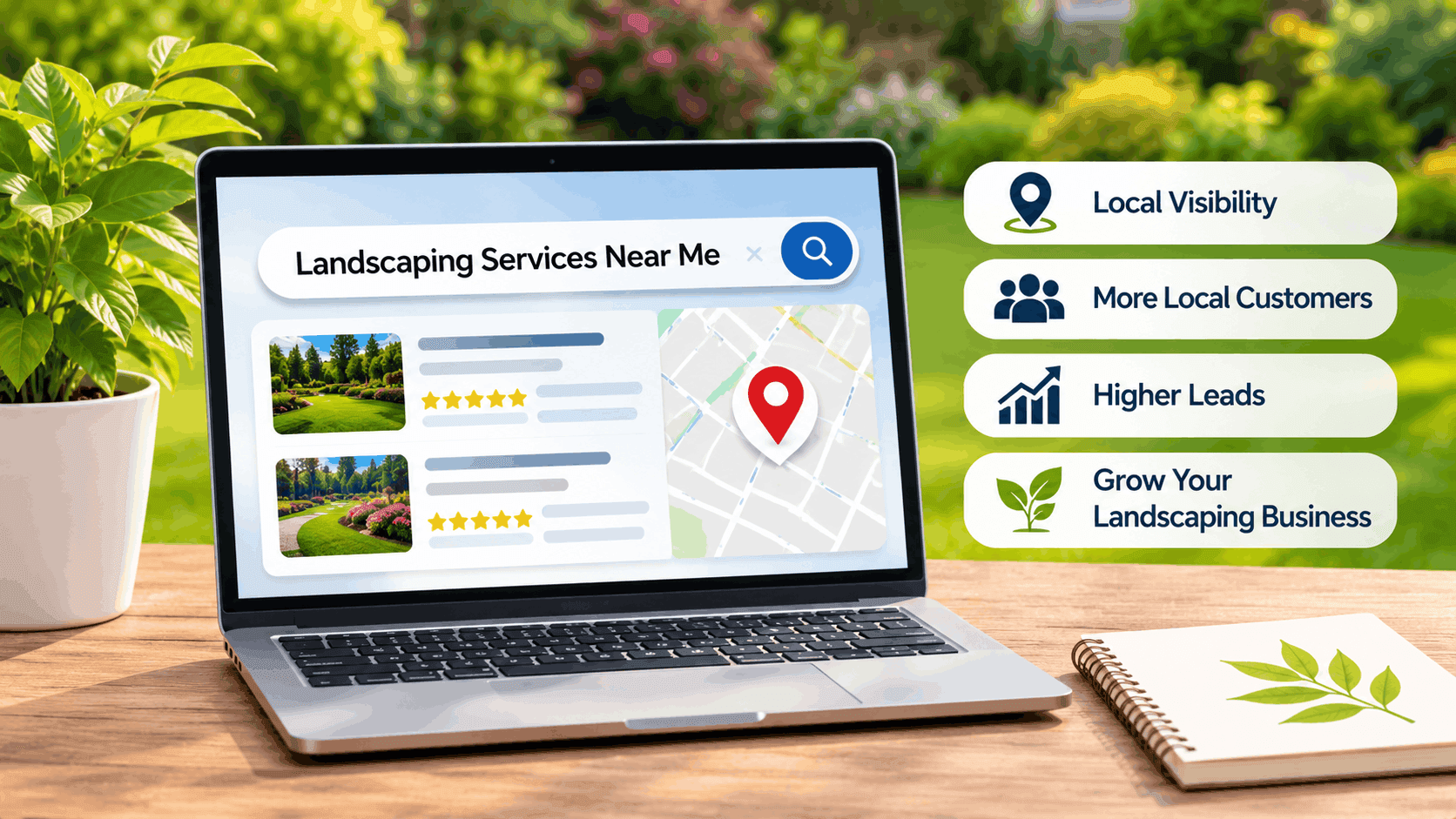
A homeowner searches "landscaper near me" on a Saturday morning. The few businesses Google shows get the call, and the rest never hear about it. Landscaping SEO is how you end up in that short list. This guide is for US landscaping and lawn care owners who want a plain plan without agency jargon. You'll get a definition, a look at how Google picks local results, a seven-step plan and the mistakes that cost calls. Every figure names its source, and dollar examples are marked as assumed.
What Is Landscaping SEO?
Landscaping SEO is the work of making your business easy to find on Google when homeowners and property managers search for landscaping, lawn care or hardscape services in your area. It combines a complete Google Business Profile, service pages on your website, real reviews and local content. Your Business Profile is the listing that appears in Google Maps and Search, so it does early work. Google's SEO guide defines SEO as helping search engines understand your content and helping people decide whether to visit your site.
Landscaping searches are local, so location matters at every step. Searchers inside your service area matter, and searchers outside it don't.
Why Does It Matter for a Landscaping Business?
It matters because Google doesn't charge to show organic results, and the calls you earn there cost you no ad spend.
Google says it never accepts money to include or rank sites in its results, and it costs nothing to appear in organic search. The Bureau of Labor Statistics puts the median hourly wage for grounds maintenance workers at $19.27 as of May 2025. A crew sent to quote a job you didn't want costs real money. Qualified calls matter more than traffic.
Example: a Columbus lawn care company wants mowing contracts. Its page says "landscaping services." Homeowners searching for lawn mowing find a rival's page instead.
How Does Google Choose Local Landscaping Results?
Google chooses local results mainly on relevance, distance and popularity, and its Business Profile help says there's no way to pay for a better local ranking.
Relevance is how well your Business Profile matches the search. Distance is how far you are from the searcher. Prominence is how well-known you are, which Google says is based on things like how many websites link to your business and how many reviews you have.
Google says it keeps its ranking details confidential, so treat any outside promise of a secret formula with caution. You can't change distance. You can change the other two, starting with a complete and accurate profile.
Which Parts of the Work Matter Most?
Four parts carry the work: your profile, your website, your reviews and your local content.
| Part | What to do | Where it shows |
|---|---|---|
| Business Profile | Complete, verified, one profile | Maps and local results |
| Website | One page per service | Regular results |
| Reviews | Ask real customers, reply | Profile and prominence |
| Local content | Answer seasonal questions | Regular results, AI answers |
Google says businesses with complete and accurate info are more likely to show up in local results. Start with the row where your business is weakest.
How Do You Improve It Step by Step?
A landscaping business can improve its local search presence in seven steps, and the profile comes first.
- 1.Claim and verify your Business Profile.
- 2.Use your real business name, with no keywords added.
- 3.Pick the fewest categories that describe your core work.
- 4.Set your service area instead of listing a fake address.
- 5.Build one website page for each service you sell.
- 6.Add photos of your own jobs, with the town named.
- 7.Ask each happy customer for a review and reply to every one.
Check your results after a few weeks. Google says some changes take hours and others several months. Our guide to setting up a Google Business Profile covers step 1.
How Do Reviews and Seasonal Content Work?
Reviews build prominence and seasonal pages catch the questions homeowners ask before they hire.
Google says more reviews and positive ratings can help your local ranking, and replying to reviews shows you value the feedback. Ask in person at the end of a job, while the yard still looks fresh. Don't pay for reviews. The FTC's reviews rule took effect on 21 October 2024, and an incentivized review counts as a testimonial under it.
Demand moves through the year. Google's own example is food searches: diets in January and turkey in November. Set Search Console to 16 months and look for your own yearly pattern. Publish the spring page before spring.
How Much Does It Cost, and What Return Can You Expect?
No neutral national price exists, so judge any quote against what one new customer is worth to you.
Google's guidance on hiring says to ask for examples of previous work and success stories. It also says no one can guarantee a #1 ranking, and if an SEO guarantees first place, find someone else.
Example (assumed figures, not a price list): a Boise landscaping company earns $2,400 on an average design-and-install job. If SEO work adds two jobs a month, that's $4,800. Compare any monthly fee with that number, not with a traffic report. Ask what's included each month and how results will be measured before you sign.
What Mistakes Should You Avoid?
Avoid stuffing your business name, listing a fake address and paying for reviews.
- Adding "Best Landscaper Columbus" to your Business Profile name. Google says unnecessary information in a name isn't permitted and could get the profile suspended.
- A virtual office as your address. Google says it isn't eligible.
- Several profiles for one business. Google says there should be one.
- Ignoring replies to reviews.
- Copying a rival's service page word for word.
- Claims you can't back up. The FTC says advertisers must have evidence for their claims.
Common Mistake: one "Services" page for everything. Mowing, patios and tree work each deserve their own page.
What Is Changing in 2026?
AI answers are using local and seasonal questions, so your service pages need to answer them in plain text.
Google's guide gives a landscaping-style example of query fan-out: for "how to fix a lawn that's full of weeds," the model may also search related questions. It says SEO best practices continue to apply to its AI features, and that a complete Business Profile can help visibility in AI responses.
Local Services Ads are another route. Google says they're available only for certain service categories, so check yours. A November 2026 core update began on 10 November. Check results before you change anything, and write down the date of each change.
What Should You Do Next?
Landscaping SEO starts with a verified, accurate profile and one good page for each service. Fix those this week, then ask your next five happy customers for reviews. Check Search Console in a few weeks and note what moved. Keep a note of each change and the date, so you know what helped. If you'd like a second pair of eyes, Margo Digitech's local SEO team can review the setup. Our guide to Google Local Services Ads explains the paid option.
Frequently Asked Questions
SEO is still relevant for landscapers. Google says SEO best practices continue to apply to its generative AI features, and local results still depend on relevance, distance and popularity. Homeowners searching for a nearby landscaper find a profile and a website, and both are built with SEO.
No neutral price list exists, so judge a quote by what a new customer is worth to you. Google advises asking for examples of previous work and says to walk away from anyone guaranteeing first place. Ask what's included each month and how results will be measured.
It can be, if the work is specific and measured. Google says a small local business can probably do much of the work itself, and that a good time to hire is during a site redesign. Hire help for the parts you don't have time for, and ask for proof.
Nothing has replaced it. Google says optimizing for generative AI search is optimizing for the search experience, so it's still SEO. AI answers change what appears on the page, and Google says its AI features are rooted in its core ranking systems. Keep building useful pages and a complete profile.
You can learn the basics in that time, but you won't see every result. Google says some changes take effect in hours and others take several months, and to wait a few weeks before judging. Start with your Business Profile and one service page, then add one change at a time.