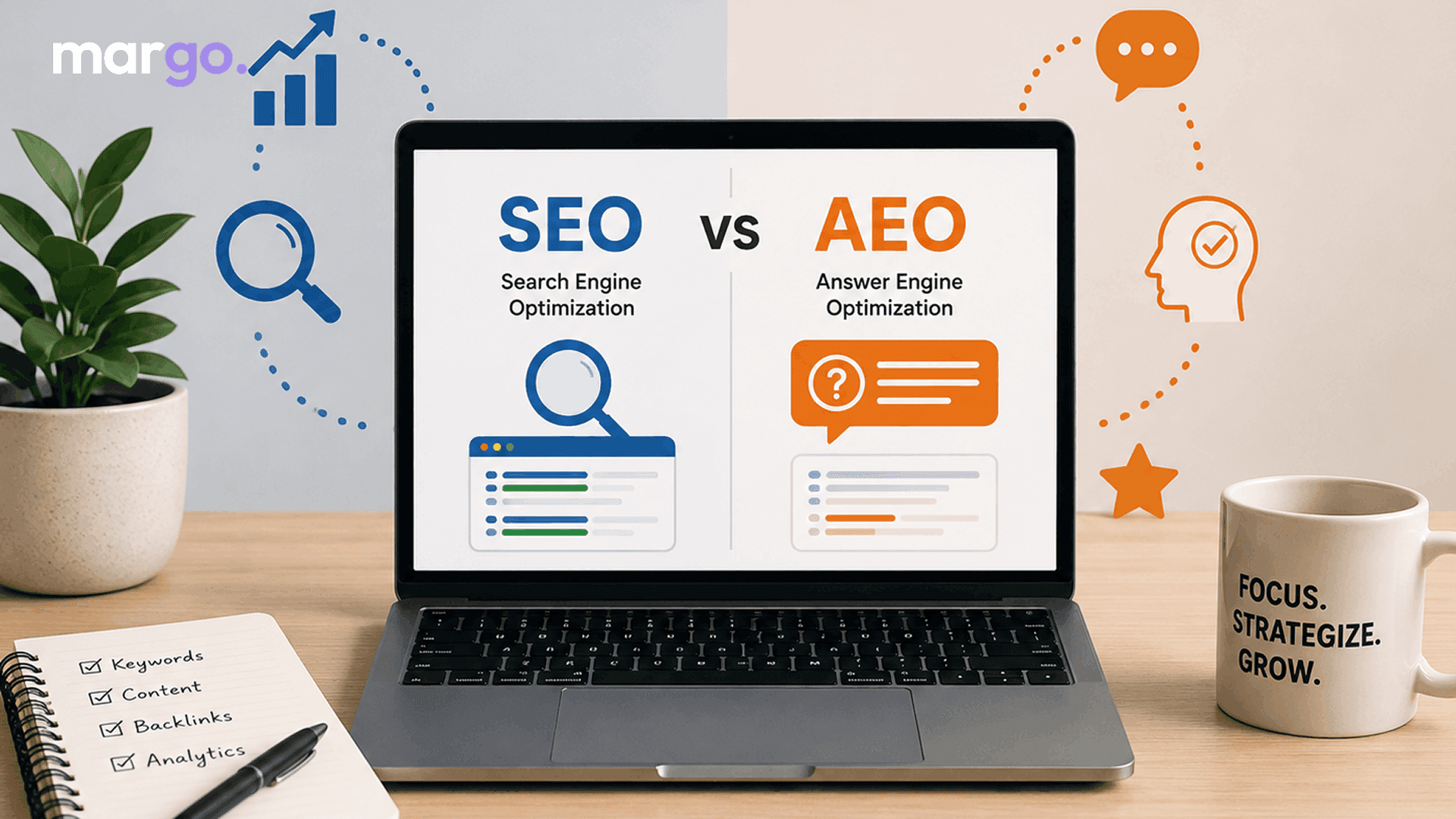
Search is changing. People no longer just type keywords into Google and scroll through ten blue links. Instead, they ask AI tools like ChatGPT, Perplexity, and Google's AI Overviews straight questions and expect a straight answer. There's now a new debate about AEO vs. SEO and whether companies should completely change their focus, split their efforts, or stick with what's worked for years.
Let's break down what each strategy means, how they differ, and which one you should be paying attention to in 2026.
What is SEO?
Search Engine Optimisation (SEO) is the process of optimising your website so that it ranks higher in traditional search engine result pages (SERPs). It looks at things like keyword research, backlinks, site architecture, page speed and content depth, to name a few, to help your pages climb up Google's rankings and get free clicks.
What is Answer Engine Optimization (AEO)?
Answer Engine Optimisation, or AEO, is the process of structuring content so that it is easy for AI-powered tools like voice assistants, chatbots, and AI search engines to pull out and display as a direct answer. In digital marketing, AEO isn't only about optimising for rankings. It's about being the answer, not just a link in the rankings.
So how does AEO work in practice? It depends on:
- Clear, concise answers that are placed right at the beginning of the content
- Structured data, or schema markup, that helps machines understand what is the context
- Question-and-answer formatting which is kind of similar to FAQs
- Authoritative, well-sourced information that AI models trust enough to cite
SEO vs AEO: The Core Differences
Understanding the SEO vs AEO difference comes down to intent and output.
| Factor | SEO | AEO |
|---|---|---|
| Goal | Rank high in search results | Be featured as a direct answer |
| Format | Long-form, keyword-optimized pages | Concise, structured Q&A style content |
| Platform | Google, Bing, other search engines | AI chatbots, voice assistants, AI Overviews |
| Success Metric | Clicks, rankings, traffic | Citations, mentions, visibility in AI answers |
| User Behavior | Browsing and comparing results | Getting an instant, single answer |
AEO tries to get your content quoted or summed up right in an AI-generated response, sometimes without the user having to click at all. SEO tries to get people to click through to your site.
SEO vs AEO Benefits
There are several advantages of both SEO and AEO. Keep reading to learn more about the benefits:
- Drives consistent, long-term organic traffic
- Builds domain authority with time
- Works across various search intents
- Well-established tools along with best practices
Here are the benefits of AEO:
- Better visibility in AI generated answers as well as voice search
- Helps build brand trust when your content is cited as a source
- Captures "zero-click" search moments
- Prepares your brand for the future of search behavior
Is AEO Replacing SEO?
This is a question that marketers ask frequently, and the short answer is no. AEO is not replacing SEO, it is building on it.
The AI answer engines still need crawlable, well-structured, authoritative web content to provide their answers. Indeed, many of the best practices for AEO are based on sound SEO practices like using clear headings, high-quality backlinks, and topical authority. Without good SEO, an AI engine often has nothing to pull from in the first place.
Think of AEO as an evolution or extension of SEO, tailored to a new generation of search interfaces, rather than a competing discipline.
Why SEO and AEO Work Better Together?
The smartest strategy is not to choose between them, but to combine SEO and AEO together. Here's how:
- Good SEO is based on good technical health, good backlinks and content that is optimised for keywords.
- To make your website SEO-friendly, add FAQ sections, use schema markups, and answer questions directly and early on in your content.
- Optimize for featured snippets Content that is optimised for featured snippets often overlaps with what AI answer engines pull from.
- Monitor your brand on traditional rankings and AI tools.
This hybrid approach means you will be found whether someone searches on Google, asks Siri, or queries an AI chatbot.
Which Strategy Should You Focus On?
If you're just beginning to build your business's organic visibility, SEO should be the foundation. It's measurable, mature, and brings in steady traffic. But ignoring AEO means missing out on a rapidly growing slice of how people find information today.
A strategy that includes both SEO and AEO is the most likely to work in the future. Brands that adapt their content to be both search-engine-friendly and answer-engine-friendly will have the strongest visibility across every stage of the search experience.
Frequently Asked Questions
AEO is the practice of optimising content to be easily understood, extracted and presented as a direct answer to user queries by AI tools and answer engines.
SEO is about getting pages to rank in traditional search results, and AEO is about getting content featured as a direct answer in AI-generated responses.
No. AEO is not a replacement for basic SEO, but an extension. In the first place, AI engines need strong SEO to find your content and trust it.
Yes. The best long-term strategy is to combine SEO and AEO, since a strong SEO foundation underpins and enhances AEO visibility.
Structured data isn’t a must-have, but it helps AI engines understand your content in context and increases your chances of being surfaced as an answer.