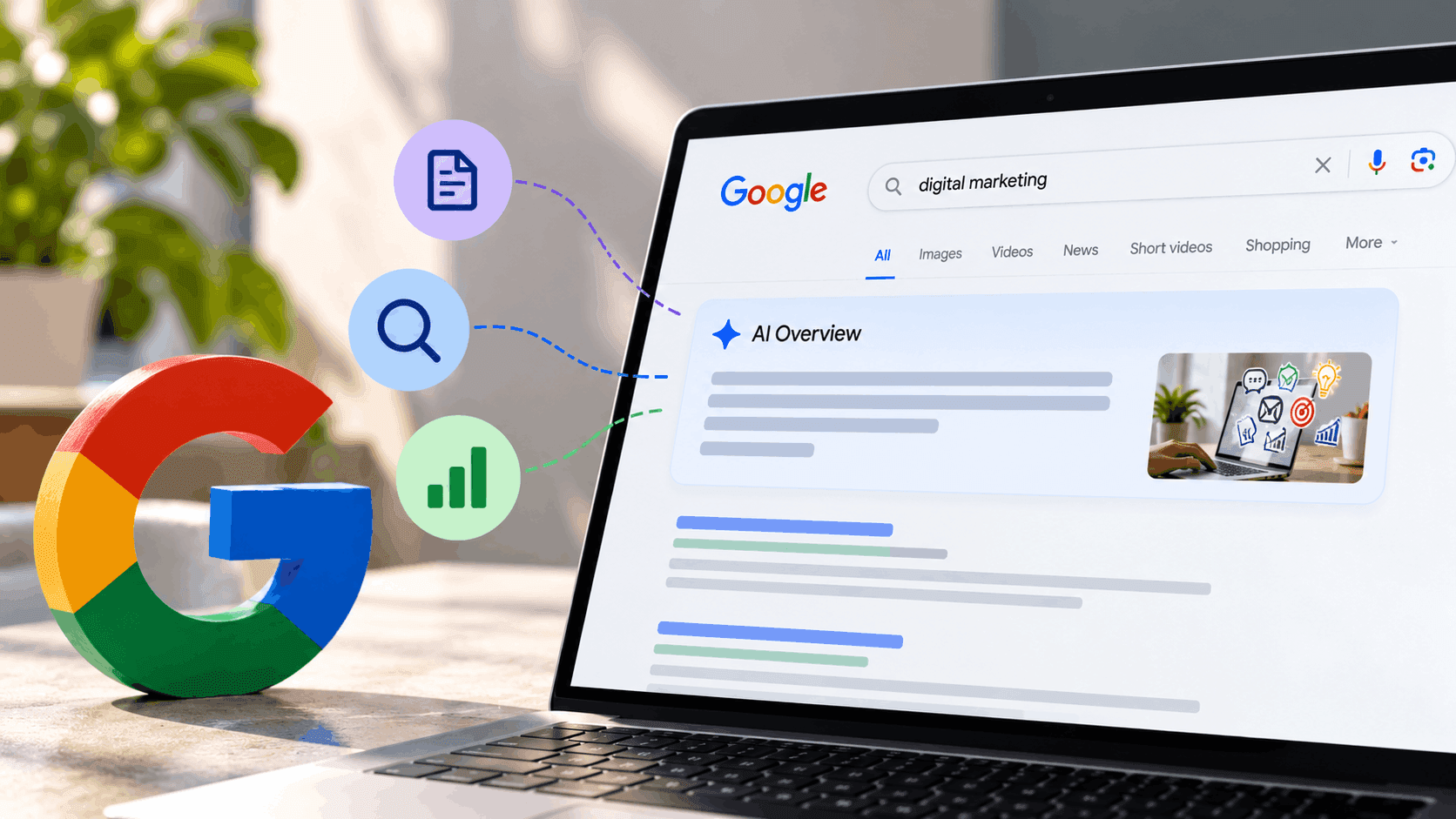
A search that used to send a visitor to ten separate blue links can now get answered entirely inside the results page, before a single click happens. Google AI Overviews are the feature responsible for that shift, and which queries trigger one, and which sources get cited inside it, has become one of the more consequential questions in SEO.
What is AI Overview on Google?
An AI Overview is a generated summary that appears at or near the top of Google's search results, pulling together information from multiple web sources into a single written answer instead of leaving the searcher to click through and compare pages themselves. It sits above the traditional organic listings and often includes small citation links to the pages it drew from, which is the closest thing to a ranking a page can get inside the feature.
Google overviews AI content is generated per query rather than pulled from a fixed database, which means the same search can produce a different overview, or none at all, depending on how the query is phrased and what Google's systems judge the intent to be.
How do Google AI Overviews work?
Google's systems evaluate a query, identify a set of pages likely to answer it well, and use a language model to synthesize those sources into a summary written specifically for that search. The citations that appear alongside the summary are drawn from that same source set, not from whichever page simply ranks first organically, so a page can be cited in an AI Overview without holding the top traditional ranking, or hold the top ranking and still be left out.
Not every query gets one. Roughly 13% of all Google queries currently trigger an AI Overview, and that share is not spread evenly across query types. Informational queries make up the largest share of AI Overview triggers at 36 to 39%, with commercial queries at around 22% and transactional queries at around 16%, though the mix has shifted noticeably over time as Google expanded the feature into more commercial and navigational searches.
What triggers an AI Overview
Query length and phrasing matter more than most single factor. Longer, more specific informational queries, seven words or more, trigger an AI Overview roughly 65.9% of the time, since Google's systems read that length as a signal the searcher wants a synthesized answer rather than a single authoritative page. Short, simple, or clearly navigational searches, like a brand name or a single product term, are far less likely to produce one.
Intent plays the other half of the role. Queries phrased as direct questions, comparisons, or requests for an explanation are more likely to trigger an overview than queries phrased as a bare keyword, because the format itself signals that a synthesized answer would satisfy the search better than a single page would.
AI overview SEO: how this changes ranking work
AI Overview SEO isn't a replacement for traditional ranking work, it sits alongside it. A page still needs to rank well enough to be part of Google's candidate set before it can be considered for a citation, so the fundamentals, crawlability, relevance, and authority, still apply first. What changes is the second layer: once a page is eligible, getting cited depends more on how clearly it answers the specific query than on where it ranks among the ten blue links.
This is also why visibility tracking now needs to account for citations, not just rankings. A page can hold steady rankings while losing clicks to an AI Overview that cites a competitor instead, which is invisible in a traditional rank tracker but shows up clearly once AI Overview presence is tracked separately.
AI Overviews content strategy: how to structure content for the feature
Clear structure and easy scanning have always been good SEO practice, and that discipline carries over here rather than requiring an entirely new set of rules. Content that states its main point plainly near the top of a section, rather than building up to it, gives a language model an easier passage to extract and cite. Writing that leans on direct subject-predicate-object sentences for the core facts of a topic has been linked to higher citation rates in some analysis, though it should support natural writing rather than replace it throughout a whole page.
Coverage matters as much as structure. Google's systems generate answers by drawing on the full set of related subquestions a topic implies, not just the primary query, so an article that also addresses the follow-up questions and specifications a reader would naturally ask next has more surface area to be pulled from than one narrowly focused on a single phrasing. Structured data doesn't directly guarantee a citation, but it helps Google's systems understand the relationships between entities on a page, which the underlying models draw on when assembling an answer.
Google AI Overview visibility tool options
Tracking whether a page is showing up inside AI Overviews requires different tooling than standard rank tracking, since a citation isn't the same as a ranking position. Semrush's AI visibility tracking and Ahrefs' Brand Radar both monitor a domain's presence specifically inside AI-generated answers, including Google's AI Overviews, and report on citation frequency the way a rank tracker reports on position.
These tools matter most for pages that already rank well but need to confirm whether that ranking is translating into AI Overview citations, since the two can diverge significantly for the same page depending on how directly it answers the query's underlying intent.
Margo Digitech tracks AI Overview citations alongside traditional rankings for clients now, treating it as a standard part of SEO reporting rather than a separate, optional add-on.
Frequently Asked Questions
It's a short, AI-generated answer that appears at the top of some Google search results, summarizing information from several web pages instead of making the searcher click through to find it themselves.
They draw citations from a set of pages Google's systems judge relevant and reliable for that specific query, which is a different, narrower evaluation than standard organic ranking, so a top-ranked page isn't automatically cited.
No. A page still needs to rank well enough to be eligible for consideration, so core SEO fundamentals matter as much as before. AI Overview visibility is an additional layer on top of that foundation, not a substitute for it.
Yes, through tools built specifically for AI visibility tracking, such as Semrush's AI toolkit or Ahrefs' Brand Radar, since standard rank trackers don't capture citation presence inside the feature.
No, only a minority do. Roughly 13% of all Google queries currently produce one, with the rate much higher for longer, informational questions and much lower for short, navigational, or brand-name searches.