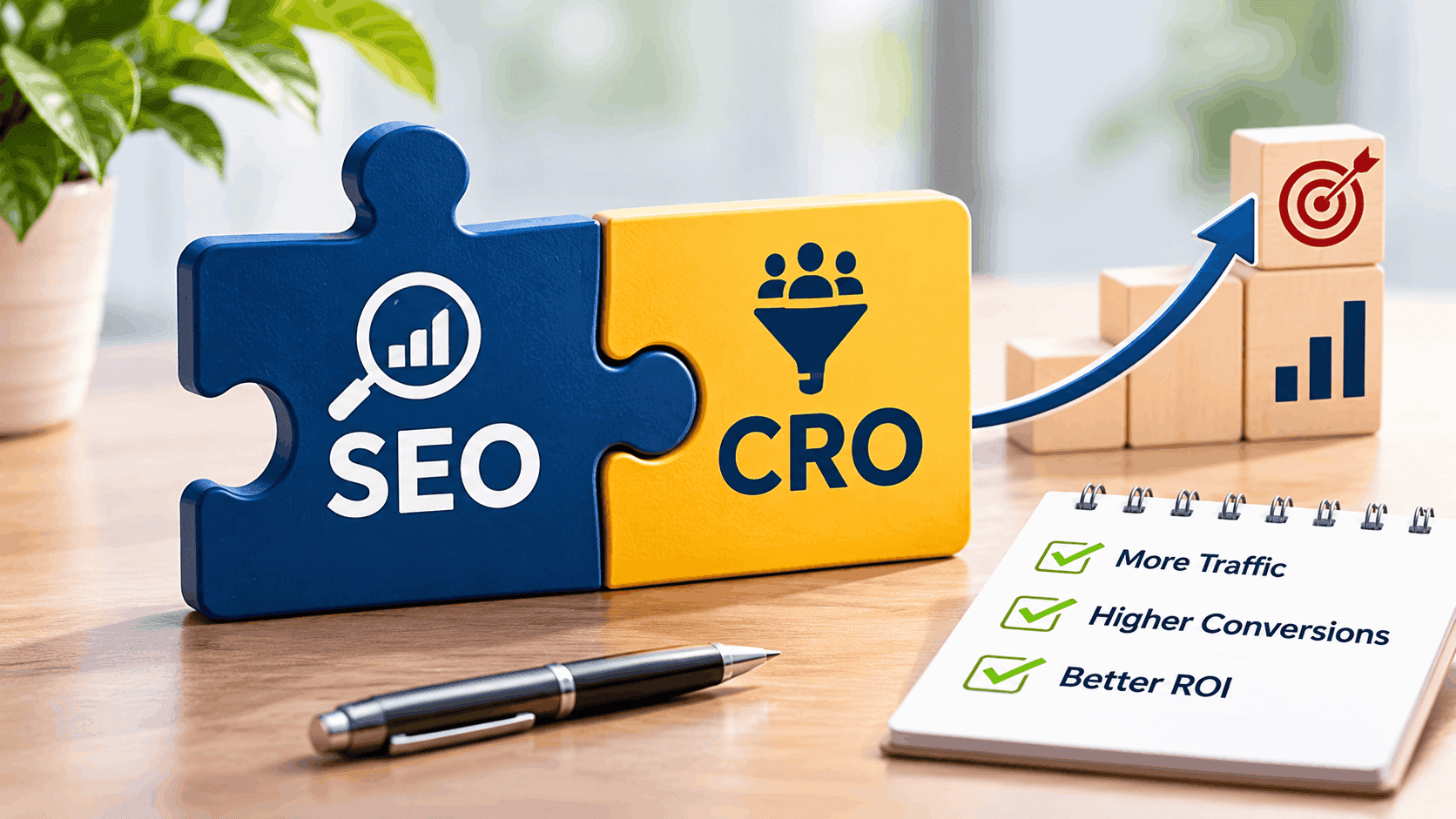
Search for CRO SEO and you'll find two jobs treated as rivals. They aren't. One brings people to a page, and the other decides what they do when they get there. Ask where your visitors go after the click, and the two jobs start to look like one. This guide is for US small business owners and marketers who are paying for one, both or neither. You'll get plain definitions, a side-by-side table, a seven-step routine and a worked example. Facts name their source, and dollar examples are marked as assumed.
What Is CRO in SEO?
CRO stands for conversion rate optimization, the work of getting more of your existing visitors to complete an action, such as booking, buying or filling in a form. SEO is search engine optimization, which Google describes as helping search engines understand your content and helping people decide whether to visit your site. CRO isn't part of SEO, but the two share pages, so each one changes the other's results. Success for CRO is measured in actions, and for SEO in visits and visibility.
Example: if 1,000 people visit a page and 20 book, the conversion rate is 2%. Divide conversions by visitors to find yours.
How Do CRO and SEO Differ?
SEO earns the visit and CRO earns the action, and each is measured with different tools.
| Question | SEO | CRO |
|---|---|---|
| Goal | More qualified visits | More actions per visit |
| Measured in | Search Console clicks and CTR | Analytics key events |
| Works on | Titles, content, site setup | Layout, offers, forms |
Search Console counts clicks and impressions. Google Analytics records key events, which it defines as actions that are particularly important to the success of your business. Google says the two tools use different metrics and systems, so their data won't match completely. Read them side by side.
Why Do They Matter Together for a US Small Business?
They matter together because the results multiply: more visitors and a higher conversion rate compound. Start with whichever number is weaker.
Example (assumed figures, not a benchmark): a Nashville dental office gets 1,000 visits a month to its implant page, and 2% book, which is 20 consultations. SEO doubles the visits to 2,000 at the same 2%, giving 40. CRO lifts the rate to 3% on the original 1,000 visits, giving 30. Do both and 2,000 visits at 3% gives 60.
Neither job rescues the other. A fast, clear page with no visitors books nobody, and a crowded page with strong traffic wastes the visits it earns.
Where Do the Two Overlap?
CRO and SEO overlap on every page that gets search traffic, starting with whether the page answers the query.
Google's helpful content guidance asks if your content leaves readers feeling they need to search again to get better information. A visitor who backs out to search again has not converted. That's a conversion lost, and a sign the page missed the query.
The search result is a page too. Google calls a meta description a pitch that convinces the user the page is what they're looking for, and click-through rate is clicks divided by impressions. Testing a title is conversion work.
Mobile matters twice. Google uses the mobile version of a site's content for indexing, so the phone is where both jobs get judged.
How Do You Run CRO and SEO Together Step by Step?
Running both takes seven steps, and the first is choosing one page that already gets search traffic.
- 1.Pick one page that already earns visits from Google.
- 2.Name the single action you want, and set it up as a key event.
- 3.Read the page's queries and click-through rate in Search Console.
- 4.Read its conversions in Analytics.
- 5.Fix any mismatch between what people searched for and what the page offers.
- 6.Change one thing, such as the headline, the form or the offer.
- 7.Wait, then compare before and after.
Leave titles and headings alone while you test the layout, or you won't know which change moved the numbers.
Where Do Page Speed and Mobile Fit In?
Page speed and mobile fit at the foundation, because a slow or awkward page loses visitors before any headline gets read.
The web.dev Core Web Vitals guidance says the largest content should load within 2.5 seconds and pages should have an interaction delay of 200 milliseconds or less. The HTTP Archive's 2025 Web Almanac found 48% of mobile websites and 56% of desktop websites passing.
Google says there's no single page experience signal, so don't chase one score. Fix speed on the landing page you're about to test first. Try it on a real phone over a normal connection, not only on a fast office desktop.
How Do You Measure Results Without Fooling Yourself?
Measure results by comparing the same page before and after one change, using Search Console for visits and Analytics for actions, and give it a few weeks.
Google says to wait a few weeks to assess SEO changes, and some take months. Conversion changes need time to collect enough visits too.
Write down the date of every change in a shared sheet. If a title edit and a new form go live in the same week, the result can't be credited to either.
Google's guidance on combining Search Console and Analytics says the pairing helps with attributing ecommerce transactions, newsletter signups and form fills to Google Search traffic.
What Mistakes Should You Avoid?
Avoid testing several changes at once, writing for conversion at the cost of the words searchers typed, and ignoring the phone.
- Changing the title, headings and layout together.
- Cutting the keyword from the headline to sound punchier.
- Claims you can't back up. The FTC says advertisers must have evidence for their claims.
- A form that only works well on a desktop.
- No baseline number, so a "win" has nothing to beat.
- Stopping a test after two good days.
Common Mistake: judging a page by traffic alone. A page with rising visits and flat bookings has an offer or layout problem, not a ranking problem.
What Is Changing in 2026?
Visits from AI features count as search traffic, and Google says those clicks are higher quality, so track their landing pages separately.
Google's documentation says users clicking from AI Overviews are more likely to spend more time on the site, and that this traffic is included in Search Console's overall search data.
The Census Bureau says e-commerce was 17.1 percent of total US retail sales in the second quarter of 2026, and the e-commerce estimate rose 12.2 percent year over year against 6.7 percent for total retail. More purchases are decided on a page. Check your key landing pages every quarter, and note the date of any Google update.
What Should You Do Next?
Treat CRO SEO as one loop. Search brings the visit, the page earns the action and the numbers tell you what to change next. Pick one page this week, define one key event and write down its current conversion rate. Change one thing and compare in a few weeks. Keep a log of each change and its date. Margo Digitech's conversion rate optimization team can run the tests with you. Our guides to conversion rate optimization and on-page vs off-page SEO go deeper.
Frequently Asked Questions
CRO is conversion rate optimization: getting more visitors to take a chosen action, such as booking or buying. SEO is search engine optimization: helping search engines understand your content and helping people find your site. SEO brings visitors, CRO improves what they do next, and both work on the same pages.
CRO stands for conversion rate optimization. It sits next to SEO rather than inside it, because it works on what visitors do on a page, not how Google ranks the page. Google Analytics defines a key event as an action that's particularly important to the success of your business.
No. SEO aims to earn more qualified visits from search, and CRO aims to turn more of those visits into key events such as bookings. Search Console reports clicks, impressions and click-through rate, while Analytics reports conversions. Google says the two tools use different metrics, so their data won't match completely.
Google says its generative AI features are rooted in its core Search ranking systems, so SEO best practices continue to matter. It also says clicks from AI Overviews are higher quality, with users more likely to spend more time on the site. That makes the landing page and its conversion path worth improving.
Yes. Google says organic results cost nothing to appear in, and its AI features still rely on its core ranking systems. The Census Bureau puts e-commerce at 17.1 percent of US retail sales in the second quarter of 2026, so more buying decisions happen on a page. Pair SEO with conversion work.