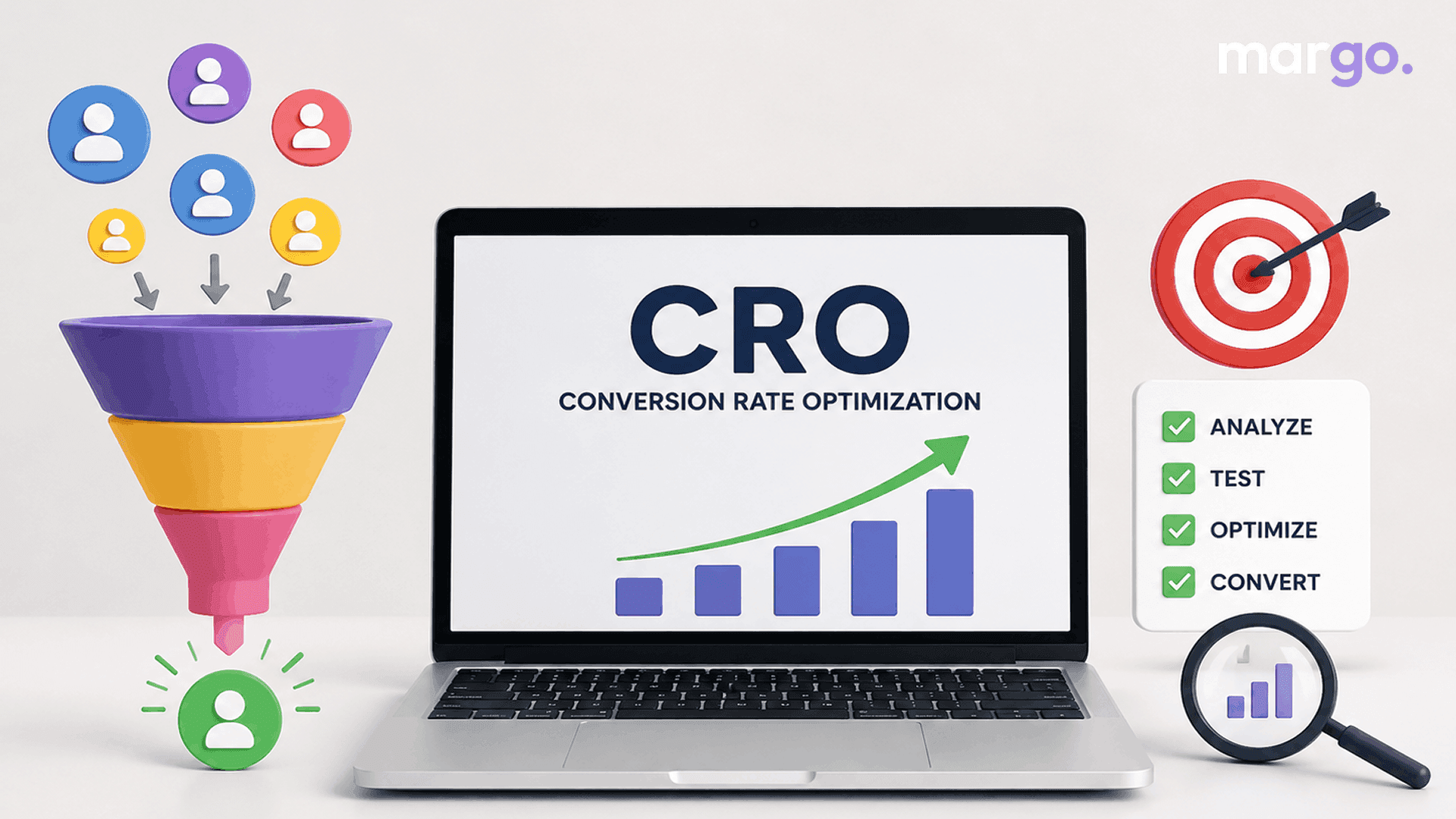
Driving traffic to your website is just half of the battle. If visitors arrive at your site and leave without signing up, purchasing, or taking any serious action, that traffic isn't doing a whole lot for your business. That's where conversion rate optimization kicks in. In this guide, we'll explain what CRO means, how the process works, the tools and experts involved, and the benefits of CRO for businesses trying to get more value out of the traffic they already have.
What is CRO?
So what is CRO actually? CRO is easy to understand: conversion rate optimization is the practice of getting more of your website visitors to do what you want them to do, whether that's buying something, filling out a form, signing up for a newsletter or starting a free trial. Conversion optimization is about getting more out of the visitors you already have, rather than just getting more traffic.
Your conversion rate is calculated by taking the number of conversions and dividing it by the total number of visitors and then multiplying by 100. Say you get 1,000 visitors to your site and 30 of those visitors buy something – your conversion rate is 3%. CRO is the continuous process of improving that number thru research, testing and iteration.
Why Is CRO Digital Marketing Important
The logic here is simple: in CRO digital marketing it's often cheaper to convert more of your existing traffic than go out and find new visitors from scratch. Paid ads, SEO and content marketing all take time and budget to get people to your site – CRO makes sure that investment isn't wasted once they get there.
Sometimes little improvements add up to big improvement. That's not a huge increase in a conversion rate, 2% to 3%, but it's a 50% increase in conversions, from the same amount of traffic. That's why conversion rate optimization is a key digital marketing discipline, not a one-off project.
The CRO Process
A structured CRO process follows various stages starting from research to testing and implementation:
- 1.You need to use analytics tools, heatmaps, session recordings, and user feedback to understand how visitors actually behave on your site.
- 2.Look for ages with high bounce rates, confusing navigation, slow load times or any unclear calls to action.
- 3.Test the change Run an A/B or a multivariate test showing the original and the variation to different segments of traffic.
- 4.Was the difference in change significant by statistical tests?
- 5.Roll out successful changes and move on to the next hypothesis.
This cycle never really ends. Conversion optimization isn't a one-and-done redesign, it's a process, because the behavior of visitors, the competition, and expectations all continue to change over time.
Conversion Rate Optimization Tools
A wide range of conversion rate optimization tools support each stage of this process.
- Use Analytics platforms (like Google Analytics) to monitor visitor behavior and conversion funnels.
- Use heatmap and session recording tools (like Hotjar or Crazy Egg) to see where users are clicking, scrolling and dropping off.
- Tools like Optimizely and VWO offer A/B testing for controlled experiments with different versions of a web page.
- Survey & Feedback tools provide you with direct feedback from visitors about their experience on your website.
- Multi-step forms or checkouts often have form analysis tools you can use to see where users are dropping off.
You'll want to choose tools that are appropriate for the level of traffic your site gets, the technical resources you have, and what you're trying to do. A high-traffic e-commerce site will typically need more robust testing infrastructure than a smaller service-based business.
CRO for E-Commerce
Conversion rate optimisation ecommerce work often focuses on the purchase journey specifically — product pages, cart, and checkout. Because e-commerce sites usually have clear, trackable conversion events (a completed purchase), they tend to be well-suited to rigorous testing.
Some of the common areas of focus includes:
- Simplifying checkout to help reduce the number of steps as well as required fields
- Improving product page content, including images, reviews, and clear pricing
- Reducing unexpected costs (like shipping fees) that surprise buyers late in checkout
- Adding trust signals such as security badges, return policies, and customer reviews
- Optimizing for mobile, since a large share of online shopping now happens on phones
Even minor friction points in the e-commerce checkout process, such as an additional form field or a perplexing shipping calculator, can significantly impact cart abandonment rates.
Working with a CRO Expert or Experts
If you want to take a more hands-on approach from a business perspective, hiring a conversion rate optimization specialist or working with conversion rate optimization experts can speed up results. The typical committed professional will be experienced in testing methodology, statistical significance and behavioral psychology. This expertise helps prevent common errors, such as concluding tests prematurely or making inferences from an insufficient sample size.
Depending on the size of your business and your budget this could be an in-house specialist that you employ or a consultant or an agency that offers CRO services as well as other digital marketing services. For smaller companies, a few hours of expert advice on how to set up your first tests can be valuable before scaling the effort internally.
Creating a CRO Strategy
If your CRO strategy is successful, it doesn't start with random tests. It starts with prioritization. Most websites have limited testing bandwidth, so it's best to focus on the pages with the most traffic and biggest potential impact on revenue, such as landing pages, product pages, or checkout flows.
A simple way to prioritize tests takes three things into account: impact (how much this change could move the needle), confidence (how good is the evidence for this hypothesis) and ease of implementation (how much effort it would take). Testing ideas that score well across all three tend to deliver the best return on effort.
Benefits of CRO
The benefits of CRO extend beyond a higher percentage on a dashboard. A well-run CRO program can:
- Lower customer acquisition costs by getting more value from existing traffic
- Improve user experience, since many CRO changes also make a site easier and more pleasant to use
- Increase revenue without requiring additional ad spend
- Provide ongoing insights into customer behavior and preferences
- Reduce guesswork in decision-making by relying on tested data rather than assumptions
Getting Started With CRO
If you are new to CRO begin by identifying your primary conversion goal and specific page where highest number of visitors leave the site. Use free or low cost analytics tools to get insights into user behavior before investing in any advanced software. Do some tests, document what you find and use the information to guide future efforts.
Final Thoughts
Conversion rate optimization (CRO) is not just a tactic, it is a continuous discipline that includes research, testing and continuous improvement. If you have a content site, a SaaS product or an online store, a well-planned CRO process can help you to get the most out of the traffic you already have, without always having to find more.
Frequently Asked Questions
Conversion rates vary widely by industry and traffic source, but many websites have conversion rates of 2-5%. In general, it’s more useful to track your own rate over time, rather than chasing an industry benchmark, and then work on improving it all the time.
Most tests require at least 1-2 full business cycles (often 2-4 weeks), and enough traffic to reach statistical significance. If you stop a test too soon, regardless of whether one version is winning, you often get unreliable results.
A/B testing is more effective with a good volume of traffic. Low traffic pages take longer to get meaningful results. Even smaller sites can get value out of CRO with qualitative research such as heatmaps, session recording and user feedback before they do formal testing.
SEO is about getting your site found in searches so you can get more visitors, CRO is about turning the visitors you get into customers or leads. The two are a good match. SEO brings you traffic, CRO ensures that traffic converts.
Many companies have started CRO in-house, with free analytics and heatmap tools, before hiring outside help. A conversion rate optimization specialist or agency gets more value if you have enough traffic to test at scale, or need help with testing methodology and statistical rigor.