A tooth cracks on a Sunday night. The patient searches "dentist near me", taps the first practice with good reviews and calls. If that practice wasn't yours, you never learn the patient existed. SEO for dentists is how a practice earns that spot. This guide is for practice owners and office managers who handle their own marketing, or who want to question the agency that does. You'll get the local ranking basics, a task list, a seven-step start plan, and straight answers on cost, timing and reviews.
What Is SEO for Dentists?
SEO for dentists is the work of making a dental practice easy to find in Google Search and Maps when people look for care nearby. It covers your Google Business Profile, your website pages, your reviews and the accuracy of your practice details across the web. The bulk of it is local SEO, because patients pick by distance, hours and reputation. It doesn't buy ads or promise a position. It improves how well Google can match your practice to a search.
For the wider basics, see Margo's guide to what local SEO is.
Why Does SEO Matter for a Dental Practice?
SEO matters because dental care is a repeat purchase and patients choose a practice when they need one. The CDC's early release from the 2025 National Health Interview Survey puts the share of US adults with a dental exam or cleaning in the past year at 66.7%.
That's a large pool of people who already know they need a dentist and are looking for a new one when they move, change insurance or get a toothache.
Example: A Tampa practice has five-star reviews but lists last year's hours. An emergency searcher calls at 7 a.m., gets no answer and moves down the list.
How Does Google Decide Which Dentist to Show?
Google says local results are mainly based on relevance, distance and prominence. Google's Business Profile Help defines each one, and a practice can work on all three.
Relevance is how well your profile matches what someone searched for. Distance is how far you are from the person searching. Prominence is how well known you are, which Google says draws on how many websites link to you and how many reviews you have.
You can't change distance. You can fix the other two, and the fixes cost time more than money.
A practice with the right treatment pages and a steady flow of honest reviews can outrank a closer rival that has neglected both.
Which SEO Tasks Matter Most for a Dental Practice?
Four tasks carry the weight, and each one maps to a signal Google describes. The table shows what to do and why it counts.
| Task | What to do | Signal |
|---|---|---|
| Business Profile | Fill every field | Relevance |
| Service pages | One page per treatment | Relevance |
| Reviews | Ask every patient, reply to all | Prominence |
| Practice details | Same name, phone, hours everywhere | Accuracy |
Google says businesses with complete and accurate information are more likely to show up in local results. Start with the profile, since it's free and quick, then move to pages and reviews.
How Do You Rank a Dental Practice Step by Step?
Doing SEO for a dental practice takes seven steps, and the first three need no developer. Margo's walkthrough on listing your business on Google Business Profile covers the first step in detail.
- 1.Claim and verify your Business Profile for each location.
- 2.Use the practice's real-world name, with no extra keywords.
- 3.Choose your categories and add the services you offer.
- 4.Write a page for each treatment you want to be known for.
- 5.Make your name, phone and hours match on every listing.
- 6.Ask each patient for a review, and reply to every one.
- 7.Check calls, direction requests and new patients every month.
Keep a simple log of what you changed and when, so you can link results to actions.
How Should Your Dental Website and Reviews Support SEO?
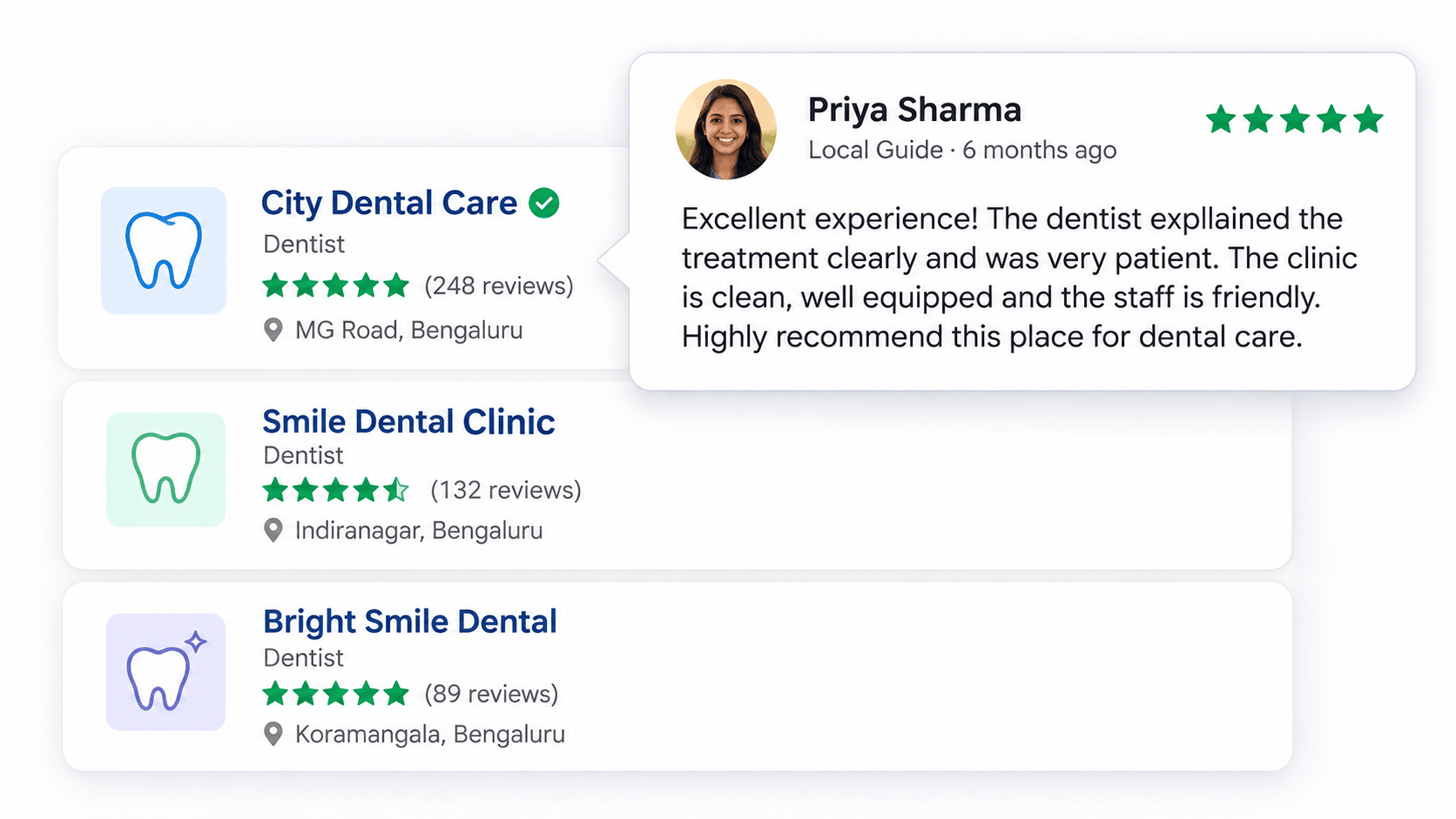
Your website should show real expertise from a named dentist, because Google says its systems give even more weight to strong E-E-A-T on health topics. Put the dentist's name and credentials on treatment pages, and use the most specific local business markup type available, such as Dentist.
Reviews need care. The FTC's reviews rule took effect on October 21, 2024, and it bars compensation or incentives tied to reviews expressing a particular sentiment. The FTC's guidance adds that courts can impose civil penalties for knowing violations.
Ask everyone, offer nothing, and reply without confirming the reviewer is a patient. Check reply wording with your compliance lead.
How Much Does SEO for Dentists Cost and How Long Does It Take?
No neutral US price list exists for dental SEO, so price it against patient value instead of against a rate card. Google also says no one can guarantee a number one ranking, so treat any promised position as a warning sign.
Example (assumed figures, not a price list): A practice pays $1,500 a month for SEO and values a new patient at $1,200 over the first year. It needs two extra patients a month to cover the fee, since one patient brings in only $1,200.
Rule of thumb: judge results after a few months, not a few weeks. Track calls, bookings and new patients, not rankings alone.
What Mistakes and Challenges Should You Expect?
The usual problems are messy profiles, thin pages and shortcuts on reviews. Each is easy to avoid once you know it.
- Keywords stuffed into the practice name
- Separate profiles for each specialty, which Google says a practitioner shouldn't have
- The same service text copied onto every location page
- Reviews bought or traded for discounts
- Hours that stop being true
Multiple dentists at one address need care. Google says the organization gets its own profile, and each practitioner's profile carries only that dentist's name.
Common Mistake: Naming the profile "Best Dentist Dallas | Implants | Cheap". Google asks for the real-world name your signage and website use.
What Dental SEO Trends Matter in 2026?
Google ran three core updates in the last year: one starting 11 December 2025 that took 18 days, one on 27 March 2026 that took 12 days, and one on 21 May 2026 that took 11 days. Rankings can shift during those windows, so don't redesign a site in the middle of one.
Paid local results are changing too. Google's help pages list dentists among the categories for Local Services Ads, and Google is migrating those ads into Google Ads as Performance Max campaigns with pay-per-lead goals, starting with select home services in August 2026. Check which phase your category falls into before you plan a budget.
What Should You Do Next?
SEO for dentists comes down to a complete Google Business Profile, clear treatment pages, honest reviews and details that match everywhere. Fix your profile this week, then write one treatment page a month and ask every patient for a review at checkout. If you'd like a team to run it, Margo Digitech's local SEO services can audit your profile and pages, then plan the first ninety days with you so each task has an owner and a date.
Frequently Asked Questions
Complete and verify your Google Business Profile, build a page for each treatment, collect honest reviews and keep your name, phone and hours identical everywhere. Google says local results rest on relevance, distance and prominence, so work on the two you control and let proximity do the rest.
Dental SEO is the set of tasks that help a dental practice show up when people search for care nearby. It includes the Business Profile, treatment pages, reviews and consistent practice details. It's the same as SEO for dentists, with a focus on local results in Google Search and Maps.
Costs vary by market, number of locations and scope, and no neutral price list exists. Work from patient value instead. If a new patient is worth $1,200 in the first year, a $1,500 monthly fee needs two extra patients a month to break even. Ask any provider to show that math.
Allow a few months before judging results, and longer in a crowded city. Google doesn't publish a timeline, and it says no one can guarantee a number one ranking. Track calls, direction requests and new patients each month so you can see progress before rankings move.
SEO is worth it when your profile is complete, your pages are useful and you track new patients from it. The CDC's 2025 early release says 66.7% of US adults had a dental exam or cleaning in the past year, so the demand is there. Results depend on competition and on your follow-through.