
A small team cannot reply to every lead within minutes, adjust ad bids all day and write a week of posts. Software can take over the repeating parts of that work. AI marketing automation is that software, and it works well only with clear rules and human review. This guide is for Indian business owners and marketers who want to automate without losing control. It explains which tasks suit automation, a step-by-step way to start, how to measure the result, and the Indian rules on consent and AI labels.
What is AI marketing automation?
AI marketing automation is the use of software that follows rules and uses artificial intelligence to run marketing tasks, such as sending follow-ups, setting ad bids, scoring leads and drafting content. Plain automation repeats steps you define in advance. AI adds prediction and generation, so the software can choose a bid, rank a lead or write a draft. A person still sets the goal, approves what goes public and checks the results. The aim is fewer repetitive tasks and the same level of judgement.
Google's own Smart Bidding is an example, because its machine learning predicts how different bids might affect conversions. Our marketing automation guide covers the rule-based basics.
Why does automation matter for Indian businesses?
Automation matters because small businesses fund a large share of India's digital ads, and customers now expect quick, helpful replies.
The small-business share of digital advertising at ₹363 billion, about 38% of the total. IAMAI says 44% of Indian internet users already use AI-enabled features such as voice search and chatbots.
Example: a Surat saree seller gets dozens of WhatsApp enquiries after a festival post and answers the last ones next morning. An automated first reply with a catalogue link keeps each enquiry warm until the owner takes over. Slow replies can lose a lead to a faster competitor, and a small team cannot staff every channel around the clock.
How does AI marketing automation work?
AI marketing automation works as a loop of trigger, data, decision, action and review, and a person owns the last step.
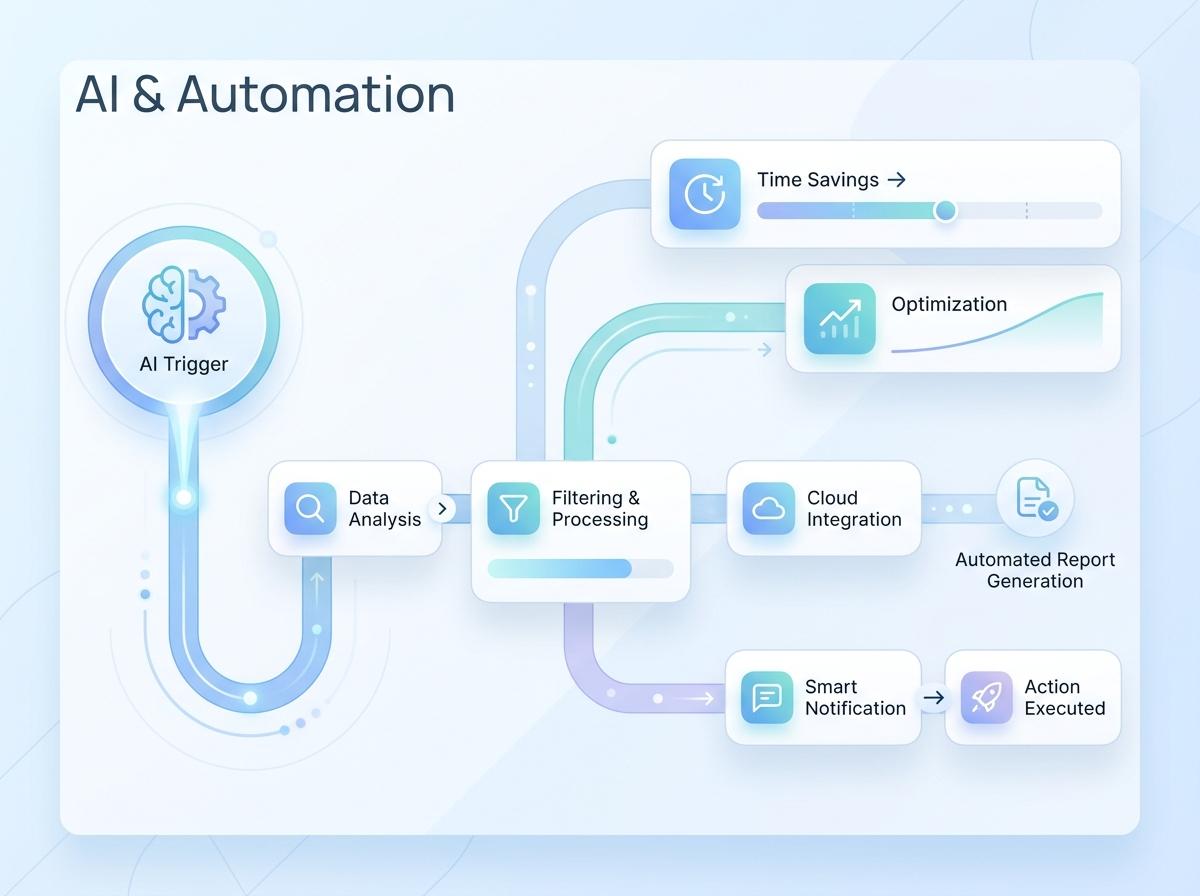
A trigger starts the loop, such as a form fill or a missed call. The software reads the data it holds about that person, makes a decision, such as scoring the lead, and takes an action, such as sending a message or placing a bid. You then review what happened.
Google says Smart Bidding trains machine learning on data at a vast scale to predict how bids affect conversions. The prediction is useful, but you still choose the goal it chases and the budget it may spend.
Which marketing tasks can AI automate?
Five marketing tasks suit automation today, and each one needs a person to check a different thing.
| Task | What the software does | What a person checks |
|---|---|---|
| Ad bidding | Adjusts each bid | Goal and budget |
| Lead follow-up | Sends timed messages, scores leads | Wording and consent |
| Content drafts | Writes first drafts and variants | Facts, tone, originality |
| Reporting | Pulls numbers into summaries | That the numbers are right |
| Customer replies | Answers common questions | Cases that need a human |
Customer replies need extra care, because a wrong answer reaches the customer directly. Keep a person on that task until the answers prove reliable.
Start with the task your team repeats every day. Automate one task at a time, so you can see what changed.
How do you start with AI marketing automation step by step?
Seven steps take you from one repeating task to a tested automation.
- 1.Pick one repeating task that costs your team hours each week.
- 2.Write down the steps a person follows today.
- 3.Choose a tool that connects to your website, CRM and messaging.
- 4.Run it on a small slice of leads or one campaign.
- 5.Keep a person in the loop for anything customers will read.
- 6.Compare results with your manual baseline after a month.
- 7.Expand only the parts that beat that baseline.
A baseline is your own result before automation, such as cost per lead or reply time.
What Indian rules and platform policies apply?
Consent rules apply to every automated message, and Google's spam policy applies to AI-written pages.
WhatsApp's business policy says you may contact people only if they gave you their number and opt-in permission to receive messages. India's DPDP Rules, notified on 14 November 2025, require clear consent notices on an 18-month phased timeline.
Google says using generative AI tools to produce many pages without adding value for users may violate its policy on scaled content abuse.
Confirm your exact duties with a legal adviser, and keep a record of when and how each person agreed to hear from you.
How do you measure whether automation works?
Measure automation against your manual baseline, with the same goal and the same period, so the comparison is fair.
Pick two or three numbers, such as cost per lead, reply time and the share of leads that book a call. Check them weekly for the first month. Where possible, automate for half your leads and keep the other half manual for a few weeks.
Give bidding changes time before you judge them. Google Ads reports a conversion on the date of the click, so last week's leads can keep rising this week. Write the result in one line, such as "automated replies cut first-response time and kept cost per lead flat", so the next review starts from facts.
What mistakes and challenges should you expect?
Automation magnifies whatever process it copies, so a process that does not work yet will fail faster once it is automated.
- Automating a broken process, which only makes mistakes faster.
- Publishing AI drafts without a fact check.
- Messaging people who never opted in.
- Generating many thin pages for search.
- Setting no stop rule, such as a daily send limit or a budget cap.
- Leaving a chatbot with no route to a human.
Common Mistake: trusting a draft because it reads well. Google warns that generative models predict a likely sequence of words rather than retrieve facts, and it says to manually fact-check and review AI content before you publish.
Pro Tip: give every automation an owner who reads its output every week.
What AI automation trends matter in 2026?
Three trends shape AI automation in 2026: users already use AI features, platforms must label AI media, and search reports now include AI results.
On 10 February 2026, India amended its IT Rules on synthetically generated information, and PIB says platforms must ensure clear labelling and traceable metadata for permissible AI-generated content. Label the AI images and videos you publish. Voice search and chatbots are already familiar to buyers, so decide which questions software may answer alone and which must reach a person.
Google's documentation says visits from AI Overviews and AI Mode are counted in Search Console's Performance report. Our guide to Google AI Overviews explains how they appear.
What Should You Do Next?
AI marketing automation pays off when one clear task, one baseline and one owner sit behind it. This week, pick the task your team repeats every day, write its steps down, and automate half of it with a person reviewing the output. If you want help choosing the task and building the workflow, our AI digital marketing team can review your funnel and set up a small, measurable pilot. Then compare the result with your manual baseline before you add a second task.
Frequently Asked Questions
Pick one repeating task, write its steps down, and choose a tool that connects to your website, CRM and messaging. Run it on a small slice of leads, keep a person reviewing anything customers will read, and compare results with your manual baseline after a month before you expand it.
Automation repeats steps you define in advance, such as sending a follow-up when a form is filled. AI adds prediction and generation, such as scoring a lead or drafting a message. Together they handle repetitive work, while people set goals, approve public content and check results.
Sources list the seven types differently, and none is an official standard. For marketing, a practical split is more useful: tools that predict, such as bid and lead scoring, tools that generate, such as draft copy and images, and tools that follow rules to act, such as automated follow-ups.
The 30% rule is an informal guideline, not a legal or platform standard. One common version says AI handles about 70% of repetitive work while people keep 30% for judgement and approval. Treat it as a rule of thumb, and make sure a person approves anything customers will see.
Yes. WhatsApp's business policy allows contact only when people have shared their number and agreed, through opt-in permission, to hear from you. India's DPDP Rules also require clear consent notices, so keep a record of when and how each person agreed.
Not by itself, but low-value mass production can. Google says mass-producing pages with AI tools, with nothing useful added, can break its scaled content abuse policy, and it asks for human fact-checking before publishing. Use AI for drafts, then add real expertise.