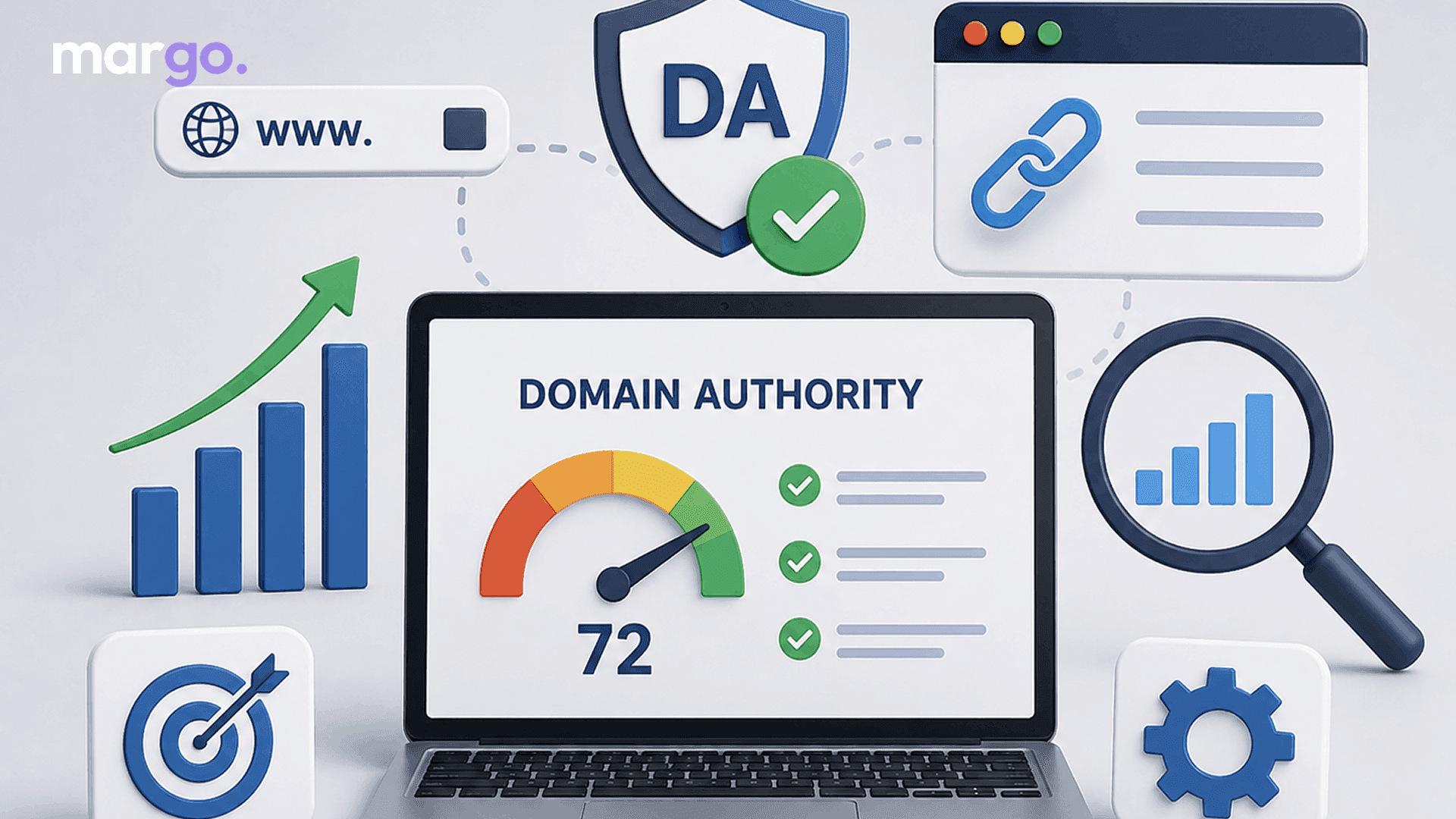
If you've done any sort of research on SEO you've probably come across the term "Domain Authority. It is one of the most quoted metrics in the SEO industry, but many website owners still aren't quite sure what it means or how to use it.
In this guide, we will talk about what domain authority is, how it works and why it is important for the success of any website.
What Is Domain Authority?
So, what is Domain Authority exactly? Domain Authority (DA) is a score developed by Moz that predicts how well a website will rank on search engine result pages (SERP). A Domain Authority score ranges from 1 to 100. The bigger the score, the better the chance to rank.
Domain Authority meaning is often misunderstood – so it's worth mentioning that DA is not a ranking factor that Google uses itself. It's not a direct metric, but it can help marketers and website owners compare the relative strength of different domains when evaluating competitors or link-building opportunities.
Domain Authority in SEO: Why It Matters
Domain Authority in SEO serves as a benchmark. It does not tell you the rank of a keyword, but it does give you a feel for how authoritative your site is compared to other sites. Usually, a website with DA more than 60 is more authoritative and has a better chance of ranking than a website with DA of 20.
So, Domain Authority is a useful tool for:
- Evaluating the SEO progress of a website.
- Comparison of the site with various competitors.
- Checking potential backlink or guest posting opportunities.
- Setting realistic SEO goals along with benchmarks.
How Domain Authority Works
To understand how domain authority works, you need to look at the data behind the score. Moz helps calculate DA using a machine learning model which helps analyze dozens of factors like:
- Linking root domains: The number of unique websites linking to your domain.
- Total number of links: How many and how good the backlinks are to your site.
- Link quality: Links from other authoritative, trustworthy sites (which carry more weight than links from low-quality or spammy sites).
- MozRank and MozTrust: Internal Moz metrics that assess the popularity and trustworthiness of linking domains.
It compares those signals across millions of websites and makes a score on a logarithmic scale. The higher you go, the more difficult it is to improve your Domain Authority score – it's much easier to jump from 20 to 30 than it is to climb from 70 to 80.
Note also that DA is a relative metric. Moz makes periodic updates to the underlying algorithm and periodic changes to the algorithm. So even if nothing on your site has changed, your score may change slightly because the web landscape in general has changed.
How to Check Domain Authority?
Want to know how to check Domain Authority for your site or a competitor's? Here are a few common approaches:
- Moz Link Explorer: Moz's own free tool can help you check the DA of any website directly.
- Domain Authority checker extension: There are different extensions for the browser, like MozBar, which allows you to see DA scores in your search results as you browse. So, competitive research becomes quick and easy.
- Third-party Domain Authority checker tools: There are different SEO tools available. Some of the common ones are Ahrefs, SEMrush, and Ubersuggest. They work much the same way as DA and can be used along with it to give you a better overall picture.
As your SEO strategy develops, it's a good idea to use a Domain Authority checker on a regular basis to see your progress and to discover link-building opportunities.
Significance of Domain Authority
Domain Authority is a quick, digestible way to understand how competitive your website is. While not a direct Google ranking factor, it correlates strongly with the types of signals (such as backlink profile and site trustworthiness) that are.
Domain authority helps provide a practical way for marketers as well as businesses:
- Benchmark SEO performance against different competitors.
- Prioritize which websites can be pursued for backlinks.
- Communicate the progress of SEO to clients or even stakeholders, but in simpler terms.
- Find out weak points in the off-page SEO strategy of a website.
How to Improve Domain Authority?
If you are looking to improve domain authority, concentrate on different strategies which enhance your backlink profile and site trustworthiness; then here is what you can do:
- Get proper backlinks: Instead of chasing numbers, work on getting links from different authoritative and relevant sites.
- Create link-worthy content: Write original research, in-depth guides or data-driven content which helps bring in earnings organically.
- Fix broken links as well as technical issues: A clean and well-organized site helps to improve crawling as well as indexing.
- Build links internally: The process of smart linking between your own pages helps improve authority across your site.
- Detect Bad Backlinks and Remove Them: Look for bad backlinks which could be spammy and then remove them immediately.
- Be patient and consistent: Domain authority takes time to build, so make sure that you are consistent over months.
Final Thoughts
Domain authority is an important metric which helps website owners as well as marketers to measure the strength of SEO along with its competitiveness. Though it does not help measure Google ranking, understanding what it is and how to improve can always help make smarter and better SEO decisions. With the help of quality backlinks, compeling content and maintaining proper site structure, it is possible to increase Domain Authority score over time and boost the overall visibility in search results.