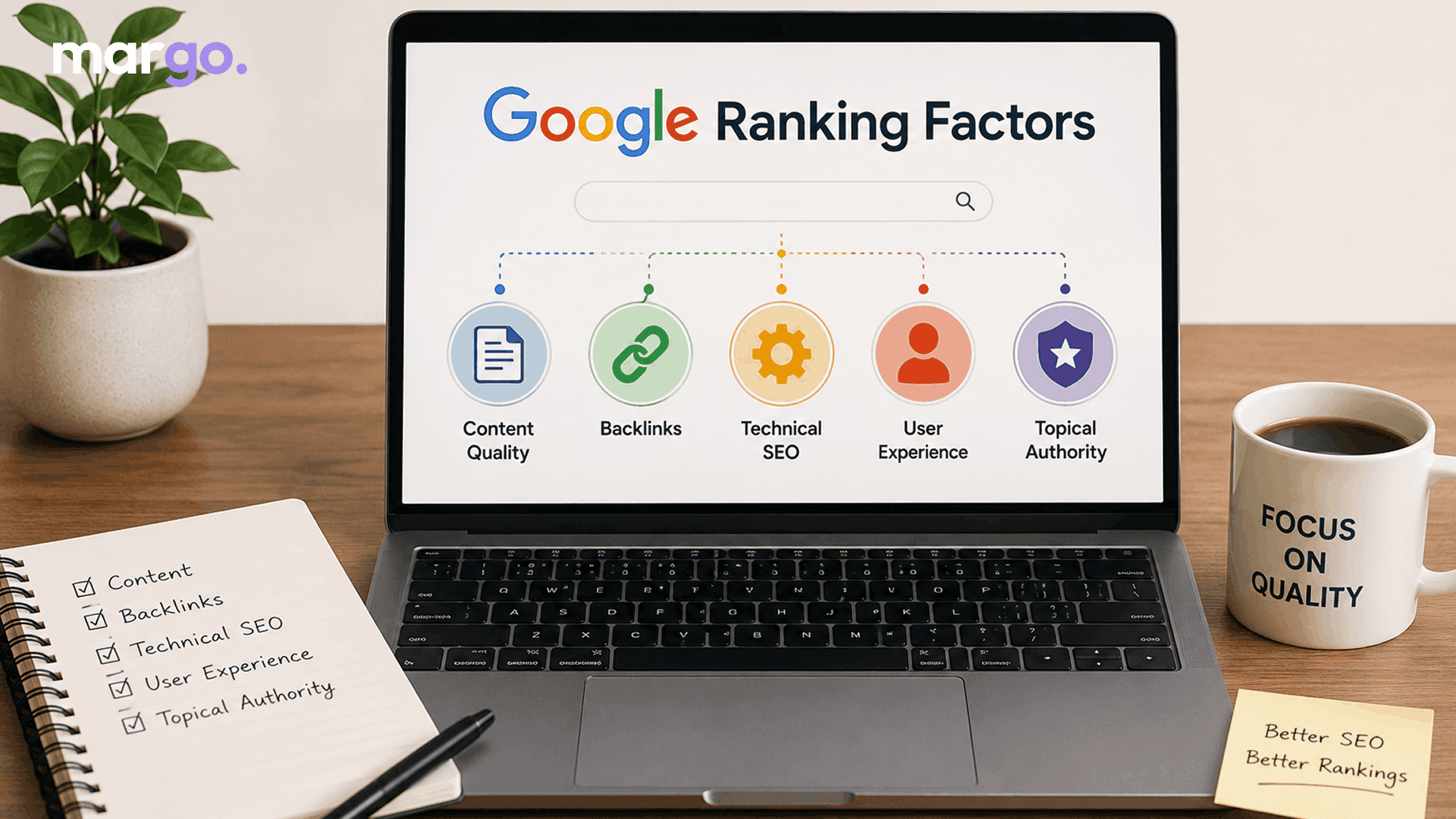
There are ranking factors that explain why some websites always show up on the first page of Google, while others have a hard time getting noticed. When someone types in a search query, Google's algorithm figures out which pages should be at the top of the results list. These are called ranking factors. How does Google's ranking system work in 2026? This guide will explain these factors in detail, along with the best ways to improve your own website's ranking.
What Are Google Ranking Factors?
A Google ranking factor is any signal that the search engine uses to figure out how relevant, good, and trustworthy a webpage is. These cues help Google figure out which pages should rank higher than others because they best answer a user's search query.
That Google's algorithm takes into account more than 200 factors is well known. Even tho 200 seems like a lot, you don't have to know all of them to be successful. Google is still the most popular way for people to visit websites, which is why where you rank in search results has such a direct effect on how many people visit your site. It's much more effective to focus on the most important fundamentals than to chase every small signal.
How Google's Ranking System Works
Google's ranking system isn't just one formula; it's made up of several steps. The first step is usually to find a set of pages that meet the basic relevance criteria for a query: they include the right words, entities, and topics. Deeper systems then re-rank those pages based on quality, link authority, new content, and the overall page experience. Before the final results are shown, spam-detection and helpful-content systems remove or demote low-value pages.
In 2026, ranking analysis isn't just about checking boxes; it's also about knowing how different systems work together. One change to an algorithm can change how different signals are weighted. Because of this, SEO strategies shouldn't stick to a set list.
The Most Important Google Ranking Factors in 2026
Google has more than 200 ranking factors that cover everything from technical details to how people use the site. However, only a few of them are always the most important.
1. Content Quality and Search Intent
Google's ranking system is still based on content. Google wants to give searchers the best, most useful answer to their question. This means that your content needs to match not only the keywords they used, but also the reason they were searching. When someone searches for a local service, they should see a page that looks and acts like a local business page, not a random blog post. A page about prices should list real prices.
2. Backlinks
Backlinks are still acting as votes of confidence from other websites. It's much more important that the sites that link to you are good and relevant than how many links they have. One of the most reliable SEO best practices for building long-term ranking strength is still getting backlinks from authoritative, topically relevant sources.
3. Technical SEO
In technical SEO, factors like site speed, mobile-friendliness, and crawlability are important and should be part of any successful SEO strategy. Even if your site has great content, it won't rank well if search engines can't easily crawl and load it.
4. E-E-A-T (Experience, Expertise, Authoritativeness, Trustworthiness)
Google is still checking whether a website really shows it knows what it's talking about. When it comes to competitive or sensitive topics like health, finance, and law, sites that build real authority and trust tend to do better.
5. User Experience and Engagement Signals
Google can tell whether people are actually interested in your content by looking at engagement signals such as click-through rate, time on page, and scroll depth. A clean, easy-to-navigate website that keeps people interested sends good signals that can help it rank higher.
6. Core Web Vitals
Rankings are still based on page experience metrics like loading speed, interactivity, and visual stability. However, these metrics work best when used along with strong content and not instead of it.
7. Topical Authority
Google rewards websites that show consistent depth and authority across a whole topic area more than websites that rank well for a single article. This is usually built up over time with a body of related, well-linked content rather than a single great page.
8. Schema Markup and Structured Data
Structured data helps search engines better understand the context of your content, which can make it more visible in search results, such as rich snippets and other enhanced listings.
The "200 Ranking Factors" Myth
Many SEO guides say that Google uses 200 or more factors to determine how to rank a website. Google doesn't really work like a static list of separate switches. Instead, it uses interconnected systems that look for patterns in quality, relevance, and user experience. Instead of trying to keep track of every signal, it's better to think about the "pillars": intent match, trust, authority, and usability.
SEO Best Practices for 2026
Focus on these best practices to make your site work with the way Google ranks pages right now:
- Focus on search intent instead of keyword density. Know what people really want when they search for a term, and make sure your content directly answers that question.
- Create groups of related, well-linked content instead of single, standalone articles to build real topical authority.
- Spend money on good backlinks. Pay attention to authority and relevance rather than quantity.
- Make sure your site is fast, mobile-friendly, and easy for crawlers to use.
- Be an expert in your field, use reliable sources, and create trust signals like author bios and clear business information.
- Make pages easy to use and navigate to keep people on your site longer and reduce your bounce rate.
- Do not use old methods. Using too many keywords, making your content too long for no reason, and tricking search engines with link schemes are more likely to hurt your rankings than help them.
Final Thoughts
In 2026, Google's ranking factors show that the search engine has become much smarter than just matching keywords. Now, your success depends on showing that your whole website is relevant, trustworthy, and easy to use, not just optimising a few pages at a time. While it may be challenging to keep track of over 200 ranking factors, you can stay competitive in search results by focusing on core pillars such as technical health, E-E-A-T, content quality, and user experience.
Frequently Asked Questions
People say Google has over 200 ranking factors. But these are not specific items on a list that you can toggle on and off one at a time; these are systems that collectively evaluate relevance, quality and user experience.
Backlinks are still important in a competitive market. However, the number of backlinks is much less important than the quality and utility of the sites linking to you.
E-E-A-T stands for Experience, Expertise, Authority and Trustworthiness. Google checks whether a site is actually credible on the topics it covers. This is particularly the case with sites dealing with health, money and the law.
Nothing big. Google is no longer matching on exact keyword frequency, but on meaning and intent. That means keyword stuffing is more likely to hurt rankings than help them. “Don’t focus on keywords but on search intent.