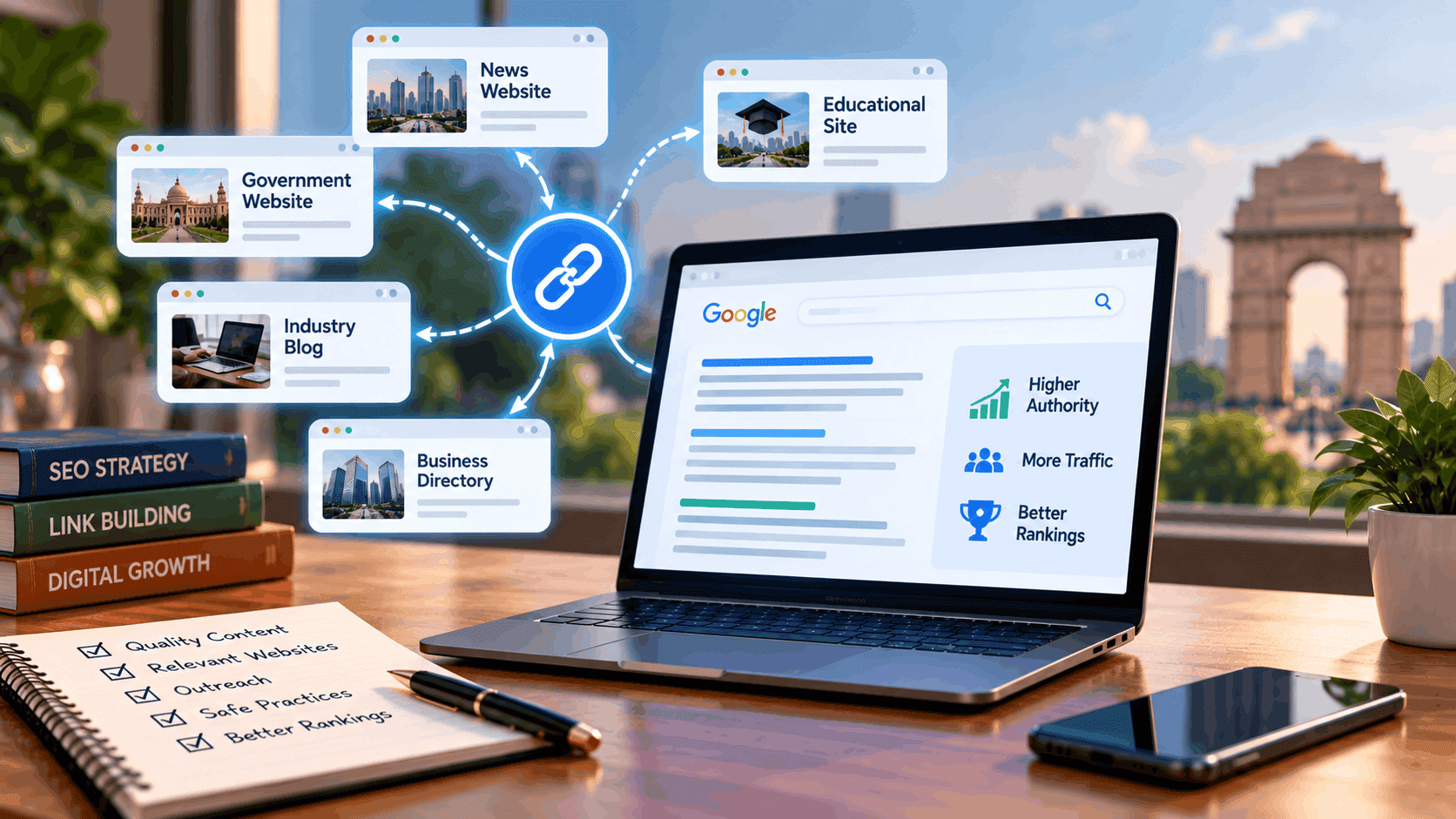
Backlinks are links from other websites to yours, and they're the part of SEO that's easiest to get wrong. Some buy a pack and hope. Others never ask anyone. This guide shows how to create backlinks that Google accepts, with seven steps, an outreach template and the shortcuts that can cost you rankings. It's for small business owners and in-house marketers in India. Facts come from Google's own documents, and any rupee example is marked as assumed. Read it before you pay anyone for links, or before you send your first request.
What Are Backlinks, and What Does It Mean to Create One?
A backlink is a link from another website to a page on your site, and creating one means giving that site a real reason to link to you. Google says it primarily finds pages through links from pages it already crawled. You can't place a safe link by force, since the link has to be the other site's choice. Your job is to publish something worth citing and tell the right people about it. Links arrive slowly, so start early and keep notes.
A link you add to your own listing on a directory is a profile. A link an editor adds to an article is a vote for your page.
Why Do Backlinks Matter for Indian Businesses?
Backlinks matter because Google uses links to understand pages. Its ranking systems guide says it has systems that understand how pages link to each other, to work out what pages are about and which might be most helpful.
The guide also says PageRank, one of its original ranking systems, has evolved a lot and continues to be part of its core ranking systems. Links haven't gone away.
Example: a Pune dental clinic publishes a guide to braces costs, and a local parenting site links to it. Parents who read the site now find the clinic, and Google sees a page that another site chose to cite.
How Does Google Treat Links?
Google reads a link as a pointer to a page, and it uses the visible text of the link to learn what the page is about.
Google's links guidance says it can generally crawl a link only if it's an anchor element with an href attribute. A link built from a button script may not be found.
It also defines anchor text as the visible text of a link, so write it plainly, such as "braces cost guide".
If you were paid in some way for a link, Google says to qualify it with sponsored or nofollow. User-submitted links on forums should carry ugc or nofollow.
Which Backlink Methods Are Safe?
Five methods earn links without breaking Google's spam policies. The ratings below are informal and are not a Google score.
| Method | Effort | Risk |
|---|---|---|
| Local partner pages | Low | Low |
| Original data or guide | High | Low |
| Unlinked mentions | Low | Low |
| Broken-link replacement | Medium | Low |
| Editorial guest article | Medium | Medium |
Local partner pages are the easiest first step for an Indian business: a supplier's where-to-buy page, a trade association's member list or a college's industry-partner page. Each is a real relationship, not a purchased slot.
Begin with the low-effort rows. A guest article carries more risk because Google's link spam examples include paid articles and press releases with optimized anchor text.
How Do You Create Backlinks Step by Step?
You can create backlinks in seven steps, and the first is building a page that deserves a link.
- 1.Publish one useful page, such as a price guide or local data note.
- 2.List sites that already link to similar pages.
- 3.Search for pages that mention you without linking.
- 4.Spot dead links on relevant pages that your page could replace.
- 5.Write each request by hand, a few lines long.
- 6.Give them something to use: a figure, a quote or a photo.
- 7.Record every request and reply in a sheet.
Send a few requests a week so each message stays personal. Reply to every answer within a day.
How Do You Ask for a Link Without Sounding Like Spam?
Ask for a link by naming a specific page, saying why it helps their readers and keeping the request to a few lines.
Example (illustrative email, not a template to paste): "Hi Meena, your guide to saree care links to a page that no longer loads. We have an updated guide with a fabric table, if you'd like a working link to swap in. Happy to answer questions."
Never offer money, discounts or free products in exchange for the link. Google lists exchanging goods or services for links as link spam. Say thanks if they link, and say thanks if they don't. Keep the email under one screen on a phone.
How Do You Track Backlinks, and What Does It Cost?
Track backlinks in the Search Console links report, which lets you see backlinks to your site and the pages that get the most.
No neutral public price list for link building exists, so count your own time. Example (assumed figures, not a price list): a designer and a writer cost ₹8,000 for one data page, and a founder spends two hours a week on outreach.
Margo Digitech's SEO cost guide says to expect first movement in 60 to 90 days. Check the report monthly, and note the date each new link appears.
Skip the disavow tool unless you need it. Google says most sites will not.
What Backlink Mistakes Should You Avoid?
Backlink trouble starts with shortcuts that look cheap and carry a policy risk.
- Buying links. Google lists buying or selling links for ranking purposes as link spam.
- Using automated programs or services to create links.
- Link swaps with every partner you know.
- The same exact-match anchor on every link.
- Chasing a number instead of relevance.
- Buying an expired domain for its old links. Google lists expired domain abuse in its spam policies.
- Hiding a paid post without a sponsored tag.
Common Mistake: treating a bulk link pack as a safe start. Google says sites that violate its policies may rank lower or not appear in results at all.
What Backlink Trends Matter in 2026?
Plan around two 2026 facts: core updates keep rolling out, and AI search needs no special optimization.
On Google's Search Status Dashboard, the March 2026 core update ran 12 days 4 hours and the May 2026 update ran 11 days 21 hours. Don't read your link results while one is rolling out.
After each update, open the links report and see which pages gained or lost links. Keep the pages that earned links current.
Google's AI features page says AI Overviews and AI Mode need no specific optimization, and the usual SEO fundamentals stay worthwhile. Earned links belong on that list.
What Should You Do Next?
To create backlinks safely, publish one page worth citing, ask a handful of relevant sites each week and keep records. Skip anything that sells links. Track what you send in a sheet and review replies every Friday. Start this week with one page and five requests, and give it a quarter before you judge. Margo Digitech's SEO team can plan an outreach routine with you. Our on-page vs off-page SEO guide and internal linking guide cover the pages around it.
Frequently Asked Questions
Build free backlinks by publishing a useful page and asking relevant sites to cite it: local partners, suppliers, associations and publishers who mention you without linking. Replace broken links where your page fits. It costs time, not money, and Google's spam policies rule out paid shortcuts.
Buying backlinks is against Google's spam policies, which list buying or selling links for ranking purposes as link spam. That's a search rule, not a legal opinion. Google says sites that break its policies may rank lower or not appear at all, so a bought link is a poor trade.
Yes, they still count. Google's ranking systems guide says PageRank continues to be part of its core ranking systems, and it has systems that understand how pages link to each other. Earn links through useful pages and local relationships, and check the links report each month.
No fixed number applies. Look at the pages ranking above you for the same search, note who links to them, and aim to earn links from similar relevant sites. As a rule of thumb, a handful of relevant links beats a pile of unrelated ones.
Google calls a nofollow link one you'd rather Google not associate your site with, and it prefers sponsored for paid links and ugc for user-generated ones. A plain link with none of these is the normal editorial kind. Paid or user-submitted links should carry a qualifier.
Margo Digitech's SEO cost guide says to expect initial movement in 60 to 90 days, with stronger traffic from month 4. A new link first has to be found and processed, and rankings depend on more than links. Judge a campaign over months, not days, and compare it with the pages ranking above you.