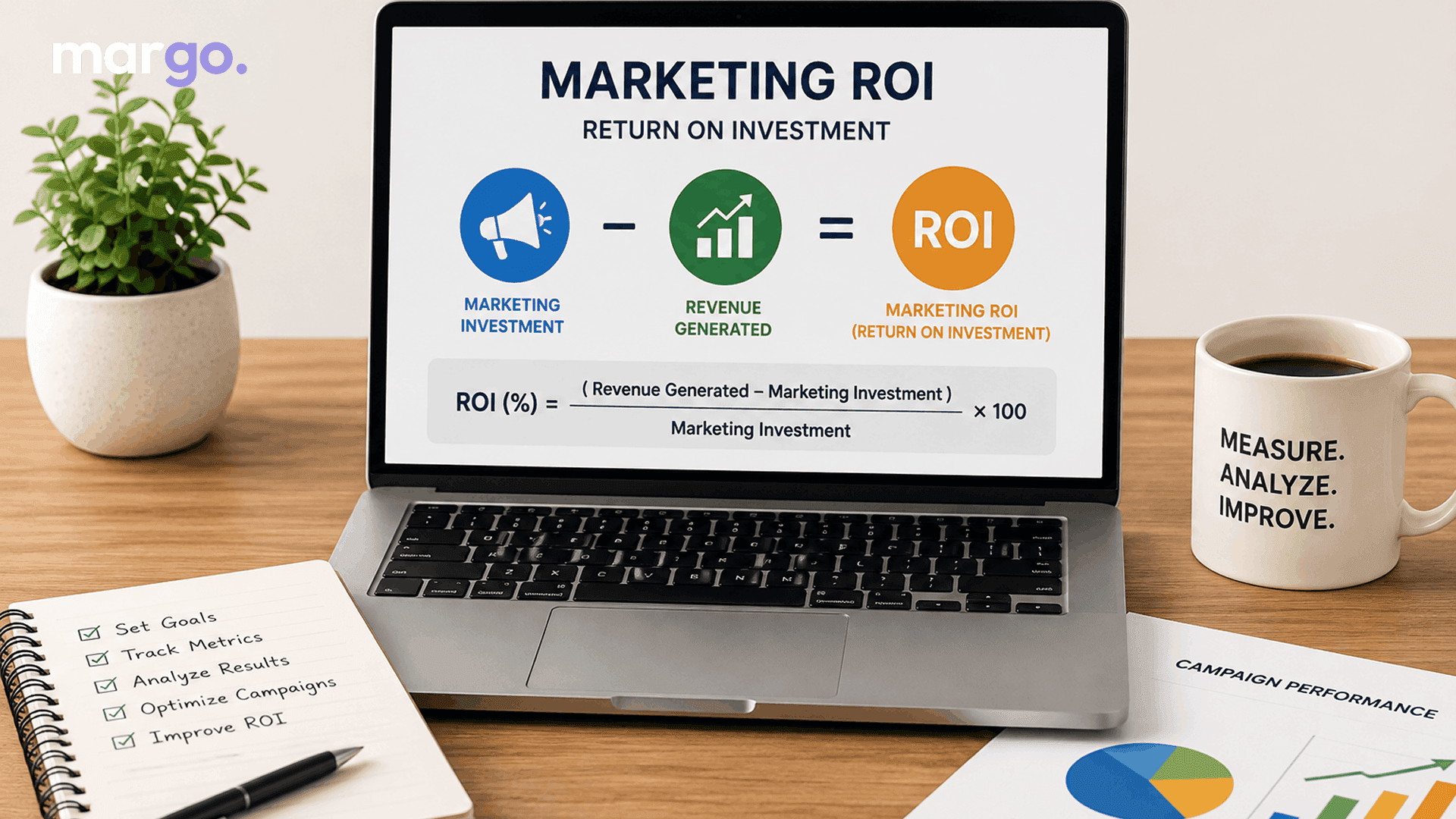
For every dollar you spend on marketing you should see some return, makes sense. But how do you know if your campaigns are working or just wasting money? That's where marketing ROI comes in. What is marketing ROI, how do you calculate it and why is it one of the most important numbers for any business that spends money on marketing.
What Is ROI in Digital Marketing?
ROI stands for Return on Investment in marketing. ROI in digital marketing is a simple way to compare how much money a marketing campaign makes, to how much it costs to run. This answer tells us if this campaign is worth the money we put into it.
Marketing ROI shows you how many sales, leads, sign-ups, or brand growth your ad spend, content, email campaigns, or influencer partnerships are actually translating to money, so you know if they're working for your business.
Why Return on Marketing Investment Matters
You can't just look at the return on marketing investment as a number. It has a direct impact on how companies prioritize, budget and choose channels.
Here's why it matters:
- Budget justification Marketing has to show leaders that spending money is improving things, not just doing things.
- Channels Comparison. You can use ROI to compare the performance of different channels (email, paid search, content marketing, social media, etc.). This means that you can put more money into the ones that are working.
- Choosing your strategy. When you have your ROI, you can choose to scale a campaign, pause it or overhaul the whole strategy.
- Growth over the years. Monitoring ROI on a regular basis allows businesses to make long-term plans for marketing rather than guess what works.
If you don't measure marketing spend against returns, you're just throwing money at marketing without knowing if it's actually working.
How To Measure Your Marketing ROI?
The basic marketing ROI formula is easy to calculate:
ROI = ((Profit – Marketing Cost) / Marketing Cost) x 100
Look at this example of how it works. Say you've started a digital marketing campaign. It cost you $5,000 and generated $20,000 in sales.
$20,000 - $5,000 = $15,000 Earnings - Marketing Cost = $15,000 / $5,000 = 3
300% ROI = 3 x 100
Thus, you got three dollars back for every dollar you spent. This means that if the ROI is positive, the campaign made money; if it is negative, it lost money.
How to Calculate ROI in Sales?
While marketing ROI looks at how well a campaign did, many businesses also want to know how to figure out ROI in sales. So basically, it's the amount of money their sales efforts generate vs how much it costs to run the sales function (salaries, tools, commissions, etc).
Same formula: Sales ROI = (Sales Tax – Sales Price) / (Sales Tax x 100) So you spend $50,000 on your sales team for three months and they bring in $200,000: $50,000 - $200,000 = $150,000 $150,000 / $50,000 = 3 300% Sales ROI 3 * 100 = Marketing ROI and sales ROI often go hand in hand — particularly in companies with marketing that discovers leads that the sales team nurtures into paying customers.
ROI of a Marketing Campaign: What to Measure
If you want to really get an ROI from a marketing campaign, you need to know exactly what it cost and what it earned.
Check these things out:
Monitoring Costs
- Advertising costs (Google Ads, Facebook Ads and more)
- Costs for content creation: writers, designers, video producers.
- Software and tools (such as CRM, email platforms, and analytics tools)
- Fees or salaries for the team that are tied to the campaign
Returns to Track
- Direct sales that the campaign was responsible for
- Lead generation and the value of those leads as a result
- The customer lifetime value (CLV) of new customers
- When they make sense (though they are harder to measure directly), brand awareness metrics
You can get a better idea of your ROI if you keep track of both sides of this equation very carefully.
ROI Measurement Problems
ROI measurement may sound easy in principle, but it can be difficult to implement in practice. Common problems include:
- Multi-touch affinity. It is often hard to know which touchpoint gets credit, as customers tend to interact with several marketing channels before purchasing.
- Sales are few and far between. B2B sales cycles are long, and it can take months to close after a marketing touchpoint. It can be hard to track ROI in the short term.
- Some marketing is not designed to generate immediate sales. It's harder to link brand-building campaigns directly to sales.
- Data in silos. You can't get a complete picture of ROI when the marketing, sales and finance teams are all working with different systems and tools.
But the right tracking tools, including UTM parameters, CRM integrations, and marketing analytics platforms, can go a long way to improve the accuracy of your ROI measurement.
Tips to Improve Your Marketing ROI
If you're not getting the results you want for the money you're spending on marketing, try these tricks:
- Focus on channels that work: Invest more in the platforms and campaigns that consistently generate significant revenue.
- Refine your targeting: less money wasted, higher conversion rate, better audience segmentation.
- Always test and optimize: A/B testing ad creative, landing pages, and email subject lines can make a huge difference in how they perform over the years.
- Boost your conversion rate optimisation (CRO): Sometimes it's not the traffic that's the problem, but what happens after people visit your site.
- Ensure marketing and sales are aligned and using the same data. This will increase the quality of leads and follow-through.
Concluding Thoughts
ROI in marketing is not only a metric to measure performance, but it is also a decision-making process. You'll see where your budget is working best, and where it isn't. And you'll know how to allocate your future marketing spend more effectively. While you can't always get an exact ROI in digital marketing and sales, particularly with multi-touch customer journeys, tracking and improving your results over time will always put you ahead of guessing. First, make your costs and returns very clear. Then, choose the right tracking tools and track your ROI regularly. This data-driven approach will help you to build smarter, more profitable marketing campaigns over time.
Frequently Asked Questions
ROI stands for “Return on Investment”. In marketing, it is used to compare how much money a campaign made to how much it cost.
To calculate the return on investment, divide the money you made by the cost of marketing and multiply by 100. For example, if you invest $5,000 and make $20,000, you will be making 300% of your investment.
The standard is often a 5:1 ratio, or 400% ROI. So for every $ 1 spent, it brings in $ 5. But what “good” ROI looks like varies by industry, channel and campaign goals, so it’s also a good idea to look at how well you did in the past.
Awareness campaigns are not always instant sales drivers that can be measured. This makes it harder to directly link to a campaign than it is with performance-based campaigns, as the effects happen over time through more trust, recognition and future sales.
Common tools used include: Google Analytics, CRM tools (HubSpot or Salesforce), UTM tracking parameters, marketing attribution software. These link marketing results to real money-making results.