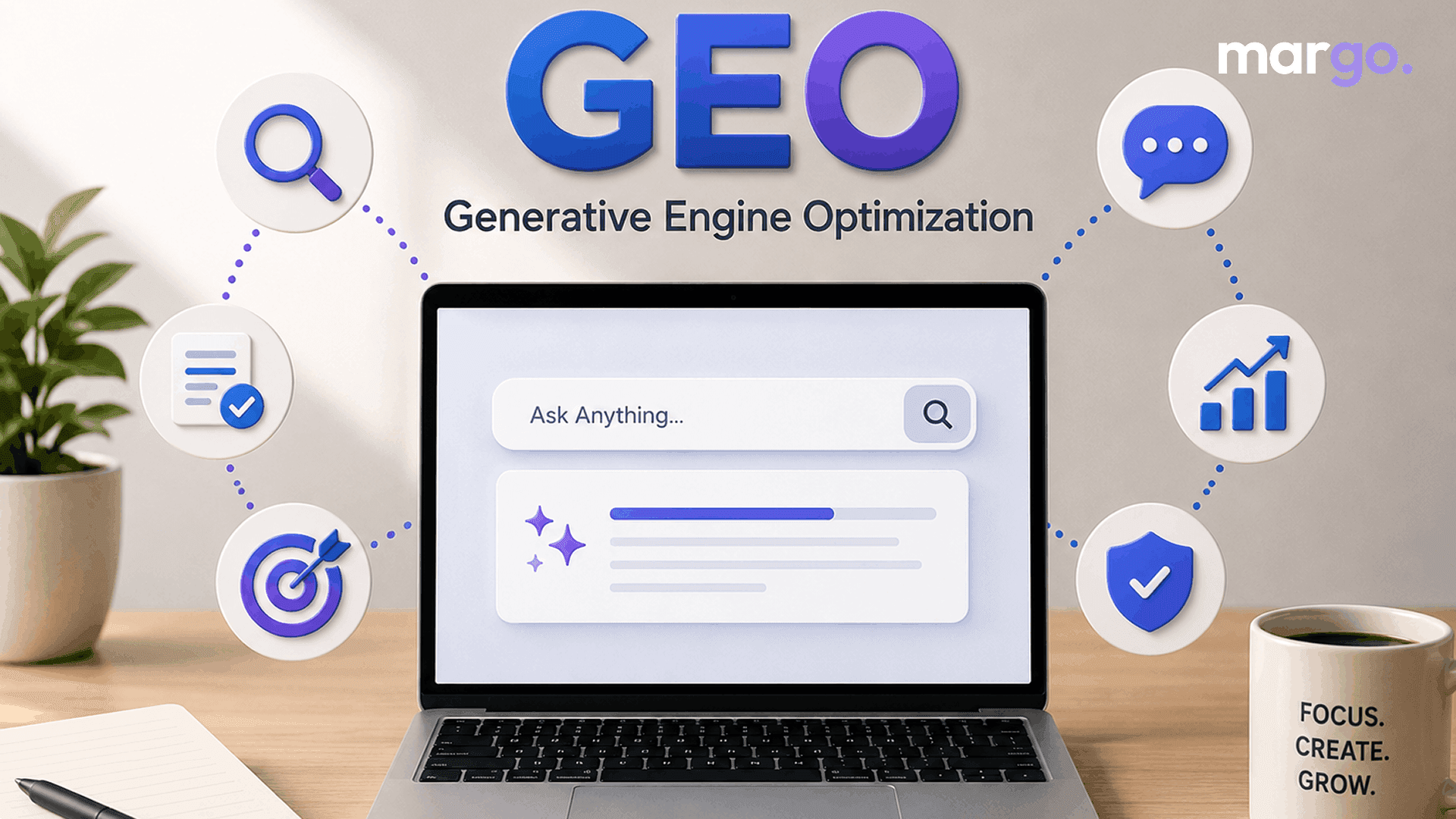
If you've noticed AI-generated summaries showing up above your search results, or chatbots answering questions that used to require a click, you've already encountered the reason Generative Engine Optimization (GEO) exists. As generative AI tools change the way people find information, marketers are changing how they do things to stay visible. GEO is at the center of this change.
GEO Meaning: A Quick Definition
Generative Engine Optimization (GEO) is the practice of optimizing content so that generative AI tools like ChatGPT, Google's AI Overviews, Perplexity and Copilot can find it, cite it or summarize it. GEO optimization is not simply about ranking on a results page, but about being a trusted source that AI models use to generate answers. In short, GEO in digital marketing is about earning visibility inside AI-generated responses, not just next to them.
Why GEO Is Becoming Important
Generative AI tools don't just list links; they combine data from different sources to make a single, natural answer. If your content isn't structured or credible enough to be selected as a source, you become invisible in that response, even if you'd normally rank well through traditional SEO.
This doesn't mean search rankings no longer matter. Ranking well still influences whether a generative engine trusts and crawls your content in the first place. GEO is not a replacement for good SEO. It builds on top of it.
How to Optimize for Generative AI
Wondering how to optimize for generative AI models specifically? The principal techniques are:
1. Answer Clearly and Directly
Generative engines like content that answers a question directly, ideally in the first few sentences. The state of Georgia is not a party to this dispute, and it is well that it is not.
2. Use a structured format
AI models can easily parse and extract information when it is presented as headers, bullet points, numbered steps, and tables.
3. Claims with Credibility Data
Regarding what to put it simply, AI tools tend to favor content that includes statistics, studies or expert sources. That's because it builds the trust signals that the generative models are looking for.
4. Implement Schema Markup
Structured data helps AI crawlers understand the context, entities and relationships inside your content. So it's more likely to be pulled into an AI-generated answer.
5. Establish Topical Authority
If you are an expert in a subject area, you publish regularly in that area. This boosts the chances that generative engines will treat your site as a trusted source.
7. Keep the content fresh and accurate
Generative engines care about current information. Publish new content regularly to grow organic search traffic and be cited by AI.
GEO Best Practices
Here are some actionable GEO best practices that can be applied across entire content.
- Answer the main question within the first 2 sentences.
- Use proper descriptive subheads that mirror the real user questions.
- Include FAQs which are formatted in clear question and answer format.
- Make sure to add quotes, original data and research points whenever possible.
- Optimize for featured snippets, since GEO and snippet content often overlap
- Ensure fast load times and clean technical SEO, since crawlability still matters
- Monitor brand mentions in AI tools, not just search rankings
GEO vs Traditional SEO
It is quite tempting to think of GEO as a replacement for traditional SEO. The truth is that both are quite similar. Traditional SEO focuses on helping rank pages with the help of keywords, backlinks, as well as technical optimization. This, in turn, helps drive organic search traffic. GEO builds on these foundations by adding a layer that looks at structure, clarity, and credibility. These are the things that generative AI models look for when deciding what to cite.
Sites with weak SEO fundamentals rarely perform well in GEO either, since generative engines still depend on crawlable, authoritative, well-ranked content as their source material.
Getting Started with GEO
When planning your content strategy for after 2026, don't think of GEO as a separate project. Instead, think of it as an extension of your SEO strategy. Begin with auditing your top-performing pages, restructuring for clarity and proper answers. Then add structured data where it is possible. Track the search rankings but also how often your brand appears in AI-generated responses.
Frequently Asked Questions
Generative Engine Optimization, or GEO, is the process of making content better so that generative AI tools can find it and use it.
GEO builds on SEO. It is not a replacement. Traditional SEO is primarily about search rankings. But GEO says it is important to be cited in AI-generated responses.
Answer in a direct, factual manner. Use structured presentation (bulleted lists, etc.) to help AI models understand and trust your content. Add Credible Data Schema markup so AI models can understand and trust your content.
Yes, GEO can indirectly help with organic search traffic, as it helps make content more authoritative and clear, which helps with traditional search rankings.
Yes. Traditional SEO is still the base of generative engines’ ability to discover, crawl and trust your content before it can be surfaced in AI-generated answers.