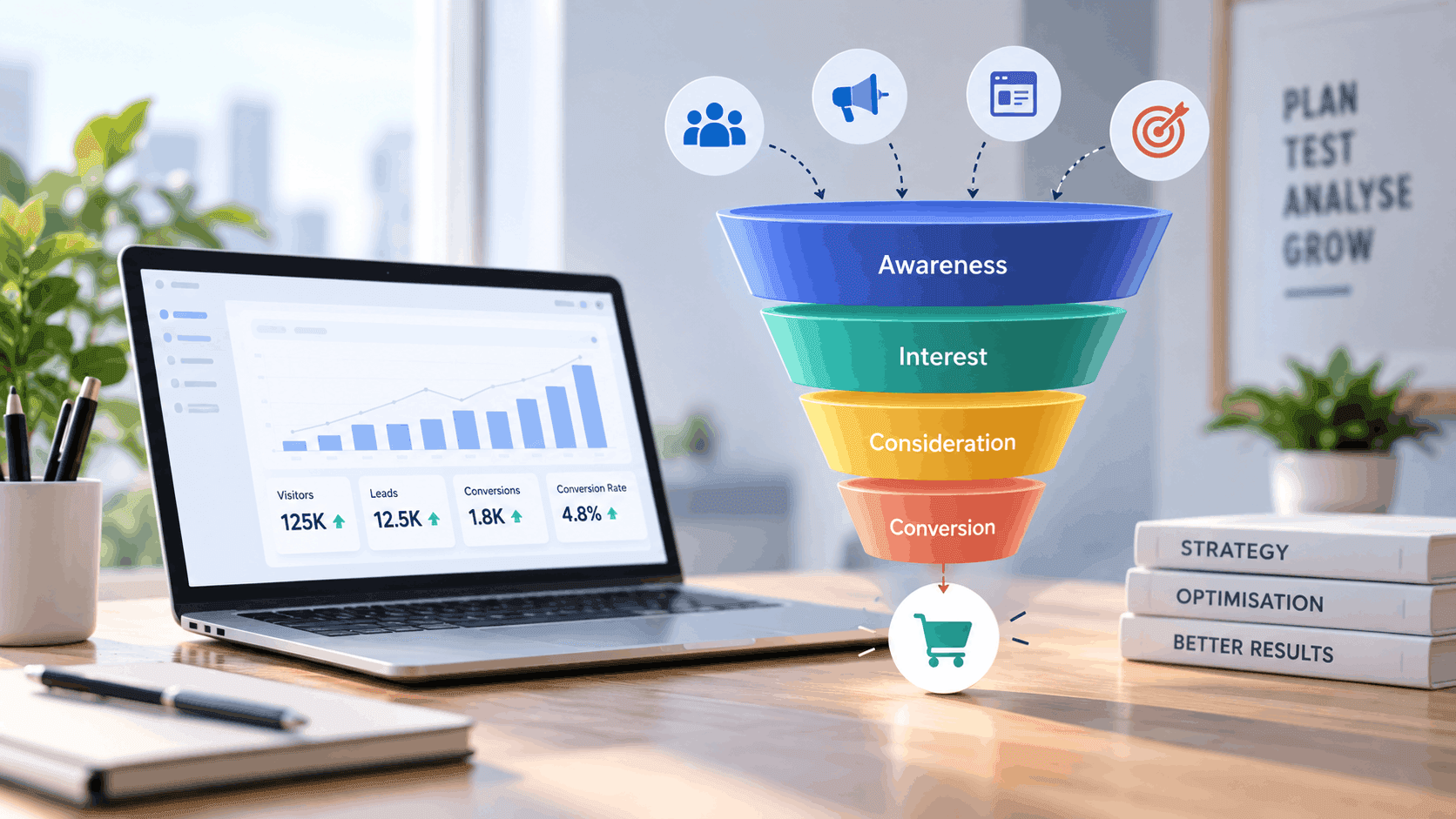
Quick overview
- A conversion funnel maps the path a visitor takes from first noticing your brand to becoming a paying customer.
- Most funnels lose the majority of visitors between the top and the bottom; the fix is finding exactly where and why.
- Optimizing each stage compounds: a small lift in interest, decision, and action stages together produces a much larger lift in total conversions.
What Is a Conversion Funnel?
A conversion funnel is a model that shows the stages a person moves through before they take a desired action on your website, such as buying a product, signing up for a demo, or filling out a lead form. It is called a funnel because the number of people narrows at each stage. Thousands of people might see your ad. Far fewer visit your site. Fewer still convert.
The idea traces back to the AIDA model, a framework marketers have used since the late 1800s to describe how a buyer's attention turns into action. According to Smart Insights, AIDA breaks the buyer's journey into Attention, Interest, Desire, and Action, and most modern marketing funnels are a direct descendant of this structure.
A conversion funnel is not just a diagram for a slide deck. It is a diagnostic tool. Once you map your actual funnel and see where people drop off, you know exactly where to focus your budget and your fixes, instead of guessing.
The Stages of a Conversion Funnel
Most conversion funnels break down into four stages, whether you sell software, run an online store, or generate leads for a service business.
01 Awareness A visitor first learns about your brand through an ad, a search result, social content, or a referral. They do not know you yet; this stage is about getting noticed.
02 Interest The visitor starts researching. They read your blog, compare your product to others, or check your reviews. They are deciding if you are worth their time.
03 Decision The visitor is close to buying. They are comparing pricing pages, reading case studies, or requesting a demo. Small friction here causes big drop-off.
04 Action The visitor completes the target action: a purchase, a signup, a form fill. This is the conversion the rest of the funnel exists to produce.
Conversion Funnel vs. Sales Funnel: What's the Difference?
These two terms get used interchangeably, but they are not identical. A conversion funnel tracks any desired action, including a newsletter signup, an app download, or a free trial, not only a sale. A sales funnel is a subset of the conversion funnel that ends specifically in a purchase, and it usually includes stages a marketing funnel does not track closely, such as the sales call, the proposal, and the closed deal.
In practice, most businesses use "conversion funnel" as the broader marketing term and "sales funnel" once a lead moves into the hands of a sales team. If your business does not have a sales team, such as most direct-to-consumer ecommerce brands, the two terms usually describe the same journey.
What Is an Ecommerce Conversion Funnel?
An ecommerce conversion funnel is the specific version of this model built around an online store. It typically looks like this:
| Funnel stage | What happens | Where people commonly drop off |
|---|---|---|
| Product view | Visitor lands on a product page from search, ads, or social | Slow page load, unclear product images |
| Add to cart | Visitor adds one or more items to their cart | Missing size or variant information |
| Checkout initiation | Visitor begins the checkout process | Forced account creation |
| Purchase | Visitor completes payment and confirms the order | Unexpected shipping costs, limited payment options |
Cart abandonment is the single most expensive leak in an ecommerce funnel. According to Baymard Institute, the average documented cart abandonment rate sits at just over 70 percent, meaning roughly seven out of every ten shoppers who add an item to their cart leave without paying for it. The most commonly cited fixable reasons are extra costs revealed too late in checkout, a checkout process that takes too long, and having to create an account before completing the purchase.
Why Conversion Funnel Optimization Matters
Optimizing a conversion funnel is not just about squeezing out a few more sales. It changes how efficiently your entire marketing budget performs.
01 Improved customer experience Confusing steps and slow pages push people away before they ever reach checkout. Removing that friction is usually the fastest way to make a funnel feel effortless instead of tiring.
02 Targeted marketing Once you know exactly where visitors drop off, your ad spend gets a lot more honest. Channels that were never really converting stop eating budget, and the ones quietly working get more of it.
03 Better ROI Plugging a leak in a funnel you already have almost always costs less than chasing fresh traffic to replace the customers slipping through it.
04 Lead generation Not everyone who reaches the interest or decision stage is ready to buy today. A funnel with clear stages still captures them as leads instead of losing them for good.
05 Increased conversions A one percent gain at a single stage rarely stays a one percent gain overall. Improvements at awareness, interest, decision, and action stack on top of each other, which is why the total lift usually surprises people.
How to Optimize Your Conversion Funnel
01 Map your actual funnel in analytics Turn on funnel visualization inside Google Analytics 4, or whatever analytics tool you already run. You need the real percentage dropping off between each stage, not a guess based on what feels true.
02 Find your biggest leak first Fix the stage bleeding the most visitors before touching anything else. A five percent improvement where you are weakest typically beats a twenty percent improvement on a stage that already performs fine.
03 Run structured A/B tests Change one thing at a time on a landing page, a checkout step, or a lead form, using a platform like VWO or Optimizely. Test several variables together and you will never know which one actually moved the number.
04 Simplify your checkout or signup form Cut every field, click, and forced account creation step that is not doing real work. Each extra box someone has to fill in is one more excuse to leave.
05 Retarget people who drop off mid-funnel Bring back the visitors who reached the decision stage but never converted, through retargeting ads or an abandoned cart email. They already recognize your brand, which makes them far cheaper to win back than someone cold.
06 Personalize the interest and decision stages Show a returning visitor something tied to what they already looked at, a related product or a case study from their industry, rather than the same homepage everyone else sees first.
How to Measure Conversion Funnel Performance
None of this works if you are not measuring it. Here are the numbers worth watching at every stage of the funnel:
| Metric | What it tells you |
|---|---|
| Conversion rate | How many visitors actually complete the action you are tracking, whether that is one stage or the whole journey |
| Drop-off rate | Where people are exiting between two specific stages, usually the fastest way to spot your worst leak |
| Cost per lead (CPL) | What it costs you, on average, to turn one visitor from awareness into a qualified lead |
| Customer acquisition cost (CAC) | Total spend divided by new customers won, the number that tells you if growth is actually profitable |
| Average order value (AOV) | For an ecommerce funnel specifically, what a customer spends on average per completed order |
Track these at a stage level, not just as one overall number. A funnel with a 2 percent overall conversion rate could be losing most of its visitors at a single, fixable stage, or it could be losing them evenly across all four, and each problem needs a completely different fix.
Common Conversion Funnel Mistakes to Avoid
- Optimizing the bottom of the funnel while ignoring a weak top; a great checkout page cannot fix an ad campaign that brings in the wrong audience
- Treating every visitor the same regardless of which stage they are actually in
- Making big design changes without A/B testing, so you cannot tell what actually worked
- Ignoring mobile performance, even though mobile traffic converts at a noticeably lower rate than desktop across most industries
- Never revisiting the funnel after the first optimization pass, even as traffic sources and customer behavior shift over time
Top Tools for Conversion Funnel Optimization
- Google Analytics 4 is the standard starting point for funnel visualization. It shows you the real percentage of visitors moving between each stage you define, at no cost.
- Hotjar or Microsoft Clarity add heatmaps and session recordings, so you can watch exactly where visitors hesitate or give up on a page, not just see that they left.
- VWO or Optimizely run the structured A/B and multivariate tests that turn a hypothesis about your funnel into a confirmed fix.
- HubSpot connects funnel data to your CRM, so you can see which leads actually turn into revenue, not just which ones filled out a form.
Conclusion
A conversion funnel only helps you when you treat it as a working model of your actual traffic, not a theoretical diagram. Map your real stages, find the one leaking the most visitors, and fix that stage before moving to the next. The businesses that grow fastest are not the ones running the most campaigns; they are the ones that know exactly where their funnel breaks and keep closing that gap. That is the work we do with brands every day at Margo Digitech.
Frequently Asked Questions
Awareness, interest, decision, and action. A visitor first becomes aware of your brand, develops interest by researching it, reaches a decision point where they compare options, and finally takes the action the funnel was built around.
There is no single universal number, since it varies heavily by industry and traffic source. According to IRP Commerce, the average all-industry ecommerce conversion rate stood at roughly 2 percent as of mid-2026, so a rate meaningfully above that for your specific category is generally a strong result.
A conversion funnel tracks any desired action, such as a signup or download, while a sales funnel specifically tracks the path to a completed purchase and often includes sales-team stages like a proposal or a closed deal.
Set up stage-by-stage funnel visualization in an analytics tool like Google Analytics 4, then calculate the percentage of visitors lost between each consecutive stage. The stage with the steepest drop is your priority fix.
There is no single best tool; most businesses combine an analytics platform like Google Analytics 4 for visualization, a heatmap tool like Hotjar for behavior insight, and an A/B testing platform like VWO to confirm fixes before rolling them out fully.