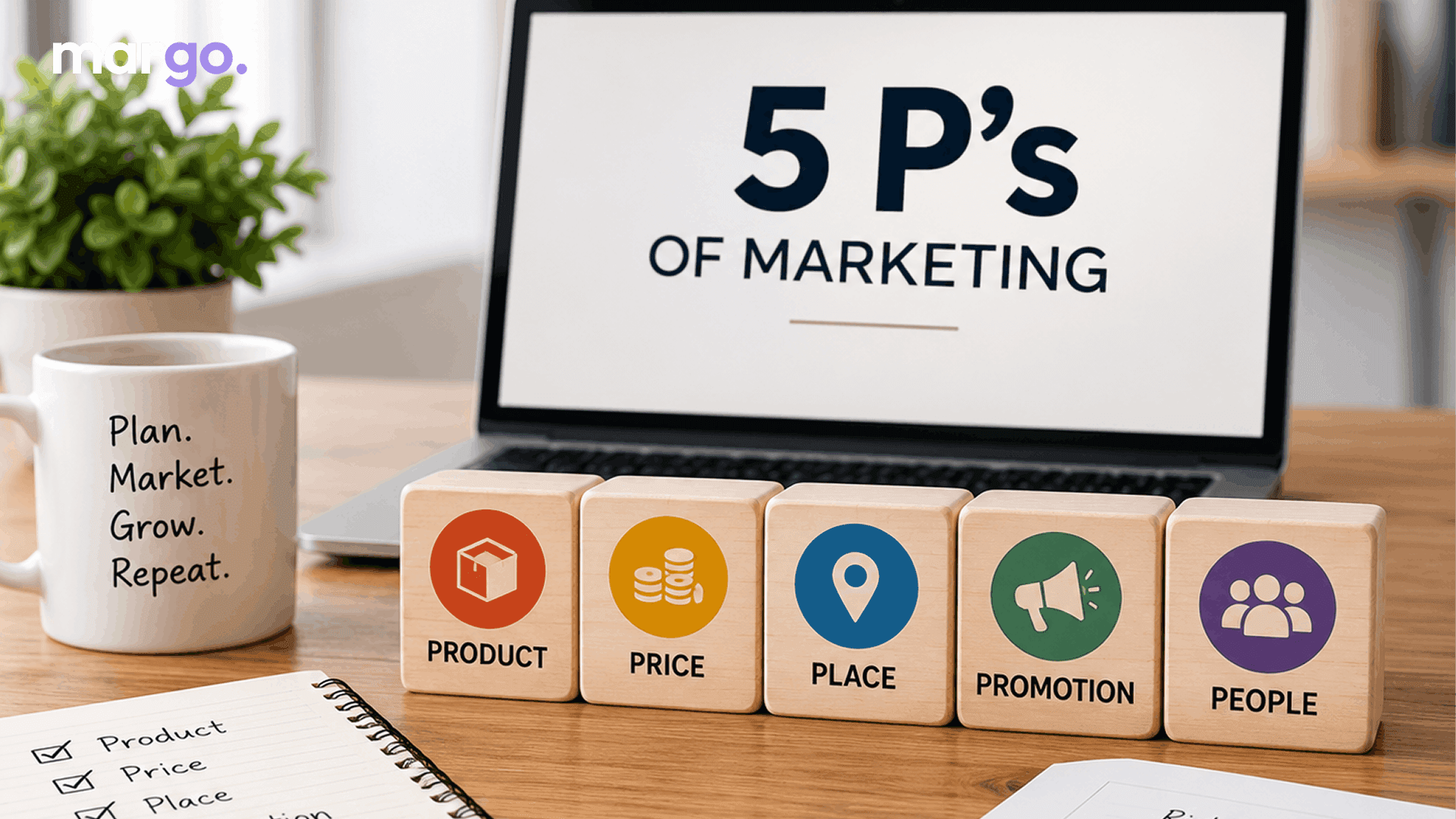
If you are new to business or marketing, you may have heard the term "marketing mix" and been confused as to what it means. The idea is based around the 5 P's of marketing. They are a simple but effective way for businesses to make plans that actually work. If you want to start your own business, study for a marketing test, or just learn how big brands stay ahead, one of the best places to start is with the five P's of marketing.
These 5 P's are still some of the most important marketing ideas taught today. In this guide, we'll break them down, show how they fit into a bigger marketing mix strategy, and explain why they're important.
What Is the 5 P's Marketing Model?
The classic "4 P's" framework (Product, Price, Place, and Promotion) was first used by marketing professor E. Jerome McCarthy in the 1960s. The "5 P's" model builds on that framework. As markets became more focused on people and customer service, a fifth "P" was added to show that every transaction involves a person.
These five things work together to make a list that marketers use to plan, check, and improve how they bring a product or service to market. Let's look at each one.
1. Item
The item is the beginning of all. This is the product, service or answer you'll be giving a customer to solve their problem. When you think of a product, ask yourself:
- What is this item for?
- Just how is it different from other options?
- What qualities, designs, or branding make it stand out?
A product has to work and also live up to customer expectations and deliver real value. If a product doesn't solve a real problem, clever advertising isn't going to help it sell.
2. Cost
Price is what people pay for your product or service. Pricing is more than simply cost recovery, it's a strategic decision on how your people perceive your brand. This price can also be a symbol of exclusivity and luxury while a lower price draws the budget buyers.
Generally, when setting prices businesses consider the following:
- Production and operating costs
- Competitors' prices
- Customer's perceived worth
- Payment options, discounts & bundles
It's often pricing that separates the companies that make money from the ones that struggle to stay open.
3. Place
Place is all about how to get your product to your customers, and how they can get it. physical stores, online stores, third party sellers and a combination of these. To decide the best location you need to know how the people you want to sell to usually shop. Do they spend more time shopping online? Are they more likely to believe what people say about stores? Customers will be able to find your product easily if you have a well-thought-out plan for getting it to them.
4. Promotion
There are many ways to promote your business, such as thru ads, social media, email campaigns, public relations, partnerships with influential people, and more. This is the part of marketing that people see most of the time. But it only works if the other four P's are true.
Promotion that works answers questions like:
- What message do you think our audience will really get?
- Which channels are the best for getting to them?
- How can we make our voice stand out from others?
Promotion isn't just about getting your name out there; it's also about earning potential customers' trust and helping them decide to buy.
5. People
People is the fifth P, which means that businesses are run by and for people. Employes, customer service reps, salespeople, and even customers are all part of this. The way people interact with each other can make or break customer loyalty, especially in service-based industries.
Putting money into things like training, culture, and the customer experience has a direct effect on how people see your brand. If you have great products but bad customer service, it will be hard to keep customers for a long time.
The 5 P's as a 5-Step Marketing Process
Many marketers think of the 5 P's as a 5-step marketing process and build their go-to-market strategy by going thru each one in order:
- Explain what your product is and what makes it special.
- Set a price that is both competitive and long-term.
- Figure out where the distribution will work best.
- Come up with a promotion plan to get people to know about it.
- Align your people to give customers the same experience every time.
If you think of these as 5 marketing principles instead of separate strategies, they will help make sure that your whole strategy works as a whole.
Market Positioning Meaning
Market positioning is the next step that makes sense once you know the 5 P's. So what does "positioning in the market" really mean? When your target customers think of your brand, where does it stand in comparison to your competitors? This is called market positioning. It's how you want people to think about your product, whether it's "the most innovative solution," "the most affordable option," or "the premium choice."
The way you position things doesn't just happen. People make choices about all five P's on purpose. The features of your product, its price, how it's sold, and the way you promote it all send signals about where you stand in the market.
The Importance of Positioning in Marketing
Positioning is an integral part of marketing as it influences consumer's perception and purchase decision. It helps you to be in a good place:
- Make waves in a crowded marketplace.
- Get customers who are interested in what you have to offer.
- Explain your pricing strategy.
- Build brand loyalty that lasts
Even a great product can get lost among other products that offer similar solutions if it doesn't have a clear positioning.
Why the 5 P's of Marketing Are Important?
Why is this framework so very relevant today after so many years of its making? The 5 P's of marketing are beautiful in their simplicity and flexibility. It provides a structured way for companies of any size, from a tiny one-person operation to a huge multinational, to look at their strategy from different perspectives.
By going over the 5 P's again and again, businesses can:
- Find holes in their current marketing mix plan.
- Adapt to how the market and customer needs are changing.
- Make sure that the way a product is developed, priced, distributed, and advertized is always the same.
- Improve how your staff and customers interact with each other.
Conclusion
The 5 P's of marketing (Product, Price, Place, Promotion and People) are important for a reason. They provide a clear, actionable approach to creating a marketing mix strategy that connects with customers and delivers long-term success.
Whether you are just starting to think about marketing ideas or you are making changes to an existing plan, going back to these five basics is always a good idea. If you understand these things and how to position your brand in the market, you will have a strong base to build a brand that truly resonates with its audience.
Frequently Asked Questions
The 5 P’s of marketing are People, Place, Price and Promotion. These four things come together to form a framework that companies use to develop and evaluate an overall marketing mix strategy.
The 4Ps (Product, Price, Place and Promotion) came into use in the 1960’s. A fifth P, “People,” was later added to emphasize the importance of staff quality, customer experience and the face-to-face interaction in the purchase decision, especially for service industries.
How your brand is seen by customers in comparison to competitors is called market positioning. You can see it in all five P's: product features, pricing tier, distribution channels, and messaging. These all send signals that show where you stand in the market.
Strong positioning can help a brand to stand out in a crowded market, to attract the right customers, to defend its prices and to build long-term loyalty. If a good product is not clearly positioned, it will get lost among similar products.
Absolutely. No matter what size business you have, the 5 P's will work for you. The small business owner can follow the same five-step marketing process a big company does: product, price, place, promotion and people.