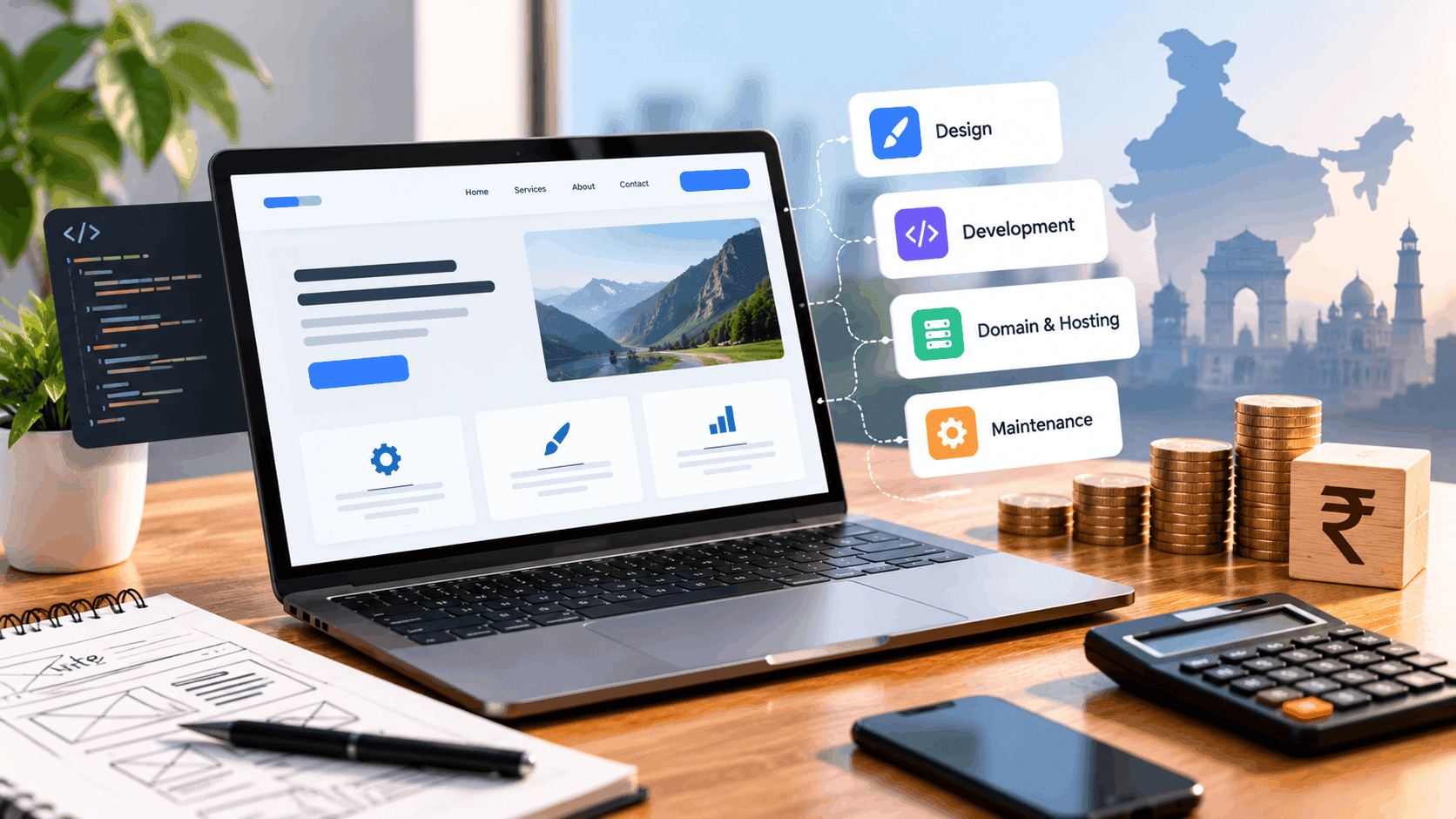
Ask five teams to quote the same website and you may get five different prices, because each one has priced a different job. Website development cost in India depends on the type of site, the number of designs, the features and the content, and no neutral price list exists. This guide is for business owners planning a new site or a rebuild. It explains what a quote should contain, how to work out your own estimate in rupees, which costs repeat every year, and which checks protect you from a slow or non-compliant site.
What does website development cost in India include?
Website development cost is the total you pay to plan, design, build, fill and launch a website, plus the yearly cost of keeping it online and secure. It covers the domain name, hosting, design, development, content, testing and maintenance. Development teams set their own prices, so two quotes for one idea rarely match. A reliable estimate comes from listing the parts, pricing each part separately and adding the renewals. A quote that cannot be split into parts cannot be compared with another.
Ask every team to show the parts as separate lines. A quote that bundles design, content and hosting into one number hides where the money goes, and a site that looks cheap in year one can cost more by year three if renewals and fixes were never priced in.
Why do website quotes differ so much?
Quotes differ because teams price different scopes, and a page count alone does not describe the work.
A site with twenty pages built on four layouts needs far less design than a site with twenty pages and twenty layouts. A quote may include copywriting, photography and a blog, or it may expect you to supply all three. Another may assume stock images where a rival plans custom photography, and that gap alone changes the total.
India adds a mobile reality. IAMAI counts 958 million active internet users, and 57% of them live in rural areas, so your site must load well on phones and slow connections. Ask each team how it will test for that before launch.
How is the cost of a website calculated?
Teams price a website by multiplying the hours each role needs by that role's hourly rate, then adding fixed costs such as the domain and hosting.
The roles are a designer, a developer and a project manager. Content writing and testing add hours of their own. The fixed costs renew every year, so count them yearly.
Example (assumed figures, not a price list): a clinic site needs 60 design hours, 120 development hours and 30 testing hours at a blended rate of ₹800 an hour. That is 210 hours, or ₹1,68,000, before content, domain and hosting. A rival quote showing half the hours has left something out.
Which type of website changes the cost?
The type of site changes cost because each type adds a different amount of design, features and testing.
| Site type | What it includes | What raises the cost |
|---|---|---|
| Brochure site | A few pages, contact form | More custom layouts |
| Business site with blog | Service pages, blog, lead forms | Content and integrations |
| Online store | Catalogue, cart, payments | Products, gateways, shipping |
| Custom web app | Logins, dashboards, workflows | Features and back end |
Each step down the table adds design, development and testing hours, and a store or web app also needs ongoing support. Pick the simplest type that does the job today. A store brings extra search work, so our ecommerce SEO guide shows what to plan for.
How do you get a reliable website quote step by step?
Seven steps give you quotes that can be compared line by line.
- 1.Write the goal of the site, such as 30 enquiries a month.
- 2.List the pages, then group them by layout.
- 3.Mark each feature as must-have or later, such as bookings or payments.
- 4.Decide who writes the content and who supplies the images.
- 5.Ask three teams for itemised quotes with hours, roles and rates.
- 6.Check who owns the domain, the hosting account and the source files after launch.
- 7.Agree payments in milestones tied to pages you can see.
- 8.Drop any quote that cannot show its hours.
What costs repeat after the site goes live?
Domain and hosting renewals, security updates, backups, content changes and performance fixes all repeat after launch.
Platform choice affects these costs. The HTTP Archive Web Almanac 2025 says WordPress powers roughly 64% of CMS-driven sites, and that its sites vary widely because of implementation choices. A well-built site and a poorly built one on the same platform cost very different amounts to run.
Budget the first year's fixed costs separately from the build, so the quote shows what you will pay again in year two. Ask each team for a monthly maintenance fee and a list of what it covers. Ask what happens if the site is hacked or goes down, and how fast they respond.
Which performance and compliance checks should the quote include?
A quote should name a speed target, mobile testing, HTTPS and clear consent notices, because each one affects visitors and rankings.
web.dev says the main content should appear within 2.5 seconds. Ask the team to measure the finished site on a mid-range phone and share the result before final payment. Write the speed target into the contract as a deliverable. The HTTP Archive Web Almanac measures the median mobile home page at 2.6 MB, growing 8.4% in a year, so heavy pages are the norm to beat.
Google uses the mobile version of your site for indexing and ranking. India's DPDP Rules, notified on 14 November 2025, require clear consent notices wherever your forms collect personal data.
What mistakes and challenges should you expect?
The costly website mistakes happen before the build starts, when scope is still easy to change.
- Choosing the lowest quote without checking what it leaves out.
- Counting pages instead of layouts.
- Starting design before the content exists.
- Registering the domain in the agency's name.
- Skipping tests on cheap phones.
- Adding features mid-build, which adds hours.
Common Mistake: budgeting for the build and forgetting the renewals, so the second year brings a surprise bill.
Pro Tip: collect your logo, photos and text before design begins. Late content can push a launch back by weeks. Our guide to website performance optimization shows how to keep a new site fast.
What website trends matter in 2026?
Three trends shape website budgets in 2026: heavier pages, AI search traffic and stricter privacy rules.
The Web Almanac 2025 reports that CMS-driven sites are over 54% of observed websites, and that page weight keeps rising. Plan a performance budget so a new design does not slow the site, and review the site's weight every quarter, since new images and scripts add up. Add a line for AI search visits to your monthly report.
Google's documentation says visits from AI Overviews and AI Mode count in Search Console's Performance report, so your site needs clear, quotable pages. IAMAI says 44% of Indian users already use AI-enabled features such as voice search and chatbots.
What Should You Do Next?
Website development cost in India is a sum you can build yourself: hours multiplied by rate, plus the domain, hosting and yearly maintenance. This week, write the site's goal and a page list grouped by layout, then ask three teams for itemised quotes. Compare them line by line. If you want a second opinion on your scope, our web design and development team can review it and give you an itemised estimate. Agree the yearly renewals in writing before you sign.
Frequently Asked Questions
Page count alone cannot set a price, because layouts and features drive the work. A 20-page site built on four layouts costs less than one with twenty custom layouts. Ask each team to quote per layout and per feature, then add content, domain, hosting and maintenance.
Rates depend on experience, skills and whether you hire a freelancer, an agency or an employee, so no single honest figure exists. Ask for the hourly rate for each role, the estimated hours, and a fixed-price option. Compare three itemised quotes before you decide.
The measurable signs say yes. The HTTP Archive Web Almanac 2025 found that CMS-driven sites are over 54% of observed websites, and IAMAI counts 958 million active internet users in India. Google counts AI search visits in Search Console reports, so sites that load fast and answer questions clearly stay worth building.
The seven steps are goals, research, site structure, wireframes, visual design, development with content, and testing before launch. A good team shows you the output of each step, such as a sitemap or a wireframe, and asks for sign-off before moving on.
Hosting cost depends on traffic, storage and support, so compare plans on what they include and on the renewal price, which can differ from the first-year price. Ask where backups are stored and how fast support responds. A slow or crowded host hurts speed and rankings.
WordPress can reduce build time, because it provides themes and plugins, and the Web Almanac says it powers roughly 64% of CMS-driven sites. Quality still varies with implementation. Choose it when your needs fit its ecosystem, and choose custom development when you need workflows a template cannot give.