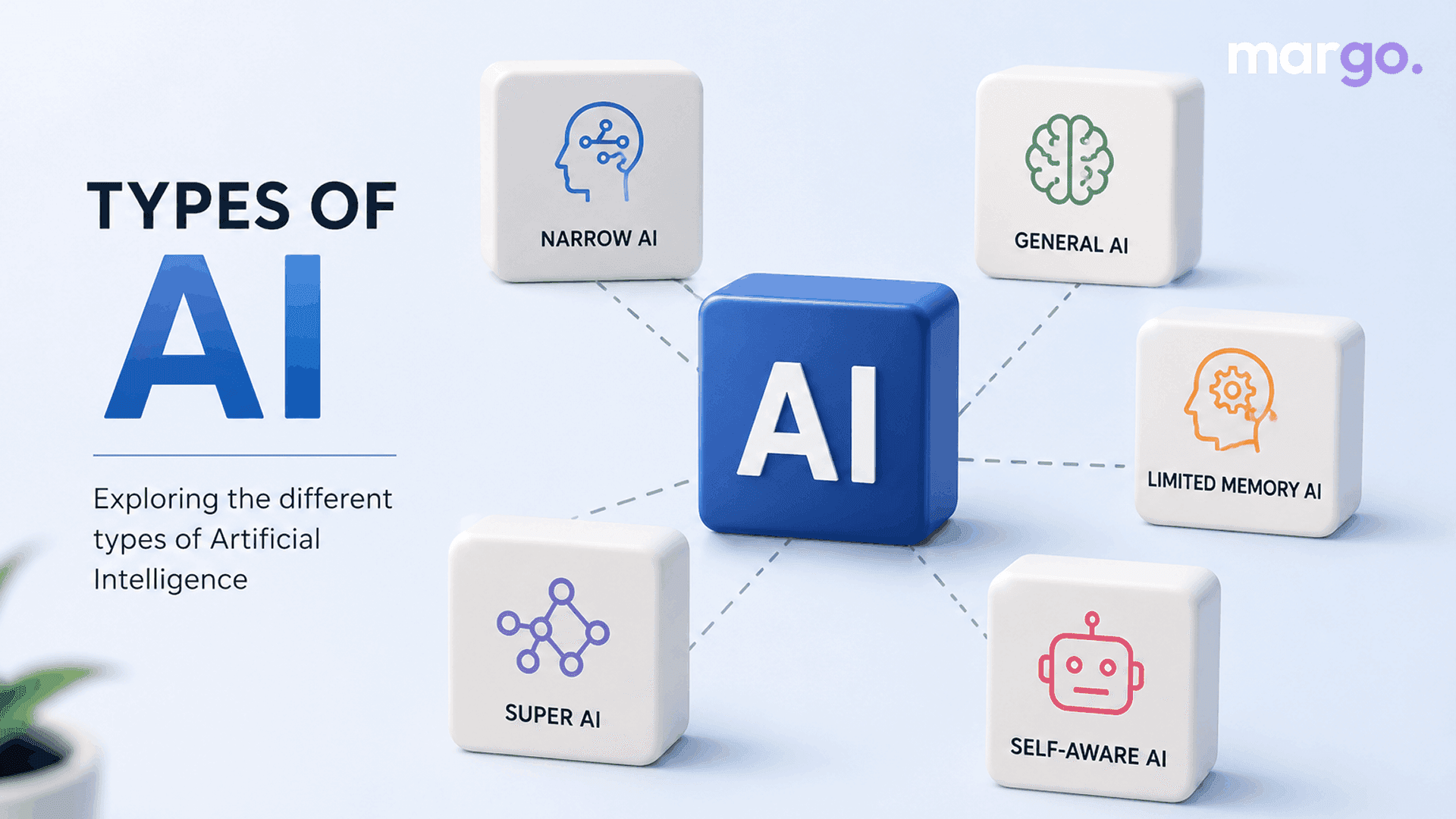
AI has moved from science fiction to application in everyday life. It drives everything from voice assistants to recommendation engines. But all AI is not created equal. Knowing the different types of AI gives us a peek into what the technology can do today, and how far off it is from the AI we see in movies.
This guide explains what AI is and looks at the different kinds of artificial intelligence (AI) systems, from the simplest reactive programs to the concept of machines that can think for themselves.
What Is AI?
Artificial intelligence, or AI, is the discipline of computer science concerned with creating machines that act like they are intelligent. Machines can learn, reason, solve problems, perceive, and make decisions.
We don't have to explicitly program artificial intelligence systems for every possible scenario. Instead, they can look at data, see patterns, and change their behaviour based on what they learn, though this varies.
Artificial intelligence is not just one technology but a huge field that includes robotics, machine learning, natural language processing, and so much more. AI is a very large field, and researchers generally divide it into two overlapping groups: by capability (how smart or humanlike the system is) and by functionality (how the system uses memory and past experience).
Taken together, these groups provide a better understanding of the different types of artificial intelligence (AI) systems that are currently in use and in development.
Types of AI by Capabilities
This grouping looks at how AI is like human intelligence, starting from simple systems that are good at only one task and going to fully autonomous machines that are thot to only exist in theory.
1. Artificial Narrow Intelligence (ANI)
Today, the only kind of AI that exists is Artificial Narrow AI. It is also called "Weak AI". Narrow artificial intelligence systems are designed to do one thing, or a small set of things, very well, but can't do anything else.
Here are some examples of narrow AI:
- AIs that you talk to, like Siri and Alexa
- How Netflix or Amazon's recommendation systems work
- Software that can recognise faces
- Filters for spam and chatbots
- Navigation systems for self-driving cars
Even though these systems are called "narrow," they can be very complex. Some of them are even better than humans at their specific tasks, such as playing chess or detecting certain diseases in medical images. But they can't think in general terms and can't apply what they know from one task to another.
2. General AI (AGI)
Strong AI, also called Artificial General Intelligence, is the concept of a computer system that can understand, learn, and apply intelligence to carry out any task a human can. General AI would be able to think, plan, solve new problems, and adapt to brand-new situations without being programmed to perform specific tasks.
We don't have AGI yet. One of the biggest problems in computer science that hasn't been solved yet is making a system with true human-level general intelligence. Experts have very different ideas about when or if this will be possible.
3. Advanced AI (ASI)
Artificial superintelligence is a hypothetical future state in which AI exceeds human intelligence across almost every realm, including creativity, problem-solving, social skills, and general knowledge. AI ethics and futurology scholars often discuss the concept of "super AI." Often the idea comes with questions about safety, control and the long-term effects of machines that can think more intelligently than their creators.
Even tho super AI is still just a theory, it has a big impact on how we talk about responsible AI development and long-term safety research.
Types of AI by Functionality
The second way of grouping things is based on how an AI system handles data and whether it remembers past information.
1. Reaction-Based Machines
The simplest form of AI is reactive machines. These systems have fixed outputs triggered by certain inputs, but they don't retain memory of what happened before and therefore can't use that information to inform future decisions. Each interaction is considered in isolation.
A typical example is the IBM computer Deep Blue, which played chess and defeated the world champion Garry Kasparov. Deep Blue would be able to analyze what moves to make in a game of chess and how those moves would turn out, but it would not recognize or learn from the games it had already played.
2. Limited Memory in AI
AI with limited memory builds on reactive machines by adding the ability to look at recent past data to help make decisions. However, this memory is only temporary and isn't stored for long, unlike human memory. This is where most real-world AI applications fit.
"Self-driving cars are a good example. They watch the speed and direction of nearby cars, the movement of pedestrians and traffic lights. They apply this new knowledge to make safe driving decisions in real time. Similarly, chatbots that refer to past conversations demonstrate their meagre memory.
3. AI Theory of Mind
AI is more advanced and largely theoretical. Machines would have to know that other beings (humans and other artificial intelligence systems) have their own beliefs, emotions, intentions, and thot processes that affect their behavior. That kind of AI would need to be able to read and respond appropriately to people's social and emotional cues.
Researchers are working on the first steps toward theory-of-mind capabilities, especially in social robotics and advanced conversational AI. But at the moment there is no system that can actually understand what others are thinking.
4. Self-Awareness AI
Self-awareness AI is at the very end of the range of functions and is still just a theory. This group comprises machines that are conscious, self-aware and aware of their own internal states. Put simply, these are AIs with a sense of "self" like human self-awareness.
The idea of self-aware AI raises serious philosophical and moral questions, and scientists, philosophers and technologists continue to debate its possibility. Right now, it is still only a theory and speculative fiction.
Why These Classifications Matter
It's not just good for school to learn about the different kinds of artificial intelligence; it also helps you set realistic goals for what AI tools can and can't do today. Almost all AI systems used in business today, from search engines to chatbots that learn on their own, are Artificial Narrow AI systems that can only do limited things with memory. "Sentient" or "general-purpose" AI is often said to do more than it can. A clear framework helps people, businesses and policymakers better understand how artificial intelligence (AI) works.
As more research is conducted, the distinctions between these groups may blur, especially as narrow AI systems improve at applying AI across more domains. With AI transforming industries and everyday life, getting to grips with these differences will only become more important.
Frequently Asked Questions
There are two main ways of grouping. AI may be categorized both by capabilities (Artificial Narrow AI, General AI, and Super AI) and by functionalities (Reactive Machines, Limited Memory, Theory of Mind, and Self-Awareness).
Not at all. There is no such thing as general artificial intelligence yet. All AI systems used today, from chatbots to generative models, are narrow AI, even though they look like they can do a lot of different things.
One well-known example of a reactive machine is IBM's Deep Blue, which beat Garry Kasparov. Deep Blue is a reactive machine because it only looked at moves and not at previous games.
Not at all. Large language models are considered narrow AI, even tho they can do a lot of different things. They are very good at language tasks, but they lack real general reasoning abilities, self-awareness, or the ability to learn new skills on their own outside of training.
There is no way to be certain. Super AI is still a concept that researchers, ethicists and technologists are debating. There is no consensus on whether it might be feasible, or when.