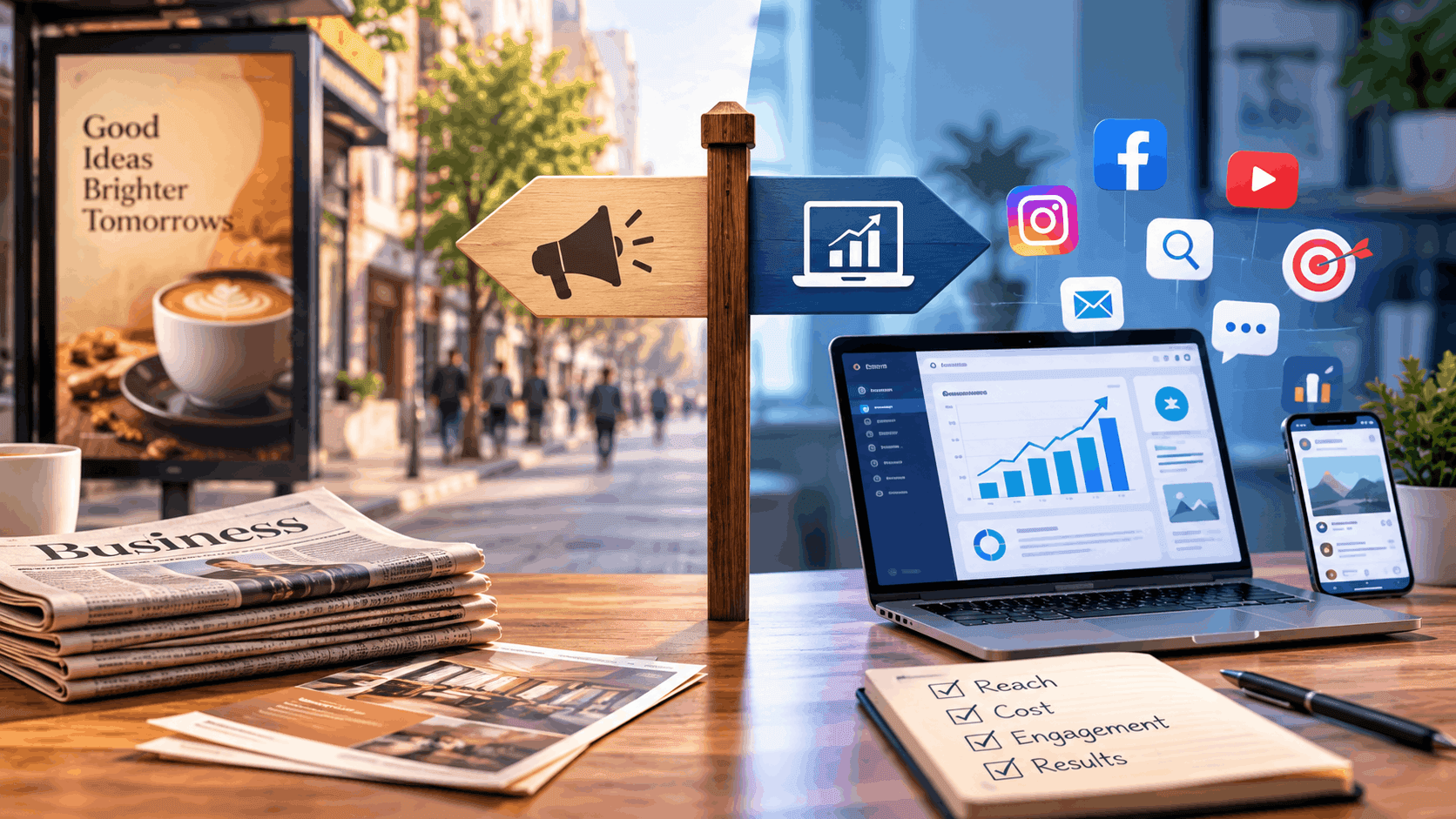
Every business runs into this fork eventually: put the budget into a billboard, a print ad, a stack of flyers - or into Google Ads, Instagram, and an SEO push. There's no clean winner here. Online and offline marketing solve different problems, and picking one over the other comes down to who you're selling to and how badly you need to prove the spend worked.
Key Takeaways
- Online marketing runs through digital channels - search, social, email, paid ads.
- Offline marketing runs through print, broadcast, direct mail, and events.
- Online is easier to track down to the dollar; offline is better at building the kind of trust a screen can't fake.
- Businesses that switch overnight usually lose more than they gain. Blending the two beats picking a side.
What Counts as Online Marketing
Anything that reaches a customer through a screen:
- Search ads and SEO
- Social posts and paid social
- Blogs, videos, gated guides
- Influencer and affiliate deals
The thing that ties all of this together: you can measure it. Every click, view, and dollar spent has a number attached to it.
What Counts as Offline Marketing
Everything that doesn't need Wi-Fi to reach someone:
- Newspapers, magazines, flyers
- TV and radio spots
- Direct mail
- Billboards, signage, transit ads
- Sponsorships, trade shows, events
Offline marketing predates the internet by decades, and in plenty of industries - local services, older demographics, anything selling on trust - it still beats a digital ad.
Online Marketing: The Real Pros and Cons
What works in its favor: you can target by age, location, or past behavior instead of hoping the right stranger drives past your billboard. Results show up while the campaign is still running, so a bad ad gets killed before it burns through the budget. And the cost of entry is low enough that a two-person shop can run something real on a few hundred dollars.
What doesn't: everyone's fighting for the same feed, which drives prices up fast in crowded categories. You're also at the mercy of whatever the platform decides this quarter - an algorithm tweak can gut your reach overnight, and there's nothing you can do about it. Some customers, especially older ones, still trust a printed ad over anything that showed up in their feed.
Offline Marketing: The Real Pros and Cons
Here's what it gets right: a sign outside your shop or a billboard on the right road builds a kind of familiarity a digital ad can't, mostly because it doesn't vanish the second someone closes a tab. It reaches its full audience without an algorithm deciding who gets to see it. And for a lot of buyers, print and broadcast still read as more legitimate than a sponsored post.
Where it falls apart: you can't actually prove who saw a flyer or heard a radio spot - you're left guessing. The upfront cost is brutal compared to digital: a single TV slot or billboard rental can eat a small business's entire quarterly budget. Once it's printed or aired, it's locked - no editing a typo out of a newspaper ad after it's gone to print. And everyone in the distribution area gets the exact same message, whether it's relevant to them or not.
Where Online and Offline Actually Meet
The businesses doing this well aren't choosing sides. A QR code on a billboard, a discount code that only works online, a TV spot that tells people to search a hashtag - these are offline moves built to push people into something measurable. That's the real play: keep the reach and trust offline gives you, but route it somewhere you can actually track.
Moving From Offline to Online Without Blowing It Up
The mistake most businesses make: they cancel the print ad the day they launch a Facebook page, before the digital side has any traction. That leaves a gap where neither channel is working. A better sequence looks like this:
- Take whatever's already working in print and adapt it for a targeted social ad in the same area - don't reinvent the message, just move it.
- Put a promo code or QR code on the offline stuff you're keeping. That's the cheapest way to turn an unmeasurable channel into one you can actually judge.
- Get a website up with basic SEO, because people who hear about you from a flyer will still Google you before they show up.
- Once you can see real numbers from both sides, move the budget toward whatever's actually converting - not just whatever feels more modern.
So Which One Wins?
Neither, universally. Go online if you need hard numbers, a flexible budget, or you're chasing a younger crowd. Go offline if your customers skew older, your business lives or dies on local reputation, or trust matters more than a click-through rate. Most brands that are actually good at this run both - offline to get noticed, online to prove it worked.
The Bottom Line
There's no permanent winner between online and offline marketing - just a decision that shifts with your budget and your audience. Online wins on proof; offline wins on reach and trust an algorithm can't touch. If you're mid-transition or building the mix from scratch, figuring out where your actual customers pay attention - not which channel sounds more current - is what gets the budget right. Margo Digitech can help map that out if you want a second set of eyes on it.
Frequently Asked Questions
At the low end, yes - a few dollars a day beats a billboard rental easily. But in a crowded niche, digital ad costs can climb until they're not cheap at all.
Technically, sure. Practically, almost nobody does it well - customers Google a business before walking in, even one they heard about from a neighbor.
Dropping the offline channel that was still working the same week the online one launches, before it's had time to prove itself.
Not really - they scale. A small shop gets the same local trust bump from offline; a big brand gets the same wide reach without needing an algorithm's permission. The math just has more zeros.