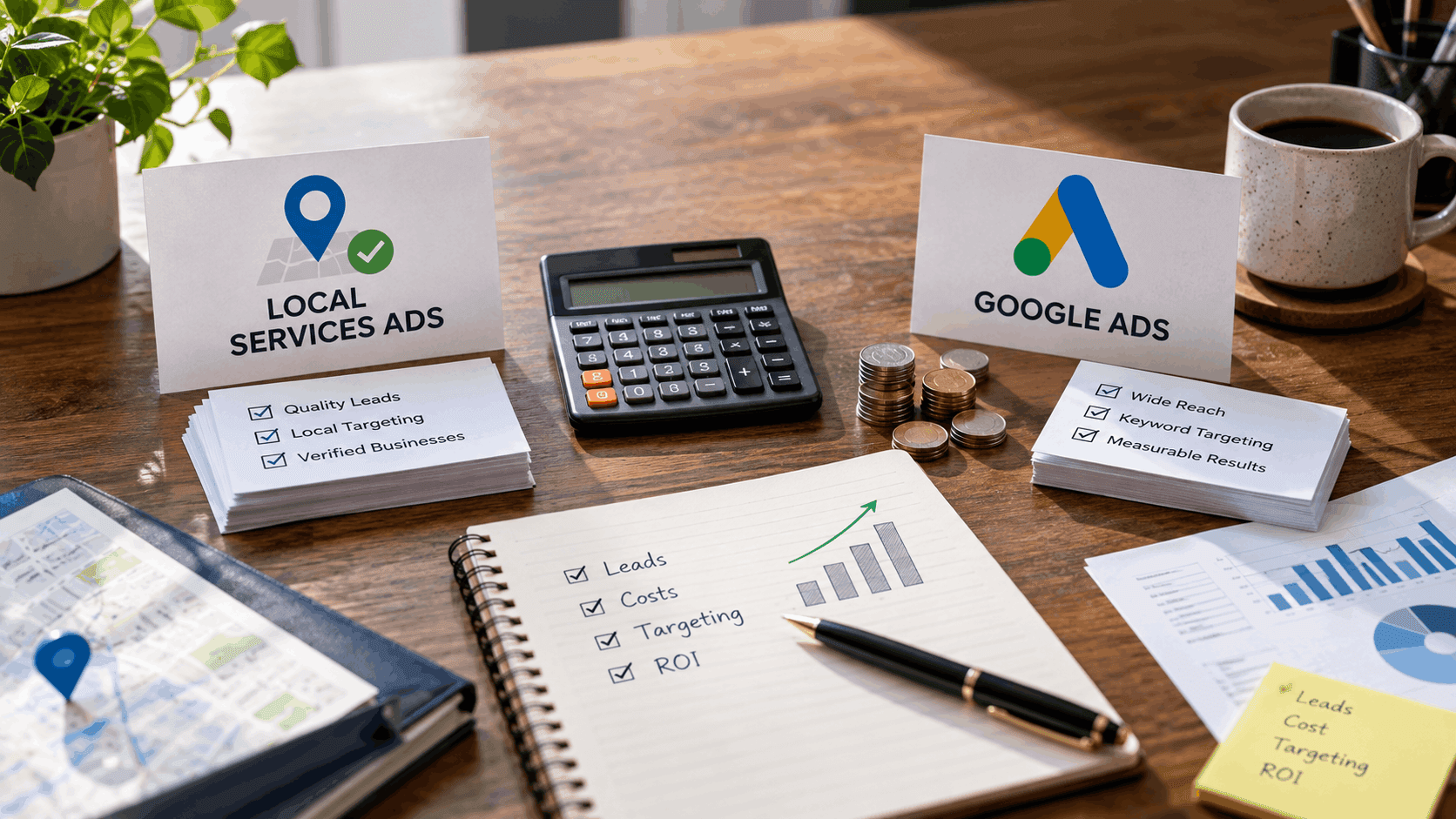
A plumber and a software company can both show up at the top of a Google search, yet one of them is paying for a phone call that already happened and the other is paying for a click that might never turn into anything. That's the real gap between Local Services Ads and standard Google Ads, and it matters more than which platform simply looks better in a screenshot.
What are Local Services Ads?
Local Services Ads, or LSA, is Google's pay-per-lead advertising product built for local service businesses like plumbers, electricians, locksmiths, and house cleaners. Instead of bidding on keywords, a business gets screened by Google, including a background check, license verification, and insurance proof, and once approved can earn the Google Guarantee badge that appears next to its listing.
That badge carries real weight with customers, since Google backs it with a reimbursement policy: if a customer is unhappy with completed work, Google may cover the cost of that job up to a lifetime cap of $2,000 in the US. A business only pays when a real lead comes in, whether that's a phone call, a message, or a booking, not for an impression or a click that goes nowhere.
What are Google Local Service Ads compared to regular search ads?
Google Local Service Ads sit in their own block above every other result on a search page, including the traditional Google Ads and the organic map pack. Regular Google Ads, by contrast, run on a pay-per-click auction model and can appear across Search, Maps, YouTube, and partner sites, which gives far more reach but charges for the click regardless of what happens after.
Eligibility works differently too. LSA is limited to a set list of approved service categories and requires the screening process described above, while standard Google Ads only needs basic advertiser verification and is open to nearly any business type.
Local Service Ads vs Google Ads: cost and lead quality
Cost is where the two diverge most. A 2026 benchmark found the average cost per lead on LSA sits around $53, with most trades landing between $25 and $80 depending on the category and market. That same analysis found LSA leads tend to run roughly half the cost of a blended Google Ads lead for home service businesses, largely because a business is only billed once a genuine lead comes through rather than for every click on an ad.
Lead quality follows a similar pattern. LSA leads have already decided they want a specific service and are calling or messaging to book it, while a Google Ads click can come from someone still comparing options, researching, or not ready to buy at all. That difference shows up directly in conversion rate, even when the raw cost per click on Google Ads looks lower on paper.
Google LSA vs Google Ads: which to use and when
| Factor | Local Services Ads | Google Ads |
|---|---|---|
| Pricing model | Pay per lead | Pay per click |
| Placement | Top block, above all other results | Search, Maps, YouTube, partner sites |
| Eligibility | Approved local service categories only, screening required | Open to most business types |
| Best for | Ready-to-buy customers wanting to call now | Reaching people earlier in the research stage |
| Targeting control | Limited, mostly category and service area | Full keyword, audience, and placement control |
| Trust signal | Google Guarantee badge | Advertiser verification only |
Neither replaces the other outright. A local trade business that qualifies for LSA usually gets its cheapest, fastest leads there first, then adds Google Ads once it wants to reach customers earlier in their search or cover services LSA doesn't support. A business that isn't eligible for LSA, or that sells something LSA doesn't cover like B2B software or ecommerce, runs on Google Ads by default.
Margo Digitech runs both channels together for local and service-based clients, using LSA to capture ready-to-book demand and Google Ads to build the broader funnel around it, rather than treating the two as competing budgets.
Frequently Asked Questions
They're used by local service businesses, plumbers, HVAC companies, cleaners, lawyers, and similar trades, to generate phone calls, messages, and bookings from customers actively looking to hire someone right away.
Generally yes for eligible trades, since a business only pays for confirmed leads rather than every click, and 2026 benchmark data puts LSA cost per lead at roughly half of blended Google Ads costs for home services.
Yes, and most local service businesses that qualify for both get better overall results running them together, since LSA captures immediate demand while Google Ads reaches people still comparing options.
LSA only covers a fixed list of service categories, so businesses outside that list, along with any business that can't pass the background check, license, or insurance screening, have to rely on standard Google Ads instead.
It tends to, since it functions as third-party trust rather than a business's own claim about itself, and customers comparing several similar listings are more likely to call the one backed by a guarantee.