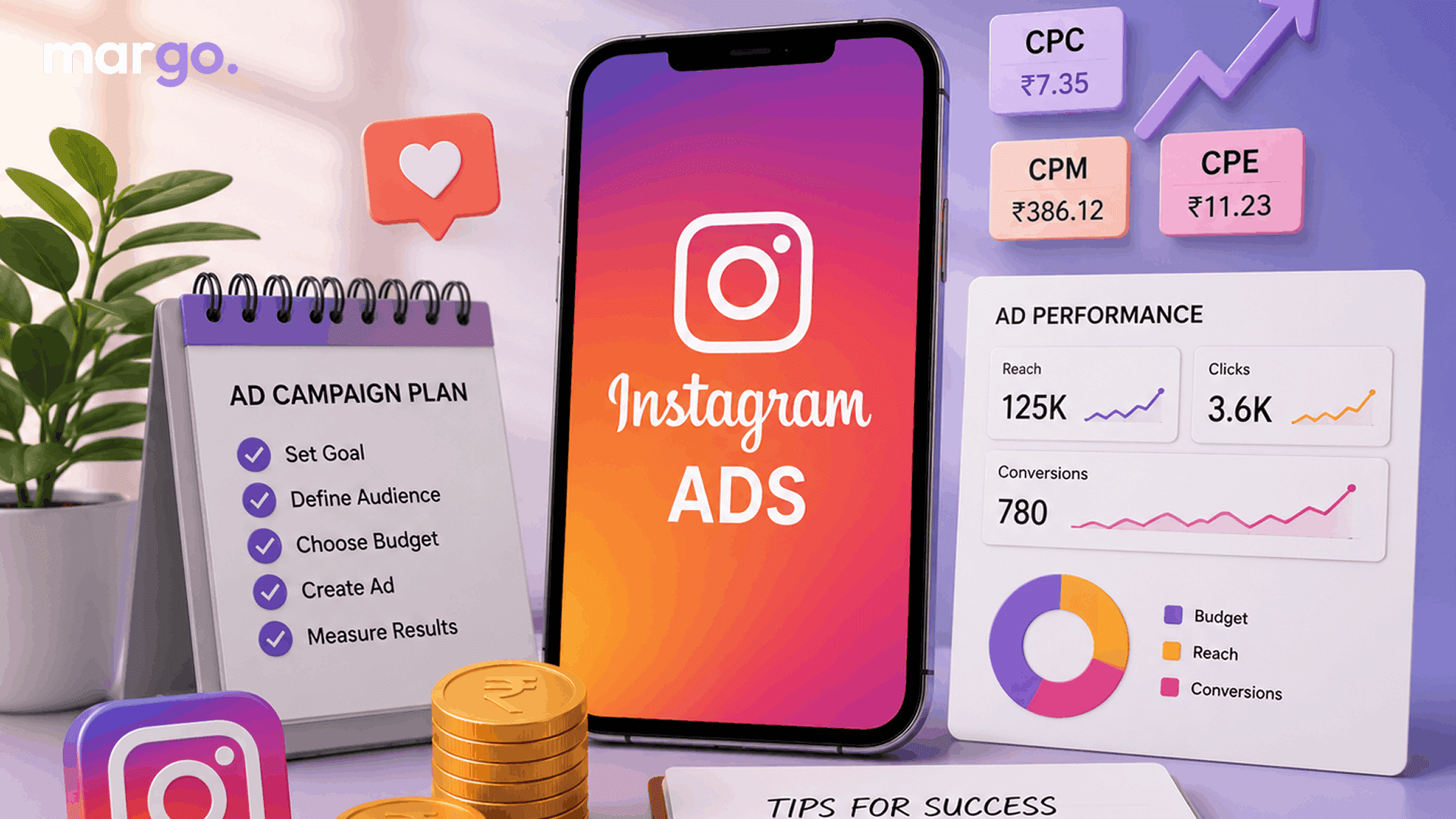
Instagram is one of the most trusted platforms for paid advertising. It now has some 3 billion monthly active users worldwide, and some 65% of consumers have an active profile on the site. Such scale has increased costs and competition in 2026, with more advertisers vying for the same placements. Meta's auction prices reflect this.
In this article, you will learn about the real cost of Instagram ads this year, how the different pricing plans work, and how to plan and run a campaign that doesn't waste money and time.
How Instagram Ad Pricing Actually Works
Meta Ads Manager is used to run Instagram ads, and prices are set through an auction rather than a fixed rate card. You don't pay a set price for a placement; instead, you bid against other advertisers trying to reach the same audience. Meta scores that bid against your ad's predicted engagement to figure out how much you should pay.
There are 3 main ways to set prices that you should know about.
Cost-per-click. This is how much you pay when someone clicks on your ad. CPCs should be in the range of $0.40 to $1.80 in 2026, with published averages of $1.01 to $1.73 across all click types.
CPM is the cost per impression, not per click. It's normally $6-$10, but really well-targeted campaigns can get it down to $2.50-$3.50, and campaigns that aren't as specific can go over $11.
Sometimes the cheapest metric on the platform is cost per engagement (CPE), which includes likes, comments, shares and saves. It varies between $0.01 and $0.06.
What's Driving Costs in 2026
Most of the difference you'll see between campaigns can be explained by three things.
The first is where to put it. Reels always have the lowest CPMs of any Instagram placement, about 20–50% less than feed for the same audience. This is mostly because Meta rewards videos that keep people's attention. Stories fall in the middle, with feed placements generally paying between $10 and $15 CPM.
The second is creative quality. In most auctions now, this is more important than the bid price. Predicting engagement is very important for Meta's algorithm. This means that a strong Reels ad with a good hook in the first one to two seconds can cut CPM by 40–50% compared to weak creative that targets the same audience.
The third is audience competition. It's always cheaper to reach a large audience than a small one with a lot of people who share the same interests, because you're competing with fewer advertisers for the same impression.
Business also makes a difference. The highest CPCs are usually seen in legal, finance, and software because a single conversion is worth a lot more to those types of businesses. In contrast, locally owned shops and speciality retailers are usually paid less.
Seasonality matters, too. Black Friday, Cyber Monday and the holiday season in general see CPMs and CPCs 30–50% above baseline as brands fight for the same shoppers. On the other hand, businesses that don't operate during certain times of the year can usually find cheaper advertising windows from January to March and during the summer.
Instagram Ad Costs at a Glance
| Metric | Typical Range (2026) | Notes |
|---|---|---|
| CPC (Cost Per Click) | $0.40 – $1.80 | Legal, finance, SaaS run higher |
| CPM (Cost Per 1,000 Impressions) | $6 – $10 | Reels run lower, Feed runs higher |
| CPE (Cost Per Engagement) | $0.01 – $0.06 | Cheapest metric on the platform |
| CPA (Cost Per Acquisition, eCommerce) | $15 – $60 | Varies by AOV and funnel setup |
| Reels CPM | $4 – $8 | Below $5 signals strong creative engagement |
| Feed CPM | $10 – $15 | Highest-cost placement typically |
Boosted Posts vs. Ads Manager Campaigns
A lot of small businesses start out with boosted posts because they're easy to set up and can be done quickly from the Instagram app. Before you buy, you should know that boosted posts and full Ads Manager campaigns are not the same thing.
| Feature | Boosted Posts | Ads Manager Campaigns |
|---|---|---|
| Where you create it | Directly from a post on your Page/Instagram (the "Boost Post" button) | Meta Ads Manager (full dashboard) |
| Ease of use | Very simple, few clicks, mobile-friendly | Steeper learning curve, more setup steps |
| Campaign objectives | Limited (engagement, traffic, messages, awareness) | Full range (conversions, lead gen, app installs, catalog sales, video views, etc.) |
| Targeting options | Basic (location, age, interests, "people who like your Page") | Advanced (custom audiences, lookalike audiences, detailed demographics/behaviors, retargeting) |
| Ad formats | Only the existing post's format (image/video/carousel as originally posted) | Full range. Collection ads, carousel, lead forms, dynamic product ads, Instant Experience, etc. |
| A/B testing | Not available | Built-in split testing |
| Budget/bid control | Basic daily/lifetime budget only | Full control. Bid strategies, cost caps, budget optimization across ad sets |
| Placements | Limited/automatic | Full control. Facebook, Instagram, Messenger, Audience Network, Reels, Stories, etc. |
| Multiple ads/ad sets | No, one post, one ad | Yes. Multiple campaigns, ad sets, and ads in one structure |
| Analytics/reporting | Basic metrics (reach, engagement) | Detailed, customizable reporting and breakdowns |
| Pixel/conversion tracking | Not supported | Fully supported |
| Best for | Quick visibility boosts, small budgets, beginners | Serious campaigns, conversions, scaling, precise targeting/ROI tracking |
How Much Should You Budget?
Many advertisers spend between 11% and 20% of their advertising budget on Instagram. They see it as part of a larger Meta or multi-platform strategy. New advertisers often begin with $300 to $500 per month to test creative and audiences before scaling.
However, if you spend less than $300, you probably won't be able to learn as much because your account won't have enough data to optimize in a meaningful way.
If you are a business with conversion-based campaigns, you can realistically expect $1,000 to $2,000 a month. This is because Meta's algorithm needs about 50 conversions per ad set to stop learning and start bidding efficiently. If campaigns don't get 50 conversions, they can stop learning forever without real optimisation starting.
For brands that want to grow, $50 to $100 per day, spread across two to three active ad sets, is a good starting point. This gives Meta enough information to figure out what's working without spreading the budget too thin.
Frequently Asked Questions
CPC is usually between $0.40 and $1.80, and CPM is between $6 and $10. However, both can vary significantly depending on the industry, placement, and the quality of the creative.
Absolutely. Reels consistently have 20–50% lower CPMs than Feeds for the same audience. This is mainly because Meta prefers videos that keep people’s attention.
For testing, most new advertisers start with $300-$500 per month. It's more likely that campaigns meant to drive conversions will need $1,000 to $2,000 a month to collect enough data to optimise effectively.
Boosting is faster, but you have a lot less control over targeting and optimisation. When you need more than just basic visibility or awareness, Ads Manager is the better choice.
As more advertisers try to reach the same shoppers on Black Friday, Cyber Monday, and during the holiday season, CPMs and CPCs can rise by 30–50% above normal.
Creativity, most of the time. Meta’s auction favors ads it thinks will get a lot of attention, so better creative can help you save money more than just raising your bid.