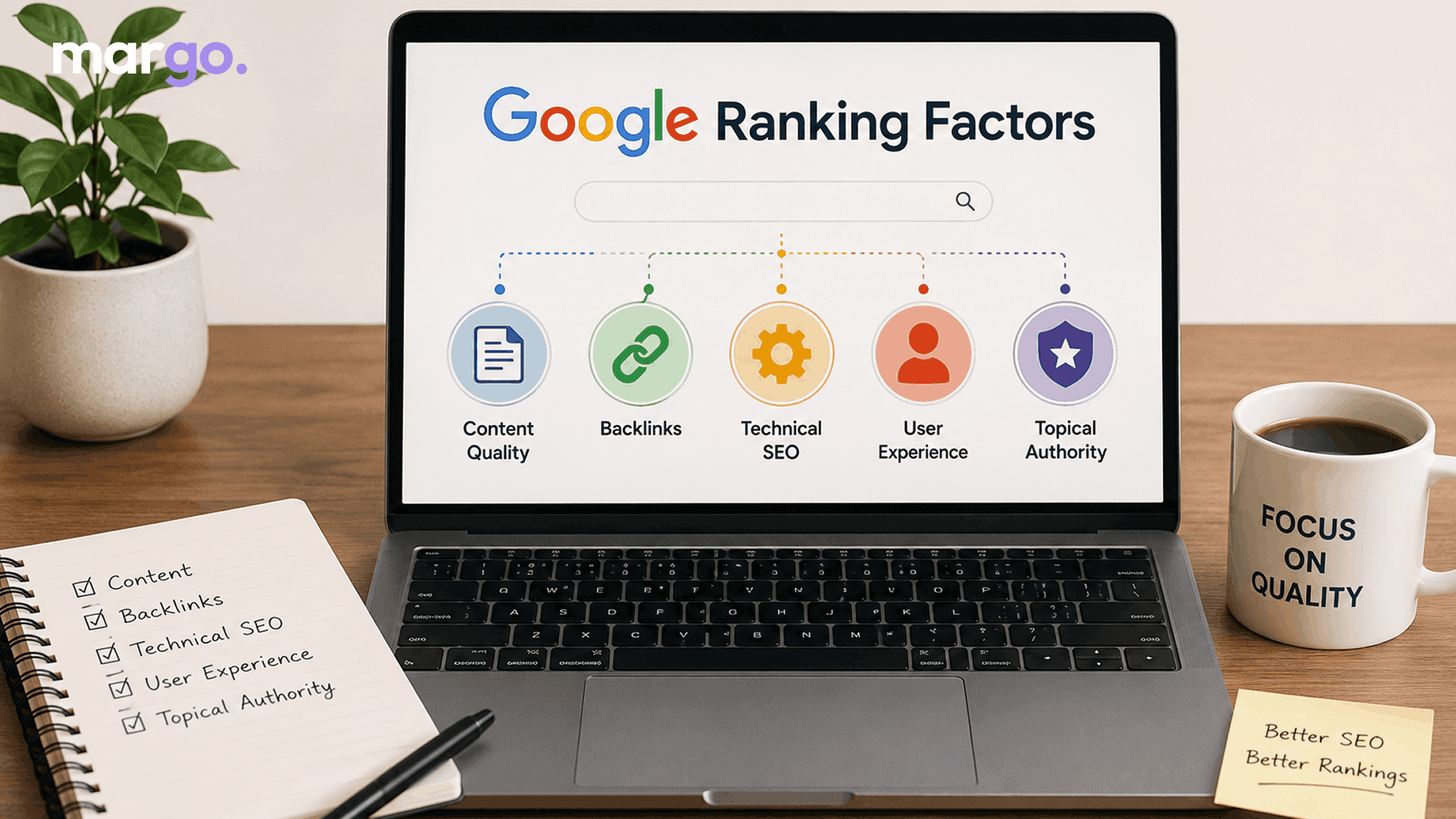
Search for google ranking factors and you will meet lists of 200 of them, each stated with total confidence. Google has never published such a list. What it does publish is a set of ranking systems, a handful of signal groups and plenty of advice on what to ignore. This guide separates what Google has said from what the internet repeats. You will see how ranking works, which signals deserve your time, which popular claims are myths, a six-step improvement routine and what changed in 2026.
What Are Google Ranking Factors?
Google ranking factors are the signals that Google's automated systems weigh to decide which pages appear for a search and in what order. Google groups its main signals into five areas: the meaning of the query, the relevance of a page, content quality, usability and context such as location and settings. The weight of each signal changes with the query, so freshness matters more for news than for a dictionary definition. Google publishes no numbered list of factors, however long the lists online run.
A ranking factor is a single signal. A ranking system is the software that combines many signals into an order.
Why Do Ranking Factors Matter for Indian Businesses?
Ranking factors matter because they decide who earns organic visibility without paying for each click. The FICCI-EY report puts India's digital advertising at INR 947 billion in 2025, up 26%, and about 63% of all advertising revenue. Rising ad spend means more brands competing for paid slots, so organic visibility is worth protecting.
Example: a Jaipur furniture seller spending ₹40,000 a month on search ads could, if its pages rank well, move part of that budget into content and product pages. Organic traffic does not stop when a card is declined, although it does need steady upkeep: fresh facts, fixed errors and pages that still answer the search.
How Does Google Decide Which Pages Rank?
Google ranks pages with many automated systems working together, each handling a different job such as understanding language, spotting spam or favouring original reporting. Its ranking systems guide says they look at many factors and signals across hundreds of billions of pages. The guide names systems such as BERT, neural matching, passage ranking, RankBrain, freshness and original content, plus spam detection. It also describes link analysis, which includes PageRank, as one of its core ranking systems (Google's ranking systems guide). Retired systems such as Panda, Penguin and the helpful content system now sit inside core ranking. Because these systems work together, fixing one signal rarely moves a page on its own.
Which Ranking Factors Has Google Confirmed?
Google has confirmed signal groups and individual systems, and each one maps to a task you can act on this month.
| Signal | What Google says | What you do |
|---|---|---|
| Meaning and relevance | Systems read intent as well as words | Match each page to one search intent |
| Quality | Helpful, people-first content wins | Show real experience and sources |
| Usability | Core Web Vitals are used in ranking | Fix slow or shifting pages |
| Links | Link analysis helps find helpful pages | Earn mentions on merit |
| Context | Location and settings shape results | Add local detail where it applies |
No signal acts alone, so a page that is strong in one area can still lose to a page that is stronger overall.
Which Ranking Factor Claims Are Myths?
Four popular claims fall apart when you read Google's own documents, so check the source before you act on any list.
| Claim | What Google says |
|---|---|
| There are exactly 200 factors | No list exists, and weights vary by query |
| E-E-A-T is a score | It is not a specific ranking factor |
| Keyword domains rank | The exact match domain system limits that credit |
| llms.txt boosts rankings | It neither helps nor harms visibility |
On E-E-A-T, Google says trust is the most important part, and its systems weigh a mix of factors that point to it (Google's helpful content guidance).
How Do You Improve Your Google Rankings Step by Step?
Improving rankings means fixing access first, then content, then speed, in that order. Six steps cover a first pass over any page.
- 1.Open Search Console and confirm your key pages are indexed and not blocked.
- 2.Write each page for one clear search intent, such as "buy" or "compare".
- 3.Add first-hand detail: your own prices, photos, process or numbers.
- 4.Pass Core Web Vitals on mobile first, where layout and speed problems show up fastest.
- 5.Earn links by publishing something worth citing, such as original data.
- 6.Re-check after each Google update and change only what the data supports.
Skip shortcuts. Google's spam systems exist to catch them.
How Much Do Page Experience and Core Web Vitals Matter?
Core Web Vitals matter as one input among many, because Google says no single page experience signal exists. Its core ranking systems use Core Web Vitals and look for secure pages and content that displays well on mobile. The good targets are Largest Contentful Paint within 2.5 seconds, Interaction to Next Paint at 200 milliseconds or less and Cumulative Layout Shift at 0.1 or less. The 2025 Web Almanac found only 48% of mobile sites and 56% of desktop sites passed all three, so a clean pass can separate you from slower rivals. Check your own numbers in the Core Web Vitals report in Search Console, which uses field data from real visitors.
What Ranking Mistakes and Challenges Should You Expect?
Ranking problems often start with chasing lists and ignoring basics. Rankings also move without any change on your side, because updates and competitors shift constantly. Fixing a signal rarely gives an instant jump, since Google must recrawl and reassess pages before anything changes. The mistakes below cost the most time.
- Copying a 200-factor checklist item by item.
- Publishing thin pages to cover more keywords.
- Buying links, which spam systems target.
- Judging success by one keyword on one day.
Common Mistake: Treating E-E-A-T as a badge to add. Show real experience on the page instead of adding a label.
What Google Ranking Trends Matter in 2026?
Frequent updates and AI answers define 2026. Google's Search Status Dashboard lists core updates in March and May 2026, with spam updates in June, August and September. Google's AI guidance says optimising for generative AI search is still SEO, and it tells site owners to ignore chunking tricks and llms.txt files for Google Search. The practical reading is simple. Keep pages indexable, original and useful, then watch Search Console for movement rather than guessing at the next update. Treat every update as a prompt to review your weakest pages first. The dashboard also shows recent core updates taking roughly 12 to 18 days to finish, so wait for a rollout to end before judging results.
What Should You Do Next?
Google ranking factors work best as habits: serve the searcher, load fast, earn trust and check results every month. Pick your five most important pages and run the six steps above on each. If you want a second opinion on where to start, our SEO services in Delhi team can review them with you. For the details behind two of the signals, read our guides to on-page SEO factors and off-page SEO.
Frequently Asked Questions
Google does not publish a number. It says its systems weigh many factors and signals across hundreds of billions of pages, and that the weight of each depends on the query. The claim of exactly 200 factors comes from third-party lists, not from Google. Treat any fixed count as an estimate and focus on the five signal groups.
Google names meaning, relevance, quality, usability and context as its key signal groups. In practice that means matching search intent, publishing helpful original content, passing Core Web Vitals and keeping pages secure and mobile friendly. Google does not rank these in a fixed order, because the weights shift from one query to the next.
No. Google says E-E-A-T is not a specific ranking factor, but its systems use a mix of factors that can identify content with good experience, expertise, authoritativeness and trust. Trust matters most. Show who wrote the page, what they know first-hand and where each claim comes from.
Yes, links still play a role. Google's guide says its link analysis systems, which include PageRank, help it understand what pages are about and which might be most helpful. Quality beats volume, and paid links fall under spam policies. Earn links by publishing original data, tools or guides that others want to cite.
Yes, through Core Web Vitals, which Google says its ranking systems use. No single speed score decides rankings, though, and relevant content still wins when speed is similar. Aim for Largest Contentful Paint within 2.5 seconds, Interaction to Next Paint at 200 milliseconds or less and Cumulative Layout Shift at 0.1 or less.
Changes can take days to months, because Google must recrawl, reindex and reassess your pages. Core updates also take about two weeks to roll out, so avoid judging a change inside a single week. Track clicks and impressions in Search Console over a month or more.