
Scope arguments start with a vague proposal. A clear one gives both sides something to check. A digital marketing proposal puts goals, work, cost and reporting on paper before any work starts. This guide is for freelancers, agency teams and business owners in India. You'll get the eight sections to include, a seven-step way to write one, a method for pricing fees, ad spend and tax in rupees, and the promises to leave out. If you're the one reading a proposal, the same eight sections let you compare two providers side by side.
What is a digital marketing proposal?
A digital marketing proposal is a document that sets out the goals, work, schedule, cost and reporting for a marketing project before it starts. Freelancers and agencies send one to win a client. In-house marketers write one to get a budget approved. A good one ties every activity to a result you can measure, and it says what is not included. It works as a plan and an offer in one, so the reader can say yes, no, or change this part.
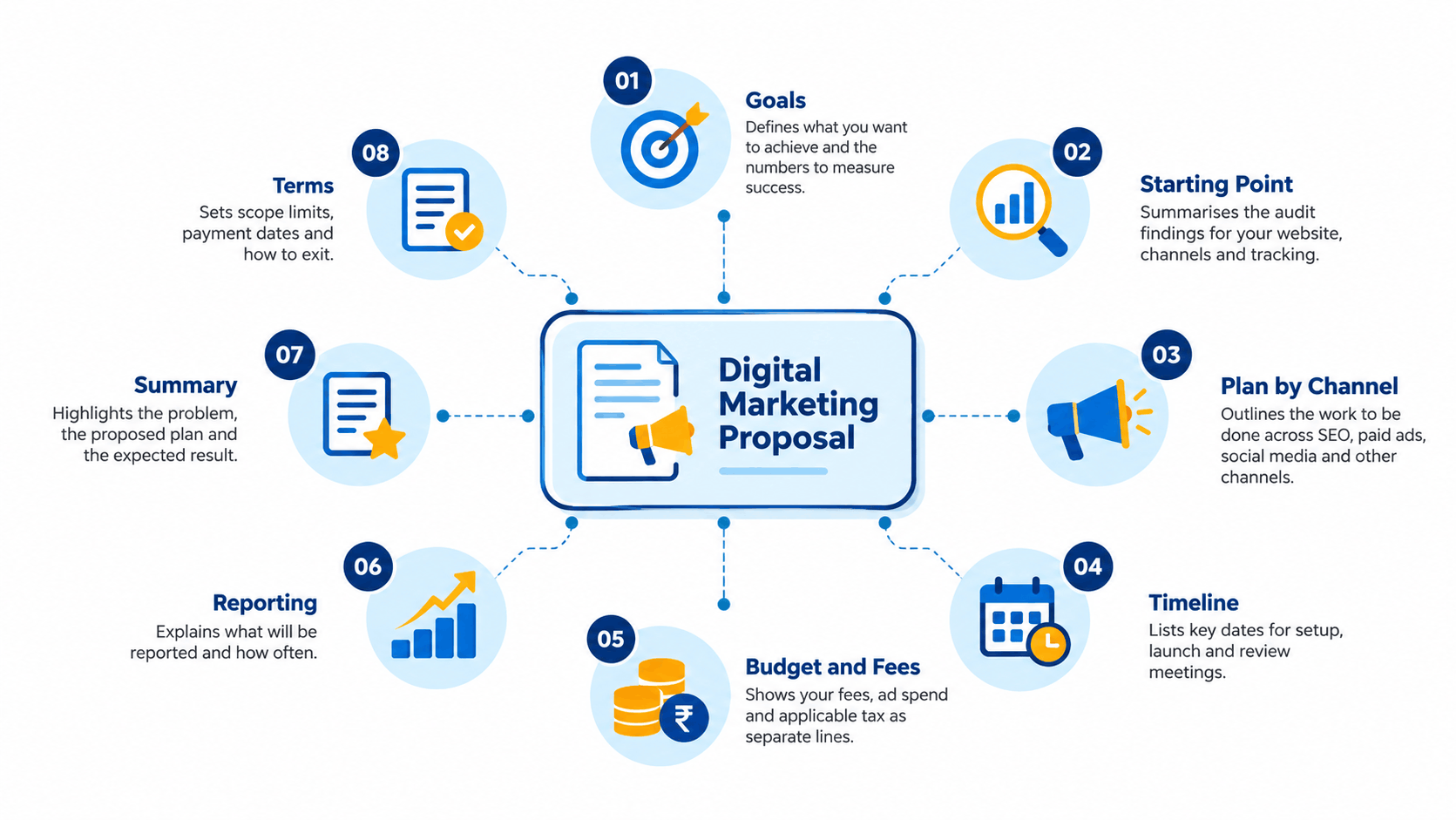
Business owners can use the same structure to compare proposals from different providers on equal terms. The document works for a one-month campaign and a one-year retainer, and only the level of detail changes.
Why does a proposal matter for Indian businesses?
Written proposals matter because small businesses fund a large share of India's digital advertising, and unclear spend is hard to control.
Industry estimates put the small-business and long-tail share of digital advertising at ₹363 billion, about 38% of the total.
Example: a Pune physiotherapy clinic compares two proposals. One promises page-one rankings in 30 days. The other targets 40 booked appointments in three months and lists what it will report each month. Only the second can be checked, so the clinic can hold its provider to it.
The same document protects the provider, because a change request becomes a conversation about the document instead of a dispute about memory.
What goes into a proposal?
Eight sections make a strong proposal, and each one answers a question the client will otherwise ask later.
| Section | What it should say |
|---|---|
| Summary | The problem, the plan and the result |
| Goals and KPIs | The numbers you will move, and by when |
| Starting point | What your audit found |
| Plan by channel | Which work, in which order |
| Timeline | Dates for setup, launch and reviews |
| Budget and fees | Fees, ad spend and tax as separate lines |
| Reporting | What you report, and how often |
| Terms | Scope limits, payment dates, how to exit |
Keep each section to a page or less. A busy owner reads the summary and the budget first.
Which services can a proposal cover?
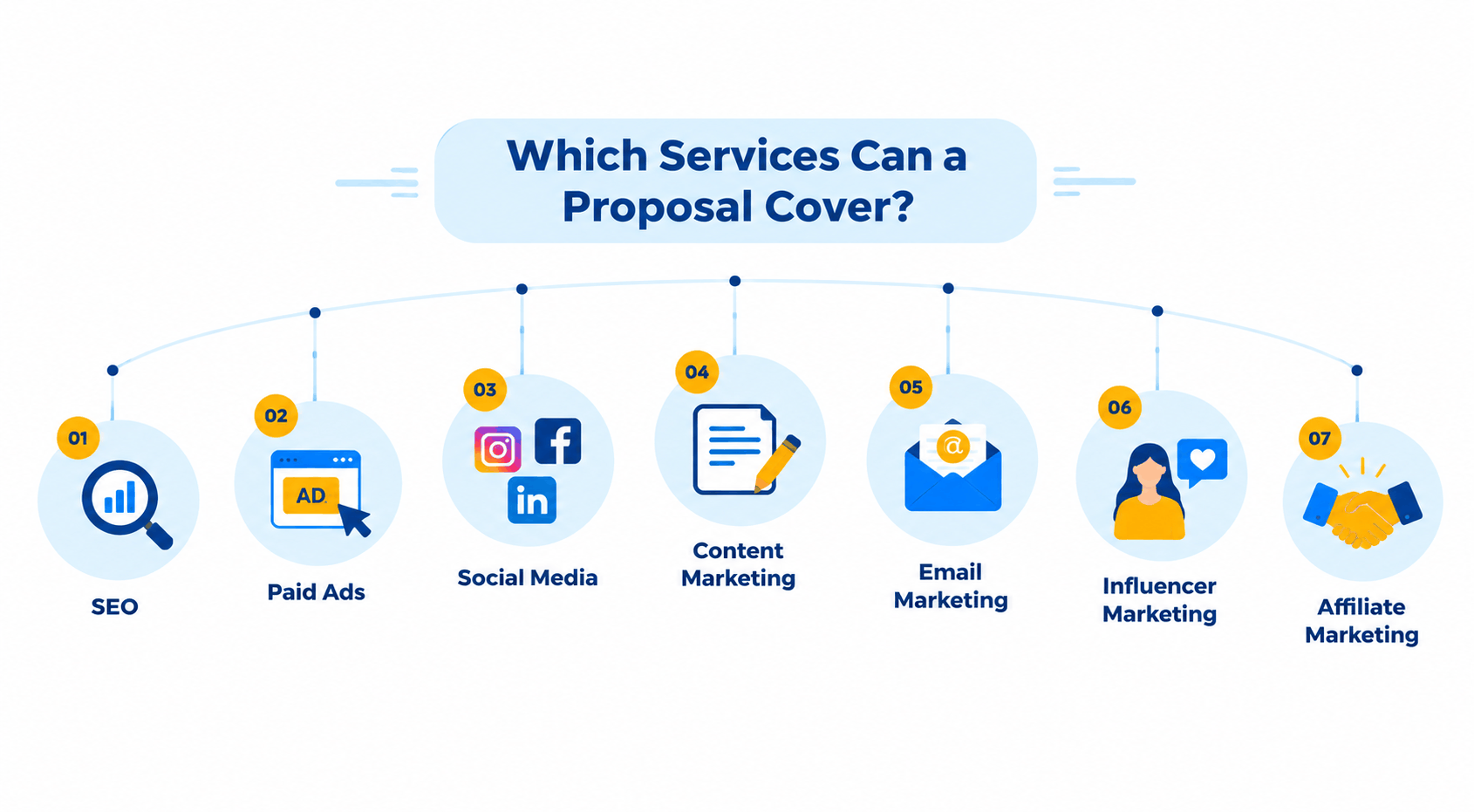
Seven common services can fill a proposal: SEO, paid ads, social media, content, email, influencer and affiliate marketing.
SEO earns traffic from search. Paid ads buy clicks on Google Ads or Meta Ads. Social media builds an audience, content answers buyer questions, and email keeps leads warm. Influencers lend you their audience. Affiliates get paid per sale.
Match each service to a KPI before you list it, so the client can see what the work is meant to deliver. Pick the two or three that fit the goal and leave the rest for a later phase. Our guide to what digital marketing is explains each type in more detail.
How do you write a proposal step by step?
Seven steps take you from a first conversation to a proposal a client can approve.
- 1.Meet the client, and write their goal in their own words.
- 2.Audit what exists: the website, search listings, ad accounts and tracking.
- 3.Choose KPIs, and set a target with a deadline for each.
- 4.Pick the channels that serve those targets, and the order of work.
- 5.Build a timeline with review dates.
- 6.Price your fee, the ad spend and the tax as separate lines.
- 7.Add terms, then read the whole document once as the client would.
Walk the client through it on a short call. Questions come out faster than they do in email.
How should you price a proposal in rupees?
Price a proposal as three separate lines: your fee, the ad budget paid to the platforms, and tax.
Google Ads can spend up to two times your average daily budget on a given day for most campaigns, and Meta says it may spend up to 75% over a daily budget. State the ad budget as a monthly cap, because daily spend moves.
Google's own charges carry GST: 18% IGST, or 9% CGST plus 9% SGST when the billing state matches.
Example (assumed figures, not a price list): a ₹40,000 monthly fee, a ₹1,00,000 monthly ad cap and GST on your fee at the rate that applies to your service. For market ranges, see our guide to digital marketing cost in India.
Which promises should a proposal avoid?
No proposal should guarantee a number-one Google ranking, because Google says no one can.
Google also warns about anyone who claims a special relationship with Google or sells a priority submission. Promise what you control: the work, the reporting and the review dates. For results, give a target range and explain what could move it. Write the reporting schedule into the proposal so every promise can be checked each month.
Influencer work needs honesty too. ASCI says disclosure is needed when there is any material connection between advertiser and influencer, including free products and discounts.
If you will handle lead data, say how, because India's DPDP Rules require clear consent notices.
What mistakes and challenges should you expect?
Proposal mistakes cost the most after the client signs, when the gap between promise and delivery becomes visible.
- Copying a template and leaving the last client's goals in it.
- Ten posts a month, with no result attached.
- Ad spend folded into the fee, so the client can't see where the money goes.
- No list of what is not included.
- Rankings or follower counts promised in writing.
- A long document, and no call to talk it through.
Common Mistake: writing the budget before the goals. Set the targets first, then price the work that reaches them.
Pro Tip: put a one-page summary and the decision you need, such as approve the plan and the first payment, at the top.
What proposal trends matter in 2026?
Three trends shape proposals in 2026: AI results in reports, stricter data rules, and clients who already use AI features.
Visits from AI Overviews and AI Mode now show up in Search Console's Performance report, according to Google's documentation. Give them a line in your reporting section.
Clients are ahead of you here. IAMAI says 44% of Indian internet users already use AI-enabled features such as voice search and chatbots, so expect the question: how will you use AI on my account? Answer it in the proposal. Say where AI helps and where a person checks the work.
India notified the DPDP Rules on 14 November 2025, with an 18-month phased timeline. Add a data-handling line to your terms now.

What Should You Do Next?
A digital marketing proposal works when it states the goal, the work, the cost and the reporting in plain words and lets the client check each one. Write your next proposal with the eight sections above, price fees, ad spend and tax separately, and promise only what you control. If you want a second pair of eyes on your plan, our campaign planning team can build one with you. Share the proposal before the kickoff call, so questions are settled early.
Frequently Asked Questions
Begin with what the client wants, in their own words. Audit what exists, then pick KPIs with targets and deadlines. Plan the channels and a timeline, give fees, ad spend and tax a line each, add terms, then explain it on a call.
The seven common types are SEO, paid advertising, social media marketing, content marketing, email marketing, influencer marketing and affiliate marketing. A proposal rarely needs all seven. Choose the two or three that serve the client's goal, and note which others you would add in a later phase.
A project proposal holds a summary, objectives, scope, timeline, budget, team and terms. A marketing proposal adds KPIs, a channel plan and a reporting schedule to that frame. Keep the summary short, because it is the part the client reads first.
No. Google says no one can guarantee a number-one ranking, and it warns against anyone who claims to guarantee rankings or sells a priority submission to Google. Commit to the activities, the report schedule and the review meetings, and give a target range for results, listing the factors that could move it.
Show ad spend as its own line, because it goes to the platform and not to you. Google Ads and Meta can spend above a daily budget on some days, so state a monthly cap. Show your fee and tax as separate lines, so the client can see where each rupee goes.
As short as the job allows. Open with a summary, run through the eight sections in the table, and finish with a clear next step. A small business needs a few pages, not a booklet. Put the summary and budget first, and park supporting detail, such as audit findings, in an appendix.