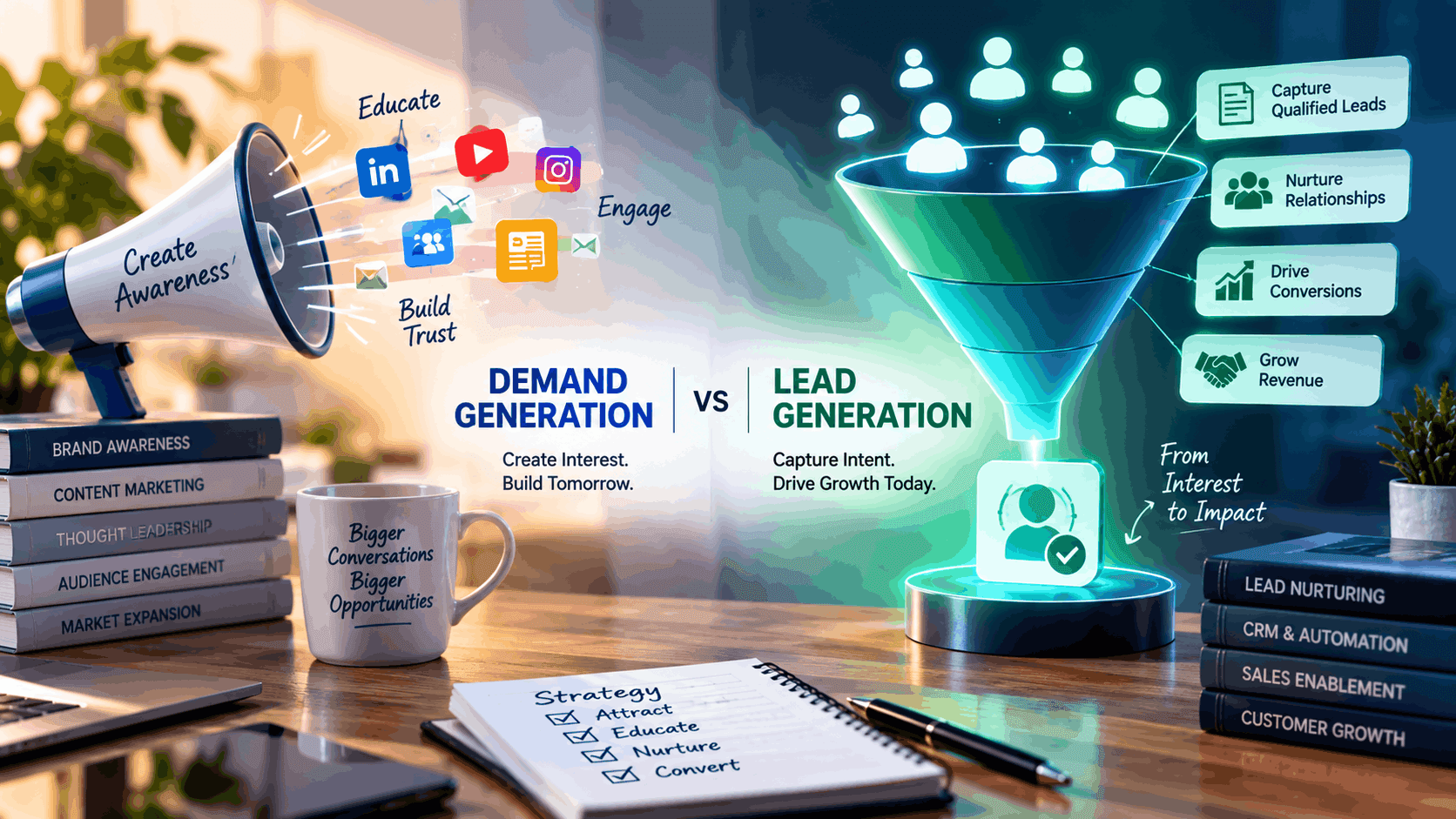
Quick overview
Marketing departments evaluating Lead Generation vs Demand Generation routinely overinvest in converting the 1% of buyers already shopping, which Alice de Courcy at Cognism notes abandons the 99% who remain unready. To capture both account segments, technology organizations recording over $100 million in revenue average 16 different marketing channels simultaneously, according to Gartner's 2024 Tech Marketing Benchmarks Survey. This budget division ensures demand generation campaigns educate the unaware majority on structural business problems, while isolated lead generation forms capture specific contact details from the active minority ready to sign a vendor contract.
What is demand generation?
Because top-of-funnel campaigns prioritize broad visibility, marketing departments deploy these early awareness strategies to generate brand interest well before a single buyer sits down to speak to a sales representative. Instead of forcing visitors into unprompted sales funnels, product writers distribute free, ungated content out onto public web platforms to educate a vast market about a latent workflow bottleneck they might not know they have.
To extract a true demand generation meaning from these metrics, budget controllers look past immediate checkout pipeline and evaluate long-term category authority. Approving these brand operations requires executive patience across multiple fiscal quarters, since ZoomInfo estimates that these content plays typically take 6 to 12 months to yield a measurable ROI.
What is lead generation?
Sales networks build their core lead generation definition around extracting contact details from in-market buyers. To convert baseline website browsing into actionable Marketing Qualified Leads (MQLs), web managers position gated assets like PDF whitepapers and instructional product webinars strictly behind entry forms at the middle and bottom of the funnel. Driving this mechanism for targeted lead generation directly into operations, technology publication Built-In requested custom prospect lists through Apollo's intelligence tools, a data extraction play that pushed their firm to immediately raise contract win rates by 10% (proving out the exact financial premium of limiting direct sales calls only to pre-filtered databases expressing purchase intent).
Core differences: demand generation vs lead generation
| Dimension | Demand Generation | Lead Generation | How they overlap |
|---|---|---|---|
| Funnel stage | Top of funnel, where buyers are learning about their problems | Mid and bottom of funnel, where buyers are evaluating solutions | Both require understanding the full funnel to hand off effectively |
| Primary goal | Creates widespread awareness and educates in-market accounts | Converts interested prospects into sales-ready contacts | Both aim to grow qualified pipeline contribution |
| Content strategy | Ungated, freely accessible content: blog posts, podcasts, social media | Gated content: whitepapers, webinars, product demos | Both use content to build trust and demonstrate expertise |
| Key tactics | Thought leadership, dark social, intent-signal-based awareness programs | Gated assets, free trials, targeted webinars, website visitor de-anonymization | Intent data informs both, who to reach and when to convert |
| Success metrics | Brand search volume, share of voice, inbound pipeline growth | MQL volume, MQL-to-SQL rate, cost per lead, speed-to-lead | Pipeline contribution is the shared north star for both |
| Time-to-ROI | Long-term: brand equity builds over 6-12 months | Near-term: pipeline results visible within weeks | Long-term demand gen investment improves short-term lead gen conversion rates |
Demand generation and lead generation tactics
Software vendors build brand awareness by publishing ungated thought leadership while distributing campaign materials through dark social networks like Slack communities and practicing social selling on LinkedIn.
Gartner's research shows that high-growth organizations capture marketing qualified leads on demand by relying on SEO and in-person events as top channel sources. To build these email databases, web managers lock whitepapers behind forms, host targeted webinars, and issue free trials to new visitors.
How AI and ABM are reshaping both strategies in 2026
The Gartner B2B Marketing Trends report indicates that 92% of businesses purchase AI-powered software so they can scale their outreach campaigns.
- Software algorithms identify emerging demand generation topics from search queries.
- Marketing platforms score leads upon arrival while tracking user engagement patterns before automatically updating the stored Apollo contact records.
- Technology.org reports that organizations coordinate personalized outreach across named target accounts by adopting Account-Based Marketing.
When to prioritize demand generation vs lead generation
Marketing departments prioritize demand generation when they launch a new product category or if Apollo data shows brand awareness falling below 20% in their target segment. Sales directors lengthen their sales cycles if they push bottom-funnel lead capture forms on buyers who do not yet understand the software problem.
Revenue teams shift focus to lead generation when they measure strong brand recognition but watch their pipeline coverage drop below 3x their quota.
How to build an integrated framework
Marketers cannot capture demand that does not exist, and a department wastes its budget if campaigns generate interest without a capture mechanism to make these strategies work together. First-party data infrastructure is established by analytics teams to map ungated educational content against early buyer journey stages. These engineers then connect reporting metrics so demand generation output feeds warmed accounts into lead generation sequences for multi-channel orchestration.
Conclusion
Demand and lead capture pipelines isolate buyers at different calendar stages, but the transition from casual awareness to a sales quota happens the moment Apollo data platforms verify a submitted contact with 96% accuracy.
Frequently Asked Questions
A media buyer tracking an educational campaign waits 6 to 12 months to measure brand equity returns. As the time-to-ROI row in the comparison table above outlines, a delayed measurement window accommodates consumers who accumulate topic exposure before committing to a checkout cart. An agency marketing director pulling attribution data at week four registers a zero-dollar return from these informational videos. By sustaining the full 12-month posting sequence, brand managers give independent articles enough runway to collect subscribers without pushing a transactional prompt.
A software vendor relying solely on capture forms bypasses the 99% of the market not browsing for an immediate purchase. Alice de Courcy's assessment demonstrates that a revenue department harvesting only active intent runs out of target accounts to message.
Demand generation programs distribute public podcasts and un-gated blog posts.
Software dashboards route incoming site data through algorithms that score live engagement and trigger automated multi-channel sequences. Gartner documents that 92% of surveyed executives bought these learning models to filter website traffic before a human sales representative intervenes.
A revenue team evaluates capture campaigns by counting raw MQL volume alongside a calculated cost per lead. A database administrator also logs speed-to-lead timestamps to measure how many minutes a sales representative waited to call the prospect back.