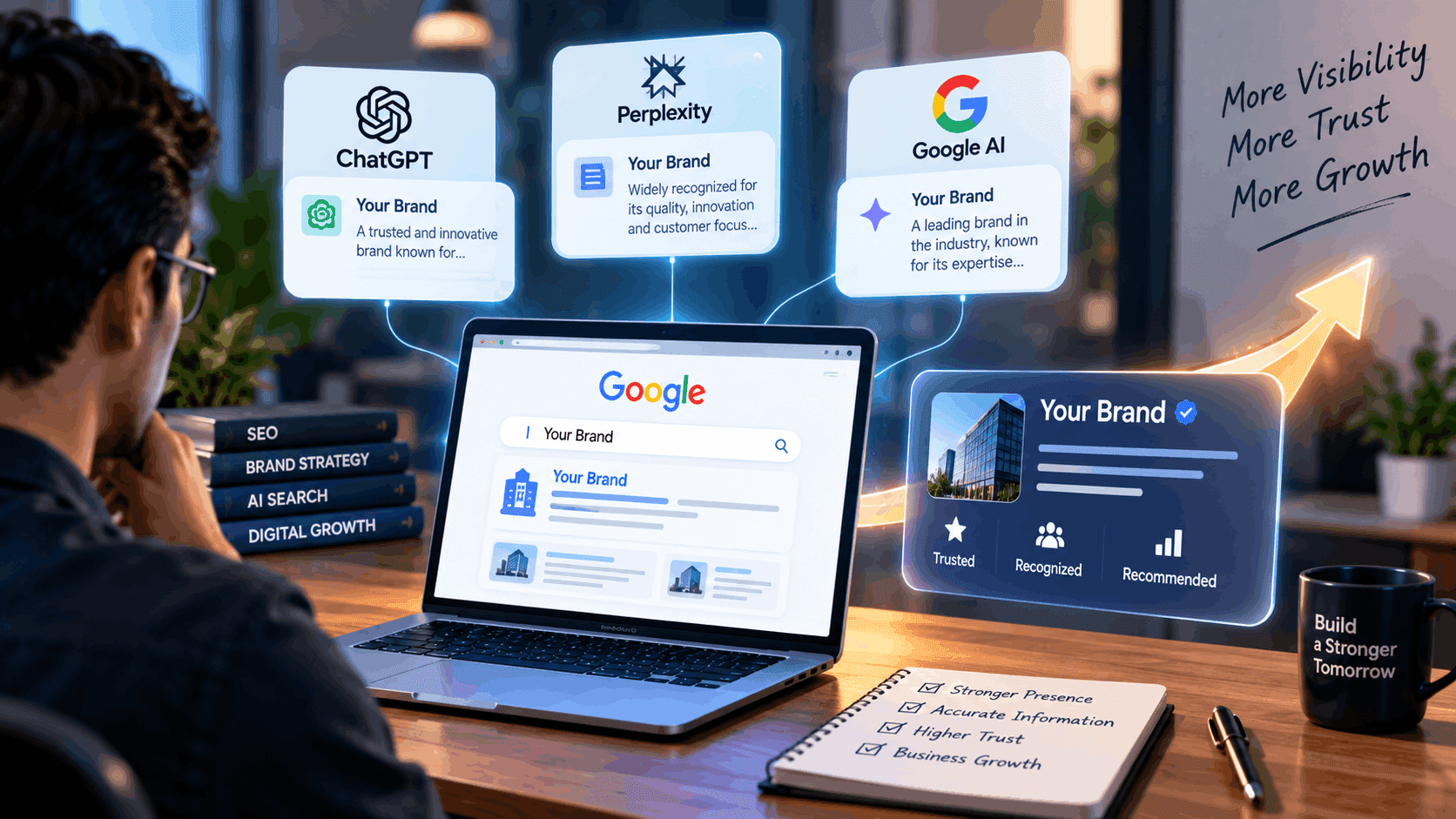
Ask ChatGPT or Perplexity about a company, and the answer it gives rarely comes from that company's own website. Branded GEO is the discipline of shaping what gets said instead, by influencing the wider set of sources an AI system actually draws from.
What is branded GEO?
Branded GEO, short for branded generative engine optimization, is the practice of managing how AI tools such as ChatGPT, Perplexity, Google AI Overviews, and Claude describe, cite, and recommend a specific brand. It sits alongside traditional SEO but answers a different question: not "does this page rank," but "what does the AI say when someone asks about us."
Brand GEO differs from generic GEO in scope. General GEO covers visibility for any topic or query, while branded GEO narrows in on queries that name, compare, or evaluate a particular company, product, or founder.
Why does brand GEO matter now?
AI answer engines increasingly sit between a brand and its prospective customers, summarising reputation before anyone reaches the company's own site. Google AI Overviews cite brand domains in 59.8% of citations when they appear, according to Otterly AI's 2026 citation research, though the feature itself only shows up in roughly a third of eligible searches.
ChatGPT behaves differently again. Brand domains account for 44.7% of its citations, with Reddit, Wikipedia, and news coverage filling much of the remainder, so a brand's own website carries less weight there than on Google.
How does AI brand visibility actually get decided?
Most brand owners assume their website is the primary input, but the opposite tends to be true. Roughly 85% of brand mentions in AI search originate from third-party pages rather than brand-owned domains. That pattern shifts the entire optimisation question away from on-site tactics and toward the wider ecosystem.
This means AI brand visibility depends heavily on what analysts, journalists, reviewers, and forum contributors have already written. A company with strong press coverage and active customer discussion on Reddit or industry forums tends to surface more consistently than one that only publishes on its own domain, regardless of how well that domain is optimised.
What actually builds brand visibility in AI search?
Third-party ecosystem presence
Analyst coverage, industry press mentions, customer reviews, and earned media shape AI responses more than owned content does. This is the single largest factor behind whether an AI system recognises and recommends a brand at all.
Consistent brand facts across sources
AI systems weigh agreement across independent sources as a trust signal. When a brand's positioning, product claims, and factual details stay consistent across its own site, press coverage, and directory listings, AI tools are more likely to repeat those details confidently rather than hedge or omit them.
Community and forum participation
Reddit remains the single most cited domain across AI platforms, and Perplexity draws 16.9% of its citations from community forums specifically. Authentic participation in the communities where prospective buyers already discuss a category carries more weight here than manufactured posts ever could.
Original data and research
Content built around genuine statistics and original research earns up to 40% more citations than standard marketing copy, since AI systems need something specific to extract and attribute. A brand publishing its own benchmark data or survey findings gives AI tools a citable fact rather than a generic claim.
What doesn't move brand visibility in AI search?
Several tactics that dominate traditional SEO checklists carry little weight for branded GEO. Google's own May 2026 guidance states structured data and schema markup are not required for AI visibility, and the same applies to llms.txt files, which the guidance explicitly describes as unnecessary machine-readable additions.
Keyword density and content chunking, both staples of older SEO advice, similarly do little to influence how an AI system summarises a brand. Reference-grade content earns three to five times more citations than standard pages, which points toward depth and accuracy mattering more than technical formatting tricks.
How brand GEO and technical structure work together
| Factor | Role in branded GEO | Priority |
|---|---|---|
| Third-party press and analyst coverage | Primary source AI systems draw from | Highest |
| Consistency of brand facts across the web | Builds trust signals AI can repeat confidently | High |
| Community and forum presence | Heavily weighted by ChatGPT and Perplexity | High |
| Original data and research | Gives AI something specific to cite | Medium |
| Question-based content structure | Makes existing content easier to extract | Medium |
| Schema markup and llms.txt | Confirmed by Google as non-essential | Low |
Roughly 73% of websites also carry technical barriers, such as robots.txt restrictions, CDN configurations, or heavy JavaScript rendering, that block AI crawlers outright. Clearing those barriers will not build brand visibility on its own, but it removes a silent ceiling that no amount of third-party coverage can work around.
How do you monitor brand GEO over time?
Tracking branded GEO means running the same set of brand and category queries across ChatGPT, Perplexity, and Google AI Overviews on a recurring basis, then logging whether the brand appears, how it is described, and which sources get cited alongside it. A shift in phrasing or a dropped citation often signals a change somewhere in the third-party ecosystem worth investigating.
Margo Digitech builds this kind of ongoing brand GEO tracking into its SEO work, pairing traditional search visibility with monitoring for how AI tools represent a client across ChatGPT, Perplexity, and Google's AI features.
Frequently Asked Questions
Branded GEO and traditional SEO overlap but optimise for different outcomes. SEO focuses on ranking a brand's own pages, while branded GEO focuses on the far larger set of third-party sources that AI systems actually cite when describing that brand.
Yes, though the path looks different from paid advertising or direct outreach. Earning genuine coverage, encouraging authentic customer reviews, and publishing original data tend to move the needle more than any single technical fix.
The two work best run in parallel rather than as competing priorities. A strong SEO foundation still drives direct traffic and supports the third-party visibility that branded GEO depends on.
Monthly tracking catches most meaningful shifts without becoming excessive, though a brand navigating a launch, crisis, or major press cycle may want to check weekly during that period. AI-generated answers can change as new content gets indexed, so a one-time check rarely stays accurate for long.
Negative coverage can shape how an AI system summarises a brand, particularly when it appears consistently across multiple third-party sources. Addressing the underlying issue and building a larger base of accurate, positive coverage tends to work better than trying to suppress individual mentions.