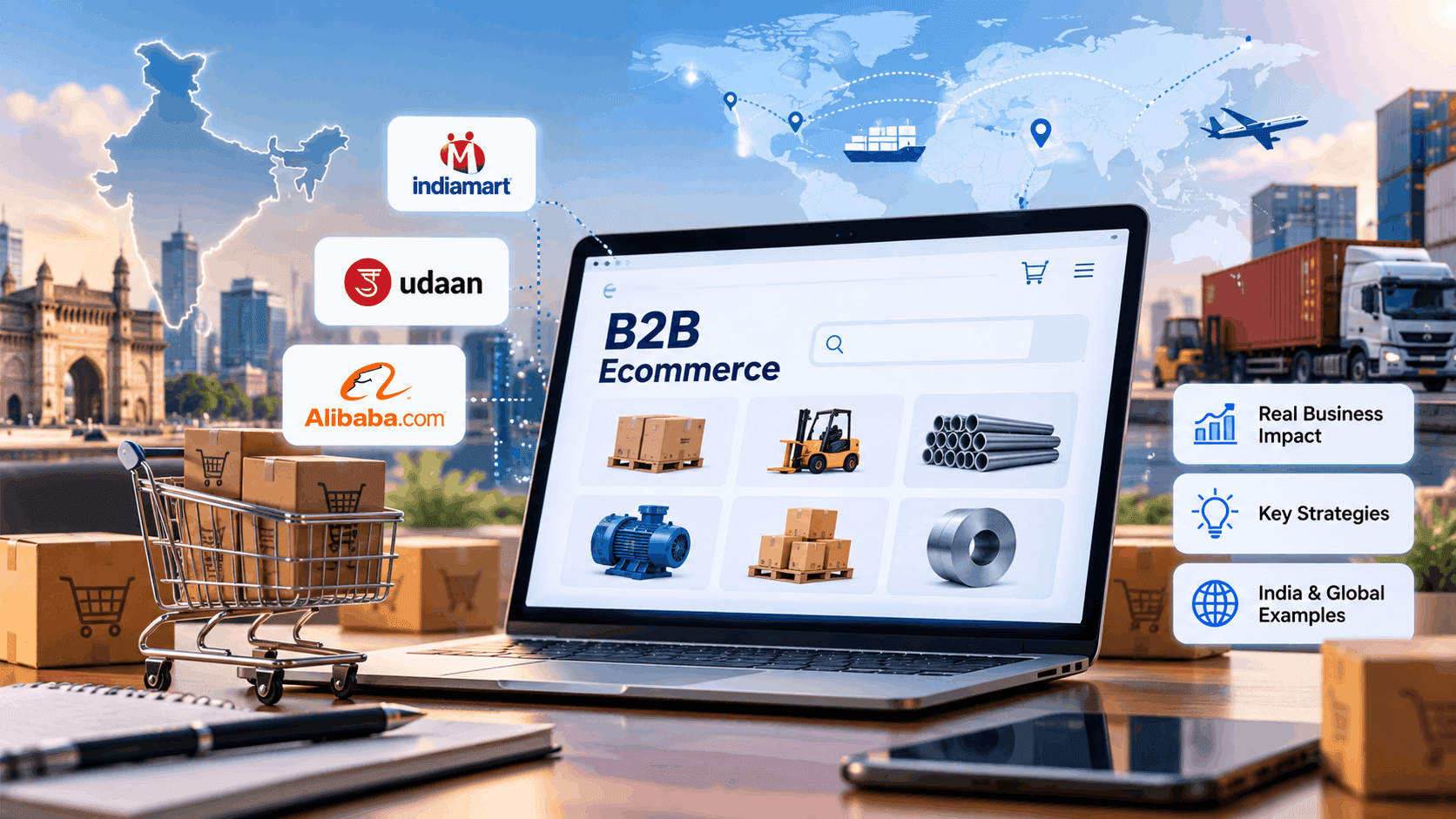
B2B ecommerce examples are easy to list and hard to learn from. A company name tells you nothing until you see what the site does for a buyer. This guide covers eight companies, five from India and three from abroad, using only what each says on its own homepage. You'll see how they handle sign-up, pricing and credit, then get a plan to copy the useful parts. Margo Digitech has no commercial link with any of them, and the order here isn't a ranking or an endorsement.
What Is B2B Ecommerce?
B2B ecommerce is the online sale of goods or services from one business to another, such as a wholesaler selling to a kirana or a factory ordering safety gloves in bulk. Prices can depend on the account, and invoices carry GST details so the buyer can claim credit. The site works as a buying tool for a business, so sign-up, pricing and payment terms matter more than a pretty storefront. B2C ecommerce sells to individual shoppers, with one public price and a card or UPI checkout.
Ask three questions of any example: who can buy, what price do they see and how do they pay?
Why Does B2B Ecommerce Matter for Indian Businesses?
B2B ecommerce matters because India has a large base of small buyers. PIB says 9.16 crore MSMEs were registered on the Udyam platform as of August 2026.
Example: a hardware shop in Nagpur orders stock from an app instead of waiting for a distributor's visit. The shop saves a phone call on every reorder.
The government figure shows scale. Your own data shows fit, so count how many of your buyers reorder. Reorders are where an account-based site earns its keep.
GST adds a reason. Amazon Business India's homepage offers to help buyers claim a B2B GST invoice and save up to 18% on eligible business purchases.
How Does B2B Ecommerce Work?
B2B ecommerce works in four moves: the buyer registers, the platform verifies the business, the buyer sees business prices and terms, then orders.
udaan describes it in three steps: sign up with a mobile number, business name and pin code, upload a GSTIN or shop licence for KYC, then order with credit and delivery through the app.
Amazon Business India asks you to register with a business licence such as GST, Udyam Aadhar, PAN or Fssai. Faire says sign-up unlocks wholesale pricing.
On these sites, prices and terms sit behind an account.
Credit changes the picture. udaan lists credit among its benefits, and Amazon Business India mentions pay-later financing, so cash flow is part of the product.
Which Models Do B2B Ecommerce Examples Follow?
B2B ecommerce examples fall into five models, and the companies below each fit one.
| Model | What it does | Example |
|---|---|---|
| Marketplace | Connects buyers and sellers | IndiaMART, Alibaba.com |
| Wholesale app | Sells stock to shops | udaan, Faire |
| Procurement store | Supplies business purchases | Moglix, Amazon Business |
| Direct seller | Sells its own range | Uline |
| Sector network | Links one supply chain | Ninjacart |
Choose the model that matches your product. A manufacturer with its own range looks at the direct seller row. A trader with many suppliers looks at the marketplace row.
Check which row your closest rival sits in before you copy its layout. A model that suits their buyers may not suit yours.
Which Indian B2B Ecommerce Examples Should You Study?
Five Indian companies show different ways to serve business buyers. Each fact below is what the company says on its own homepage.
- IndiaMART calls itself India's Largest Online B2B Marketplace and says it connects 21 Cr+ buyers with trusted sellers. It also offers image search for matching products.
- udaan describes itself as India's largest eB2B platform for small business owners, from kiranas and chemists to hotels and offices.
- Amazon Business India asks for a business licence at registration and mentions pay-later financing.
- Moglix headlines AI-powered procurement for business.
- Ninjacart says it works on the agri ecosystem, covering payment risks, quality, logistics and real-time information.
Which Overseas B2B Ecommerce Examples Should You Study?
Three overseas sites show how a global marketplace, a wholesale network and a direct seller present themselves.
- Alibaba.com describes itself as the world's largest online B2B marketplace. Its homepage promises connections with manufacturers with verified production capabilities, and protection from payment to after-sales.
- Faire says buyers can unlock wholesale pricing with over 100,000 brands after sign-up.
- Uline sells shipping supplies and says orders placed by 6 pm get same day shipping.
Each site makes one promise about trust, price or speed near the top of its homepage. Open each homepage on your phone and note what you see before you scroll. Write down the one promise it makes.
How Do You Apply These B2B Ecommerce Examples Step by Step?
You can apply these examples in seven steps, and the first is choosing which buyer promise you can keep.
- 1.Pick one promise: trust, price or speed.
- 2.Decide who can buy and what proof they give, such as GSTIN.
- 3.Show business prices after sign-up if they differ by account.
- 4.Put the credit or payment terms in plain words.
- 5.Issue GST invoices from the first order.
- 6.Offer a repeat-order button on the account page.
- 7.Track repeat orders per buyer each month.
Start with one product line in one city before you open the whole catalogue. Ask five buyers what would make them reorder.
What Mistakes Should You Avoid When Copying B2B Ecommerce Examples?
The big mistakes come from copying features that your buyers don't need.
- Copying a marketplace when you sell one product range.
- Hiding every price with no way to request one.
- Slow KYC that makes a buyer wait.
- Promising credit you can't fund.
- Quoting a rival's "largest" claim as your own.
- Skipping GST invoices.
- Letting buyers see a price and changing it at checkout.
- No phone number for large orders.
- Treating every buyer like a shopper.
Common Mistake: judging an example by its homepage alone. Place a small test order before you copy anything.
Pro Tip: call your first ten buyers and ask what they ordered elsewhere.
What B2B Ecommerce Trends Matter in 2026?
Two trends show on the homepages in October 2026: AI-assisted buying and visual search.
Moglix leads with AI-powered procurement, and IndiaMART offers upload-an-image search. Alibaba.com also links an AI Mode on its homepage.
For a small seller, the lesson is simpler. Make your product names and specifications clear enough that a search tool can match them. Add photos from the side and the back, with sizes written in the listing.
Credit and speed also feature. Amazon Business India mentions pay-later financing, and Uline's front page leads with same day shipping for orders placed by 6 pm. If you can't offer credit yet, offer reliable dispatch times.
What Should You Do Next?
If you came looking for B2B ecommerce examples to copy, pick one promise and one model, and test them with a small group of repeat buyers. Track repeat orders before you add features. Margo Digitech's ecommerce SEO team can help buyers find your catalogue. Our ecommerce SEO guide and ecommerce agency guide go further. Write your promise on one line and check each month that delivery matches it. Start with ten buyers, then add one feature a quarter.
Frequently Asked Questions
B2B ecommerce is one business selling to another online. An example is a kirana store ordering stock through a wholesale app such as udaan, which says it serves small businesses from kiranas to offices. Buyers sign up, verify their business and order with credit and delivery.
Indian examples include IndiaMART, udaan, Amazon Business India, Moglix and Ninjacart. Each describes itself on its homepage, from a marketplace for buyers and sellers to AI-powered procurement and an agri supply chain. We haven't ranked or assessed them, so check references before you rely on any.
Overseas examples include Alibaba.com, Faire and Uline. Alibaba.com calls itself the world's largest online B2B marketplace, Faire offers wholesale pricing from over 100,000 brands after sign-up, and Uline sells shipping supplies with same day shipping on orders by 6 pm. Check each site's terms before you rely on a claim.
B2B sells to businesses, and B2C sells to individual shoppers. B2B sites ask buyers to register and prove they run a business, show account-based prices and terms, and issue GST invoices. B2C sites show one public price and take a card or UPI payment at checkout.
A B2B product is something a business buys to run or resell: packing boxes, safety gloves, industrial tools, raw materials, groceries for a shop or office supplies. The same item can be B2C when one person buys it for personal use, so the buyer decides the type.
Pick one product line and one buyer group, decide who can buy and what proof they give, show prices and payment terms in plain words, and issue GST invoices. Test with a small group of repeat buyers in one city before you open the full catalogue.