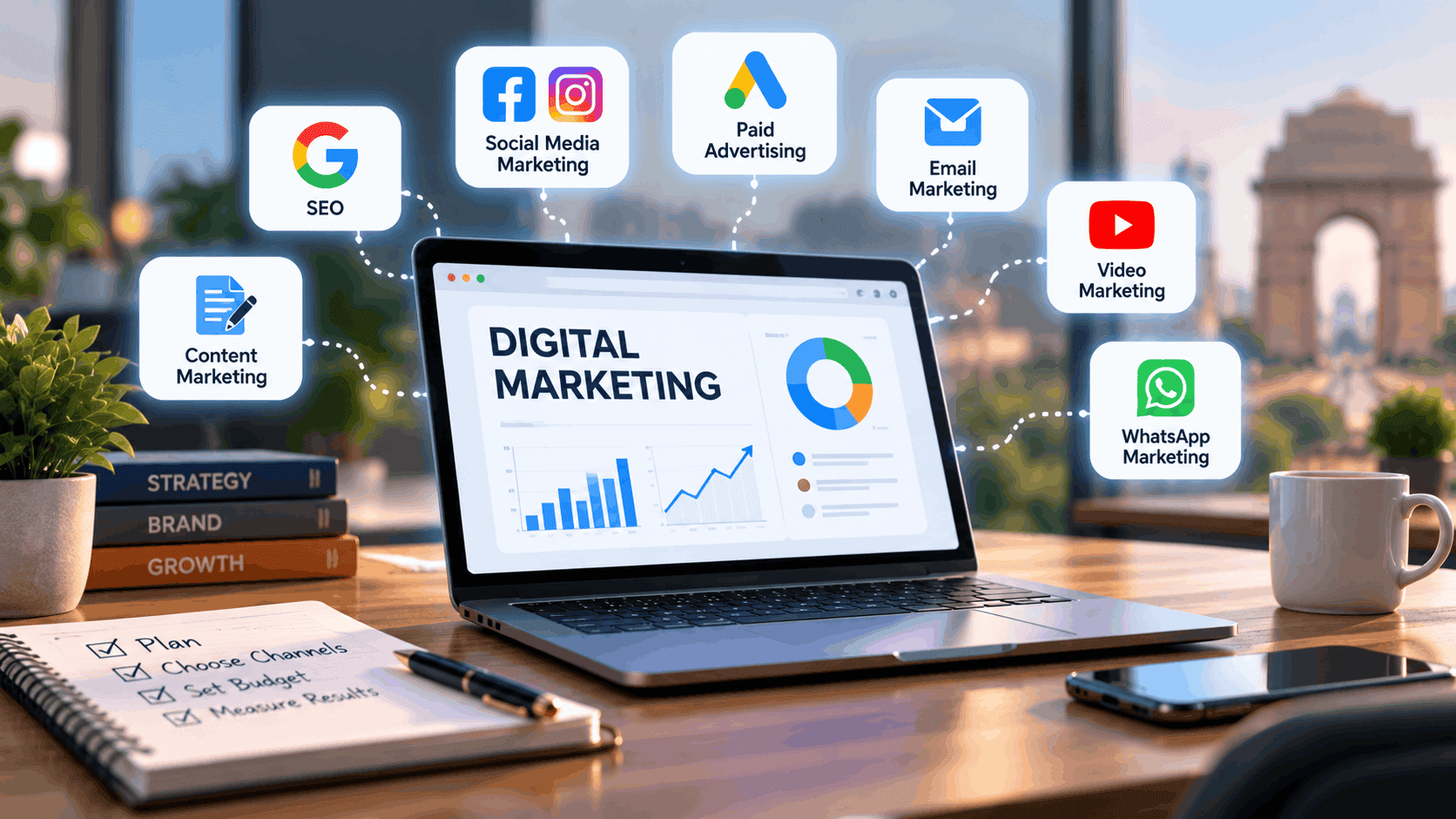
Which Digital Marketing Channels Should You Use for Your Business in India?
Every week someone pitches a new channel: search, social, email, WhatsApp, video, influencers, affiliates. You can't run them all on a small budget, and you shouldn't try. This guide explains what digital marketing channels are, what each one needs and how to pick two or three to start with. It's written for owners and marketers of small and mid-sized businesses in India. Facts name their source, and rupee examples are marked as assumed. You'll leave with two channels to test and the rules each one carries. Read the table first, then the steps.
What Are Digital Marketing Channels?
Digital marketing channels are the routes through which people reach your business online, such as search results, social platforms, email, text messages, video sites and other websites. Google Analytics groups website visits into named channels, including Direct, Organic Search, Paid Search, Email, Organic Social, Paid Social, SMS, Affiliates, Display and Organic Video. Each channel has its own audience, cost and rules, which is why you pick a few and run them well instead of spreading a small budget thin across all of them.
A channel is where people find you. A campaign is what you run inside it. Keep the two apart in your plan.
Why Does Choosing the Right Channels Matter in India?
Choosing channels matters because your audience is large but your budget is not. TRAI counts 1,114.17 million internet subscribers for the quarter to June 2026, so almost any channel can reach someone.
That reach tempts small firms to spread money thin. Reach isn't the same as buyers. A channel is worth your money only if people there act on what you offer, which you learn from a test and a report.
Example (assumed figures, not a price list): a Surat saree seller with ₹30,000 a month splits it across six channels at ₹5,000 each and can't test any properly. Putting ₹15,000 into two channels gives each one a fairer test.
How Do Digital Marketing Channels Work Together?
Digital marketing channels work together in three layers: owned, earned and paid.
Owned channels are the ones you control, such as your website and email list. Earned channels bring attention you didn't buy, such as search rankings and mentions. Paid channels are ads where you pay for each placement or click.
Search and email work as a pair: search finds new people, and email brings them back. Social media can feed both by sending people to a page where they can join your list.
Google Analytics defines Organic Search as visits from non-ad results, and says it includes Google's AI Overviews and AI Mode. It defines Direct as visits through a saved link or a typed URL.
Which Digital Marketing Channels Exist?
Seven digital marketing channels cover a small business plan, and each suits a different job.
| Channel | Type | Best for |
|---|---|---|
| Organic search | Earned | Steady demand |
| Paid search | Paid | Ready-to-buy people |
| Social media | Both | Awareness and chats |
| Owned | Repeat sales | |
| SMS and WhatsApp | Owned | Reminders |
| Video | Both | Demos and trust |
| Affiliates and influencers | Paid | Reach through others |
Match the channel to the job. Don't pick a channel because a rival uses it.
Start with the row that matches your goal. A service business that needs enquiries picks organic search and paid search. A shop with repeat customers picks email and WhatsApp. A brand with something to show picks video.
How Do You Choose Digital Marketing Channels Step by Step?
You can choose your channels in seven steps, and the first is naming the one result you need this quarter.
- 1.Name one result, such as enquiries from your city.
- 2.Write down where your buyers already look for businesses like yours.
- 3.Pick two channels from the table that match.
- 4.Set a monthly budget for each, with a test period.
- 5.Tag every link so your reports show the channel.
- 6.Review results after the test period.
- 7.Drop the weaker channel or give it a smaller share.
Add a third channel only when the first two run without your daily attention.
What Does Each Digital Marketing Channel Need to Work?
Each channel has a price of entry, and part of that price is rules and habits.
- Organic search: Google defines people-first content as content created primarily for people, and not to manipulate search rankings. No one can guarantee a #1 ranking, Google says.
- Paid search: Google Ads can spend up to two times your average daily budget on a given day for most campaigns.
- Email: Google's sender guidelines require one-click unsubscribe and a clearly visible unsubscribe link in marketing messages.
- SMS: TRAI allows inquiry-based commercial messages for seven days from the inquiry.
- Influencers: ASCI says free products count as a material connection that needs disclosure.
How Much Should You Spend, and How Do You Measure Channels?
Spend a fixed share on each channel for a test period, then judge by cost per enquiry from that channel.
Example (assumed figures, not a price list): a Pune dental clinic puts ₹12,000 into paid search and ₹6,000 into email and Business Profile upkeep. Google Ads adds GST to your bill, and Google lists IGST at 18%.
In Google Analytics, the channel reports show which route brought each visit. Tag links consistently or visits fall into Direct and the picture blurs.
Review the numbers monthly and keep notes on what you changed. Move money only after the test period, and write down why you moved it.
What Digital Marketing Channel Mistakes Should You Avoid?
The mistakes come from trying too many channels, tracking too little and copying a rival's mix. Each one is cheap to avoid if you catch it in the first month.
- Starting four channels in one month.
- Links with no tags.
- Buying followers or reach instead of customers.
- Messages sent without consent.
- Influencer posts without a label.
- Judging paid search before the test period ends.
- Reporting visits and ignoring enquiries.
- Sending the same message on every channel.
- No one owning each channel.
Common Mistake: reading Direct traffic as a channel you can buy. Tag your links, because untagged ones may land there.
Pro Tip: give each channel one owner and one monthly number.
What Digital Marketing Channel Trends Matter in 2026?
Two things matter in 2026: AI search sits inside organic reporting, and core updates keep moving rankings.
Google Analytics says Organic Search includes visits from Google's AI Overviews and AI Mode, and it lists an AI Assistant channel for traffic with the medium ai-assistant. Tag your own links so these visits show up clearly.
Google's Search Status Dashboard lists the March 2026 core update at 12 days 4 hours and the May 2026 core update at 11 days 21 hours. Don't judge organic search in the middle of one.
Check your reports after each update, and compare channel by channel before you change the plan.
What Should You Do Next?
Choose your digital marketing channels from one result, test two of them for a quarter and tag every link so the reports are honest. Margo Digitech's digital marketing team can build the plan with you. Our what is digital marketing guide and digital marketing packages guide help you compare scope and cost. Write the plan on one page and share it with whoever runs each channel. Review it every month and cut the weakest channel after a fair test.
Frequently Asked Questions
The main types are organic search, paid search, social media, email, SMS and WhatsApp, video, display ads, and affiliate and influencer marketing. Google Analytics uses named channel groups like these to sort website visits, so your reports use the same names and comparisons stay simple.
No single channel is best for every business. Pick the one that matches your goal and where your buyers look: paid search for ready-to-buy people, email for repeat sales, organic search for steady demand. Test two channels for a quarter and compare cost per enquiry.
Start with two channels, and add a third once the first two run without your daily attention. With a limited budget, two channels with proper tests teach you more than six with token spend. Review results monthly and move money to the channel that brings enquiries.
Owned channels are ones you control, such as your website and email list. Earned channels bring attention you didn't buy, such as search rankings and mentions. Paid channels are ads where you pay for each click or placement. A plan can mix all three.
Search, social media, email and messaging all reach Indian buyers, since TRAI counts 1,114.17 million internet subscribers. Choose by your buyer, not by the country: a B2B firm may favour search and email, a boutique may favour Instagram and WhatsApp. Check TRAI's rules before you send messages to anyone.
Tag every campaign link, then read the channel reports in Google Analytics for visits, enquiries and cost per enquiry. Untagged links fall into Direct and hide the true source. Review monthly, after the test period, and judge organic search outside core update windows, not during them.